Final Major Project - Ella Preston
UAL Foundation diploma in Design and Media Ravensbourne University

Anything Can Happen
Anything Can Happen
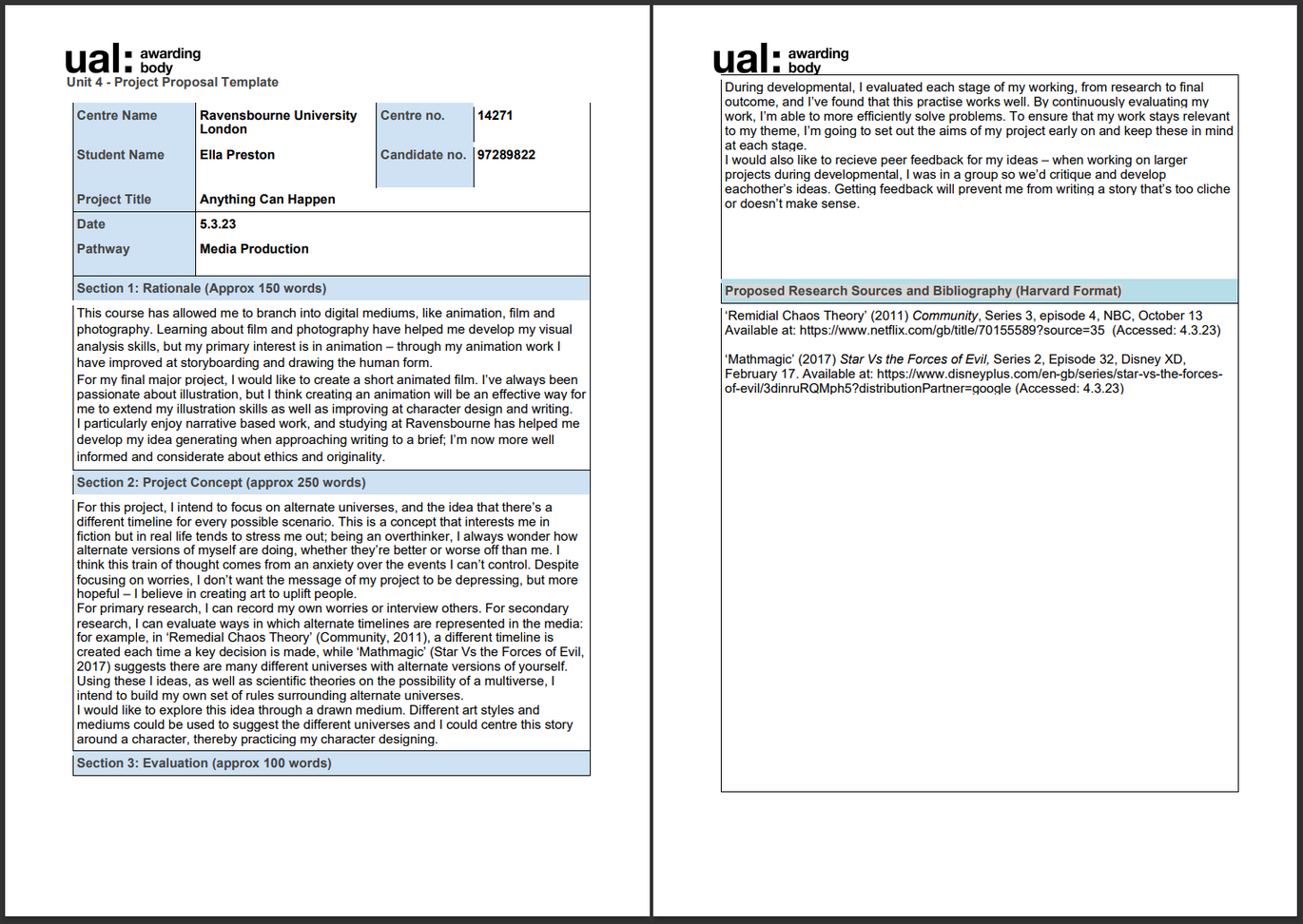
Context | Proposal Form
Context | My Idea
I chose to investigate alternate universes and the idea that there are other realities similar to ours because it's something that interests me. Being an overthinker, I like to imagine if there are other universes with alternate versions of myself and how they're doing. However, this train of thought also stresses me out because I start to wonder if the alternate versions of myself are worse off than I am.
I'm going to use this idea to investigate my worries over the different possible outcomes for events, and how I can write a story based on this concept.
Research | Do Alternate Universes Exist?
I did research into whether or not there's a possibility that alternate universes could actually exist. I did this because alternate universes are a common topic in science fiction, but if I'm going to write science fiction, I need to know the science first. This will also help my story be more believable.
The idea of a multiverse comes from the fact that our universe has the perfect conditions to sustain human life. The odds that our all the different aspects needed to create life would occur all together is statistically unlikely, which is why some scientists believe there must be an alternate universe for every probable scenario. (Drake, 2022)
Inflationary Cosmology:
After the Big Bang, the universe began rapidly inflating. While it ended 13.8 billion years ago for Earth, there are theories that in some places, it's still happening. When this inflation ends in a particular place, a new universe is created in its own bubble. (Vilenkin, 2011)
Infinite Expanse:
The universe is expanding, and the further you get from Earth, the faster this happens. In places, the universe is expanding so fast that light from distant galaxies cannot reach us; there's a point in the universe that we cannot see past. This means could be universes beyond this point that we will never be able to see. (Smart, 2022)
Many-Worlds Interpretation of Quantum Mechanics:
This theory suggests that there is an alternate timeline or version of Earth for every possible outcome. “Hugh Everett [the physicist behind this theory] says, Look, there’s actually an infinite number of parallel Earths, and when you do an experiment and you get the probabilities, basically all that proves is that you live on the Earth where that was the outcome of that experiment, but on other Earths, there’s a different outcome.” (Kakalios, 2022)
I found this research useful because many of the theories on alternate universes are pretty accurate to what I've seen in the media, which I was not expecting. I also think having alternative concepts on how to approach my project will help me generate ideas.
Research | Alternate Universes in the Media
I watched Remedial Chaos Theory (Community, 2011), a sitcom episode in which 6 new timelines are created depending on who answers the door to get the pizza.
I chose to watch it so I could research the ways different timelines are created and how they develop.
"When Jeff introduces an element of randomness into Troy and Abed's housewarming party, reality splits into six timelines affecting the group's relationships." (Community, 2011)
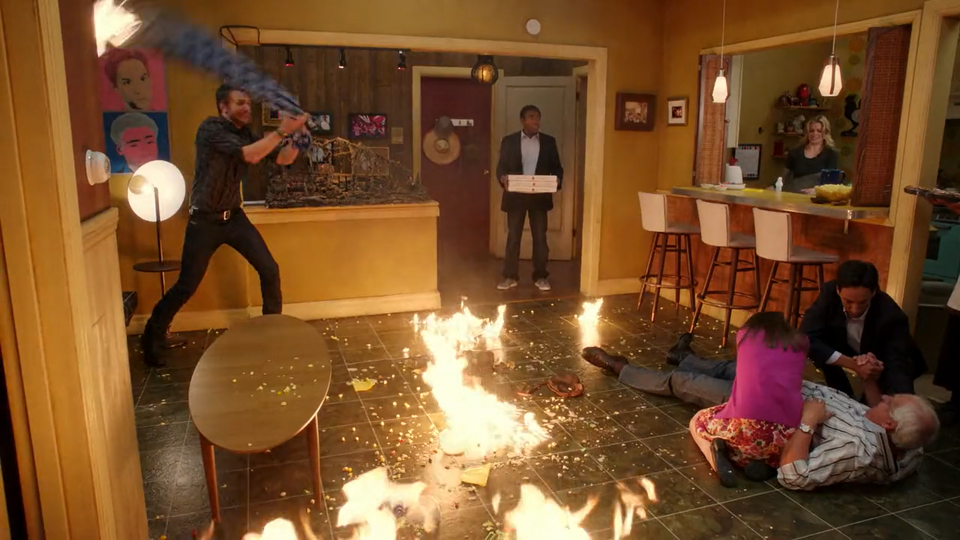
- Most of the alternate timelines were pretty mundane and uneventful, only two ended badly
- Although the timelines all differ, there are a few consistencies that occur in all of them (eg. Britta singing, Jeff hitting his head, etc)
- Some of the individual timelines felt incomplete as stories but through watching them all, you get a better sense of the characters feelings and intentions.
- All timelines add together to create one whole story
- Despite there being seven different timelines, there's still one that's clearly the primary timeline, and this is the one where everything went well.
- This timeline was also triggered by a key event - it's the only timeline where the person getting the pizza wasn't determined by a roll of the dice
- The probability of a certain timeline being created was 1/6, which links to my research on probabilities.
Overall, I liked Community's representation of alternate universes. It implied that each key decision can lead to a different chain of events. Being a comedy, all the timelines were pretty lighthearted, except the darkest timeline, which was still quite exaggerated in its tragedy.
Research | Alternate Universes in the Media
"When Star refuses to solve a problem in math class, she learns that avoiding her least favourite subject may have cosmic repercussions." (Star Vs. the Forces of Evil, 2017)
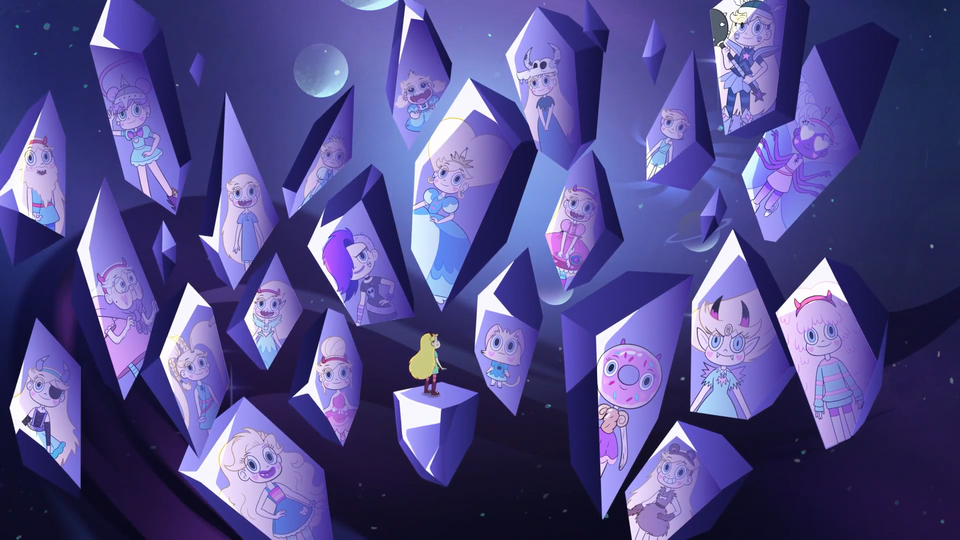
I watched Mathmagic (Star Vs. the Forces of Evil, 2017) an episode of a cartoon where the main character causes her's and other timelines to collide when she refuses to answer a maths question.
I chose to watch this because it depicts alternate universe versions of the main character.
- Like Community, the beginning of the story kept repeating as Star lived through another timeline. This happened because refused to answer a maths question.
- This question is the key event that starts to upset the timelines.
- However, instead of creating multiple timelines (eg. 1 timeline where Star answers the question and 1 where she doesn't), her whole universe starts to collapse because she is the only version of herself that can't solve the maths problem.
- This suggests that there's a lot more consistency among all the timelines (instead of randomness) and a timeline that doesn't follow a certain pattern is an outlier.
- Unlike Community, this story had a moral: you should try doing something even if you're bad at it. It's interesting for me to see how the show put a relatable message alongside a sci-fi plotline.
- I particularly liked how Star got to see all the alternate universe versions of herself (pictured above) Although, I think the artists could've been bolder with their character design - most of Star's alternate universe selves are just her in different outfits.
Mathmagic presents an interesting depiction of alternate universes because it suggests that there are certain events that must happen, no matter what timeline. This is an interesting concept and could be useful to consider when writing my own story.
Research | Alternate Universes in the Media
Spider-man: Into the Spider-verse (2018) is an animated movie where multiple Spider-men, each from a different universe, are brought to the same timeline and must work together.
I chose to look at this movie because it presents the character's alternate universe versions of himself in a unique way.
"After gaining superpowers from a spider bite, Miles Morales protects the city as Spider-Man. Soon, he meets alternate versions of himself and gets embroiled in an epic battle to save the multiverse." (Spider-man: Into the Spider-verse, 2018)
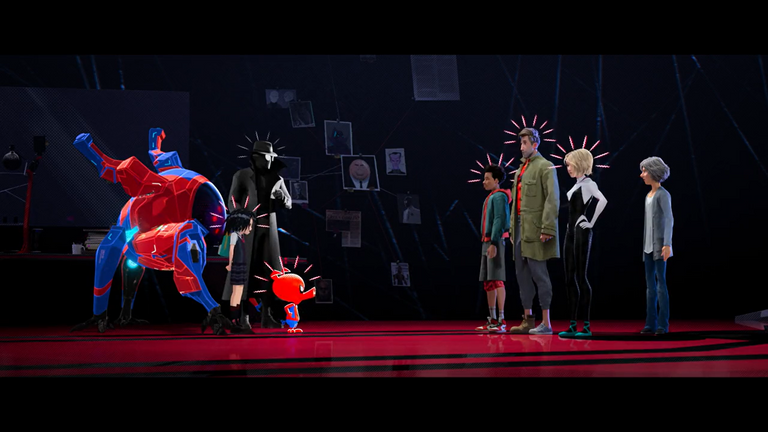
In this film, there are many alternate universes and each with a different version of Spider-man. However, what I find interesting is that despite (Miles, Gwen, Peter B, Penny, Peter Parker and Spider-man Noir) technically all being alternate versions of eachother, they're all completely different. This suggests that what makes someone an alternate version of you is not who they are but what their role in the world is. This differs to Mathmagic (2017) and in my opinion offers a much better opportunity for character designing and writing, which is why it may be useful to take inspiration from for my project.
Research | Artists and Practitioners
Thalia Reborn (Case, 2015)
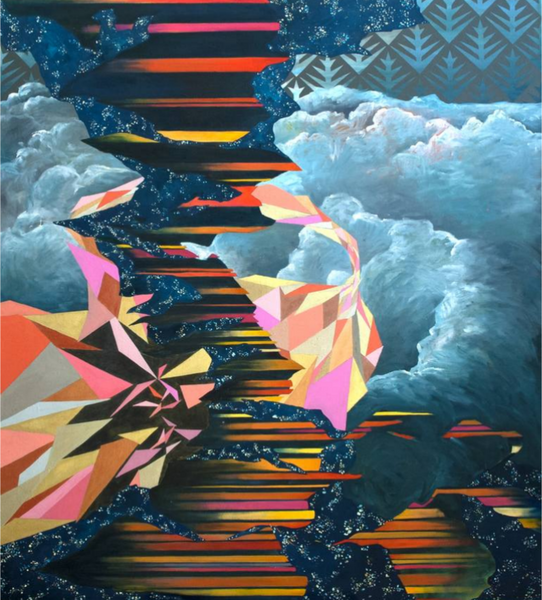
I find her work particularly relevant because her interest in alternate realities stems from the current poor emotional state of people and the possibility of hope.
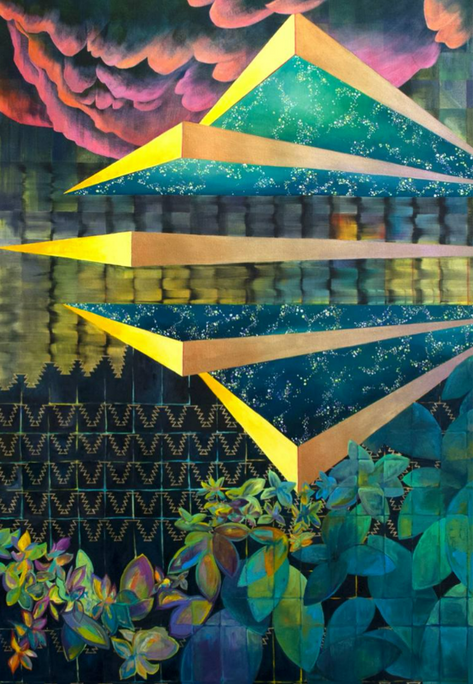
I also really like the visuals in her work; they're vibrant with a variety of textures. This could provide inspiration for the visuals in my own project.
Alice Case is an artist who creates abstract paintings inspired by the possibility of alternate realities. She uses art to "create colliding worlds and dimensions that relate to both physics and everyday life and [she] searches to articulate what it feels like to exist in this age of inundating information" (Case, 2017)
Nigh (Case, 2015)
Research | Artists and Practitioners
Eric Wayne is an artist who did a series of paintings called "Selfies From Alternate Universes", where he used FaceApp to generate his images and then digitally painted them. FaceApp is an app that uses AI to photoshop the people in any photos you input. These pictures show him at various ages and genders. He stated "The people seem real, and yet none of them exist. And yet, the 9 portraits so far somehow convey more of my essence (so to speak) than if I used 9 pictures that look just like me." (Wayne, 2018)
(from left to right, top to bottom) #3 (Wayne, 2018), #4 (Wayne, 2018), #5 (Wayne, 2018), #6 (Wayne, 2018), #8 (Wayne, 2018), #9 (Wayne, 2018)
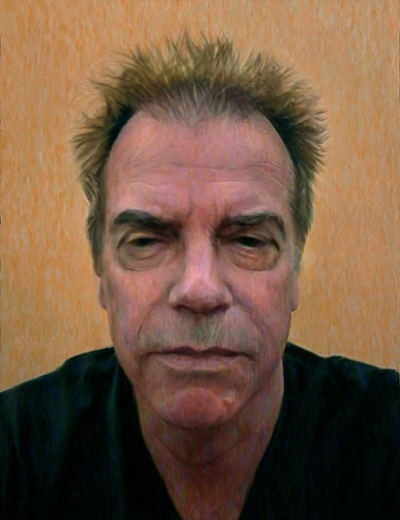
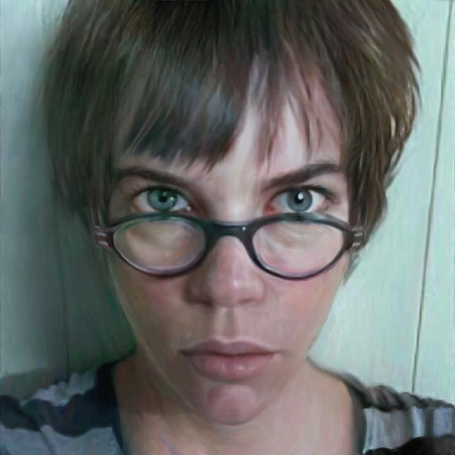
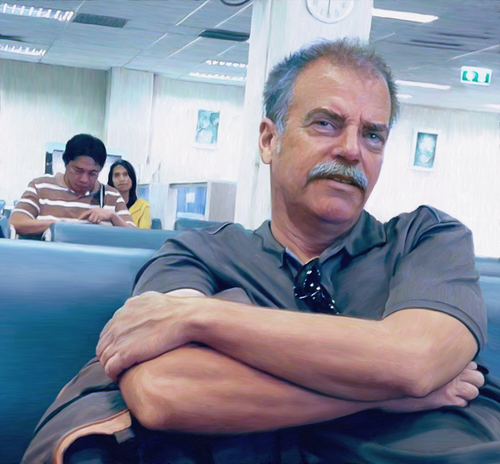
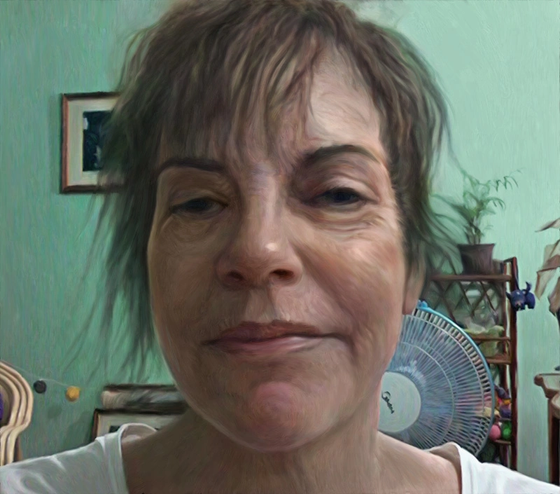
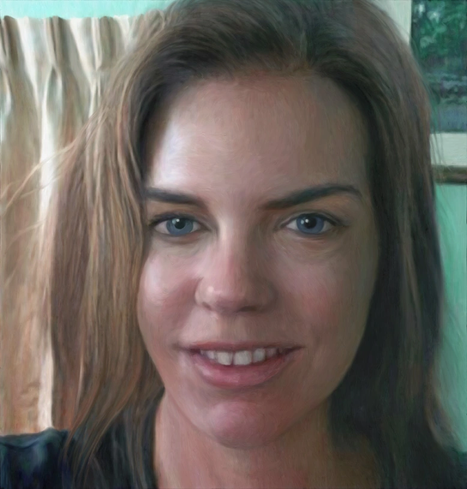
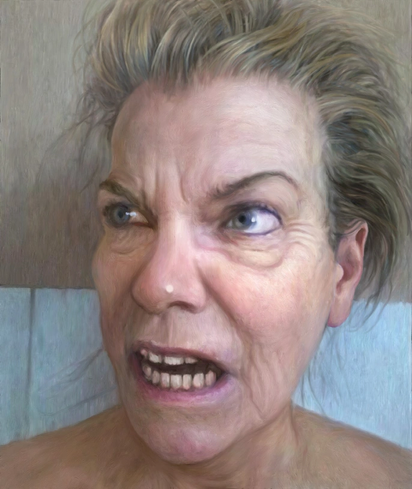
This series interests me because it's based around the idea that we could have alternate versions of ourselves. However, in some ways I find these paintings creepy; the fact that none of these people are actually real just shows how far technology has developed and gives the work a more sci-fi undertone.
Although all the people look different, they also have features that make it clear they have some kind of relation to eachother - this is something I could take inspiration from when designing my character.
Research | Books
"Blendin Blandin is searching for the legendary Time Pirates' Treasure, but he needs Dipper and Mabel's help... and yours too! Journey through time and explore the dragon-infested medieval era, the Weird-and-Wild West, and the laser-and-giant-baby-filled future. YOU choose from multiple paths that lead to different wacky adventures! You might end up finding the greatest treasure ever known, or you could send the twins and Blendin into an abyss from which they will never return!"
Gravity Falls: Dipper and Mabel and the Curse of the Time Pirates' Treasure!: A Select Your Own Choose-Venture! (Rowe, 2016)
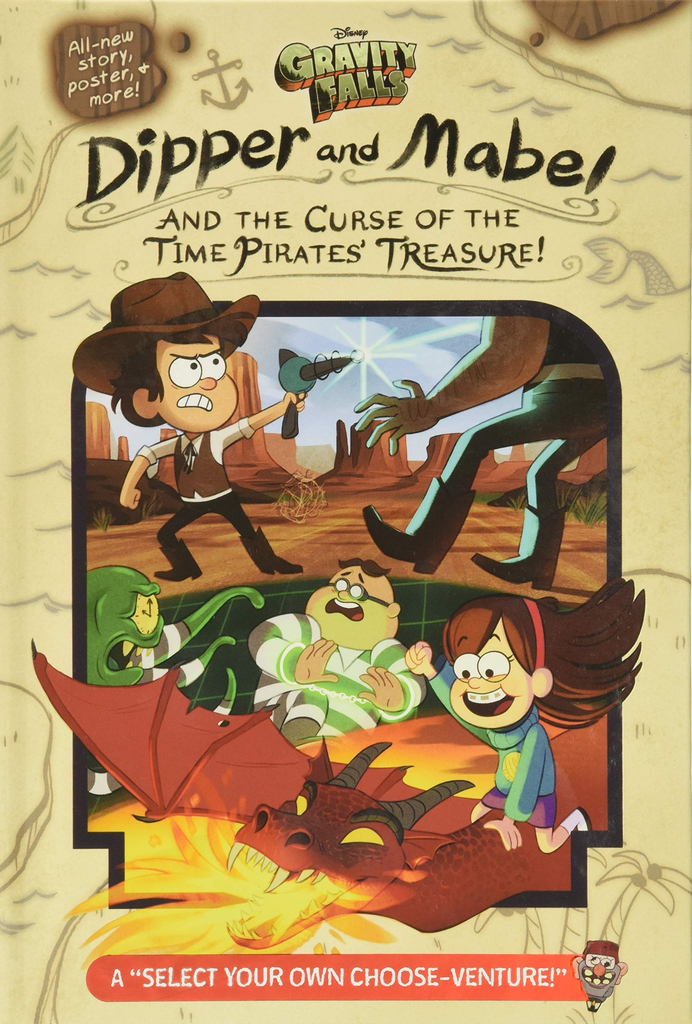
Photo of page 5 (Rowe, 2016)
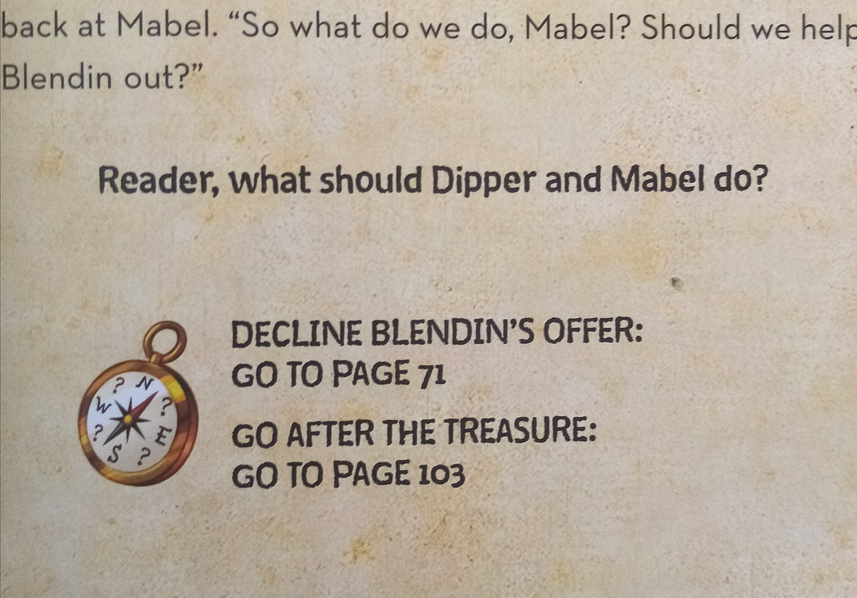
"Choose your own adventure" is a genre of books where the reader gets to decide what the character should do, often written in second person. However, not all of the reader's decisions will lead to a happy ending for the characters. I read Dipper and Mabel and the Curse of the Time Pirates' Treasure! (2016) because it's a pick-your-path book that I own and I wanted to see how these kind of stories work.
I found this concept interesting because it relates to my previous research on Remedial Chaos Theory (Community, 2011) - the decisions you make as the reader can take the story in very different directions. When reading these kind of books, I usually find that things often go wrong and you have to either start again, or go back to the previous decision. However, I had never considered that the bad endings are alternate versions of the good endings until now, and this idea intrigues me.
I think this kind of interactive story works well with my project intentions, and I think it could be interesting to consider a video game outcome where the player makes choices for the character and there are animated cutscenes. However, this may be more difficult writing-wise, and I also have no experience with coding or making games.
Research | Pecha Kucha
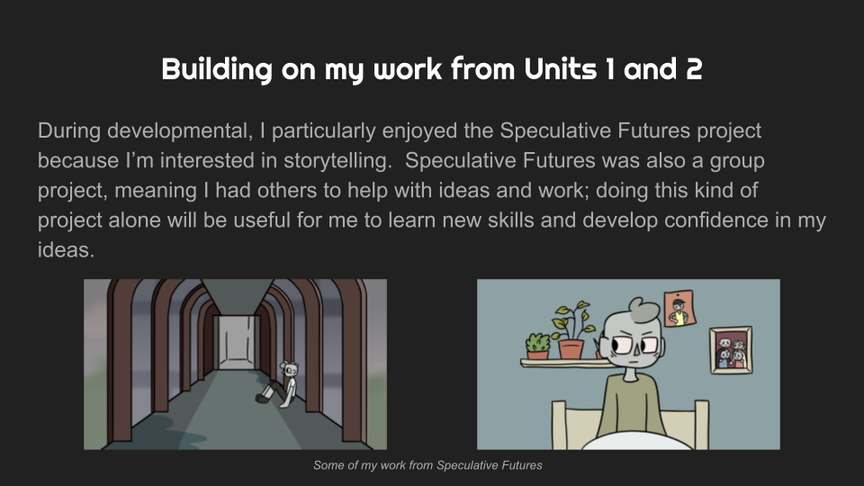
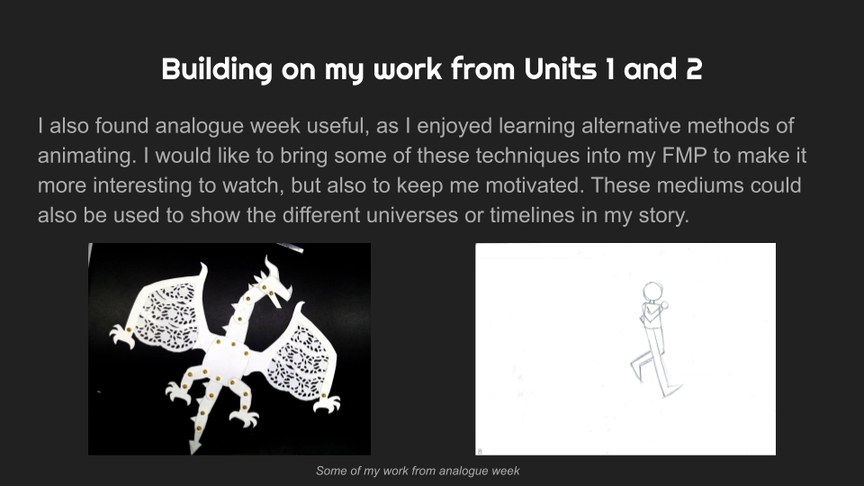
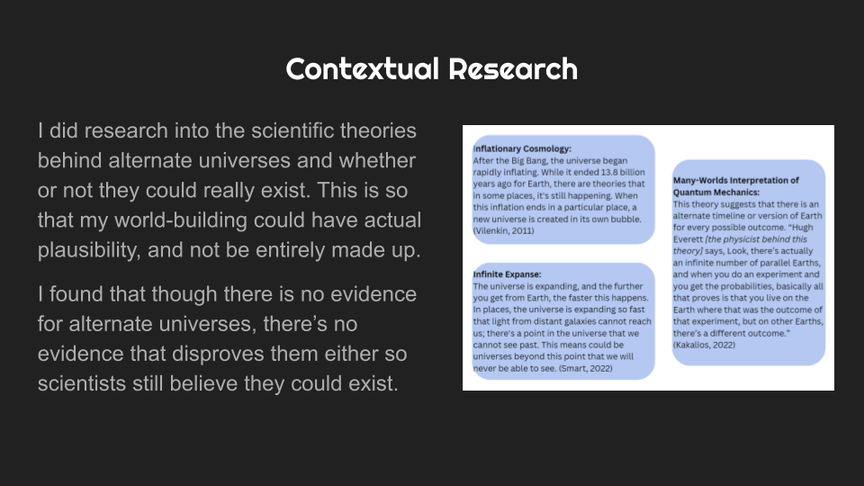
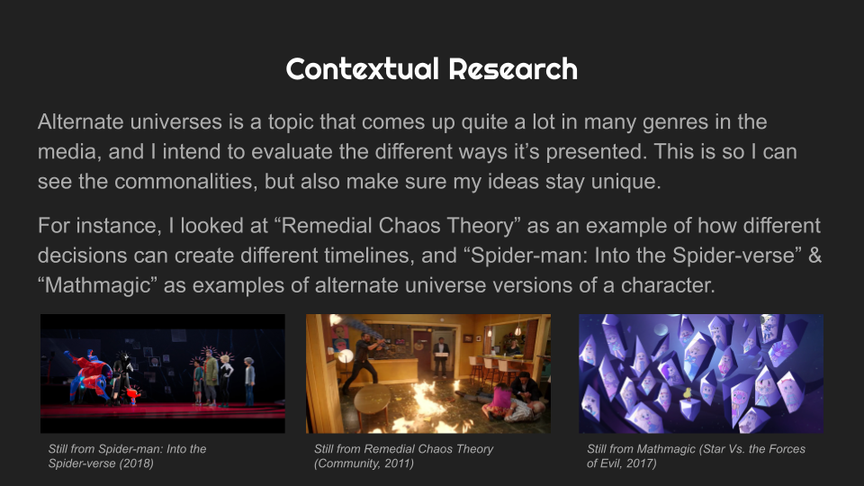
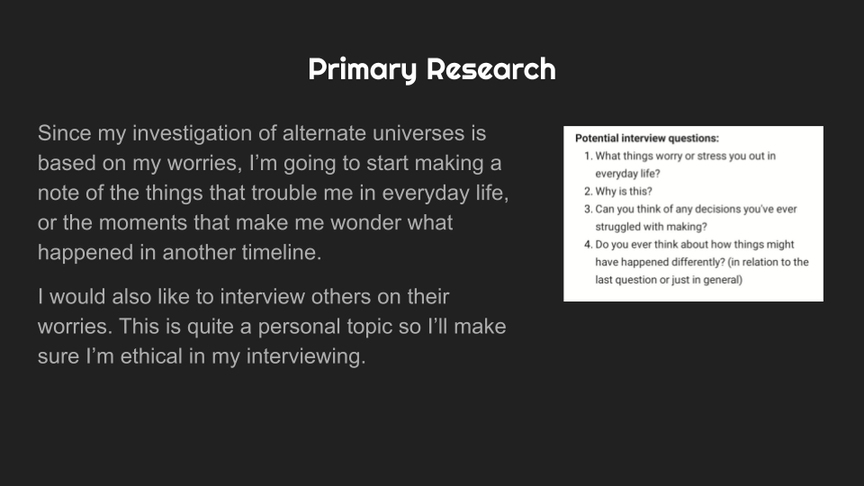
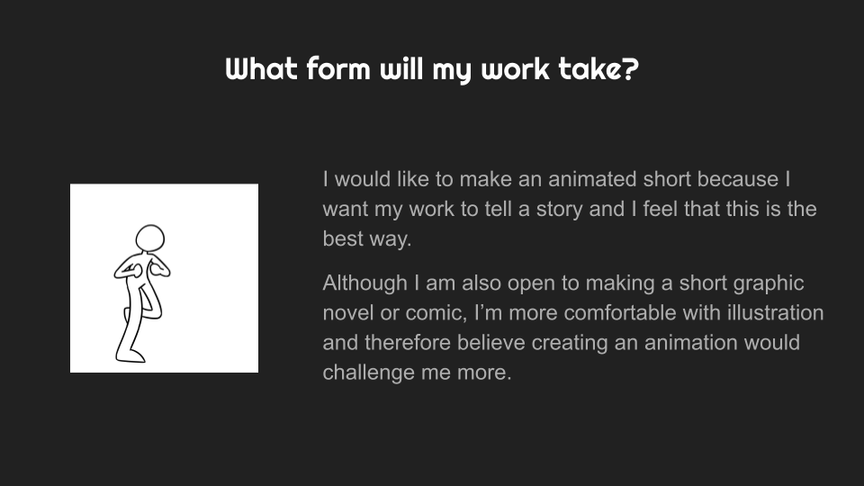
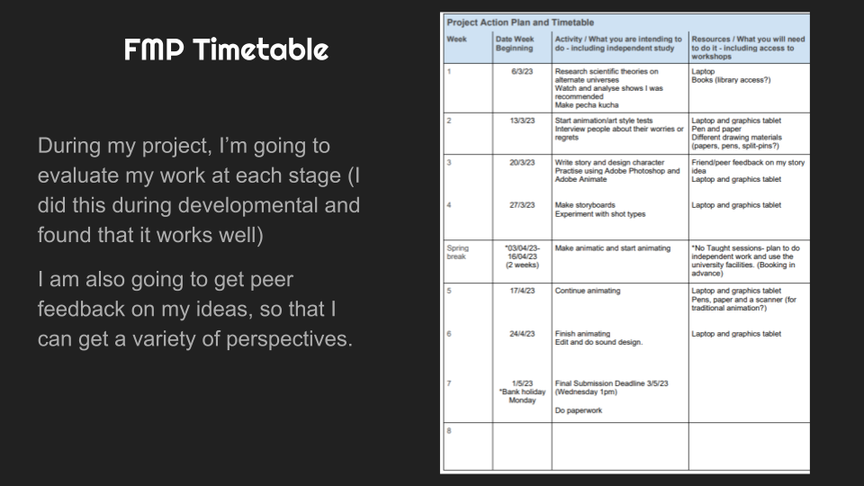
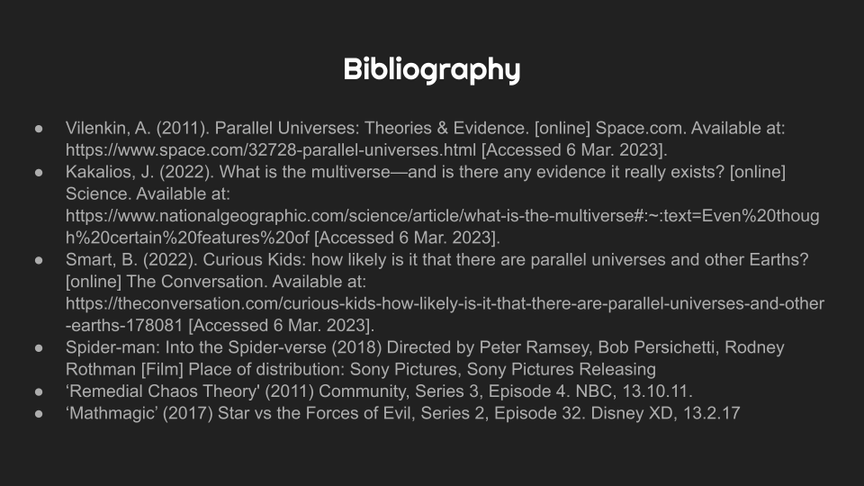
I made this "Pecha Kucha" as a way to condense and present my project idea to others. This was useful because it allowed me to get feedback on my ideas so far.
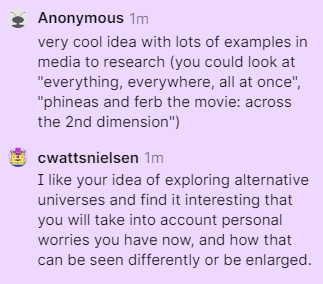
It was also suggested that I could use different drawing styles to show each different universe.
Peer feedback on my Pecha Kucha
Evaluation | My Work So Far
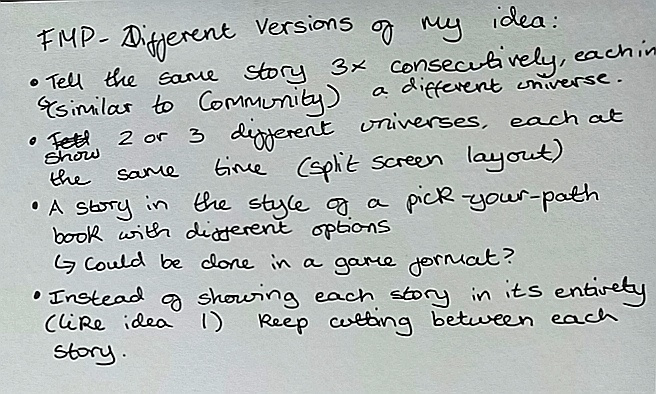
Classnotes on different versions of my idea
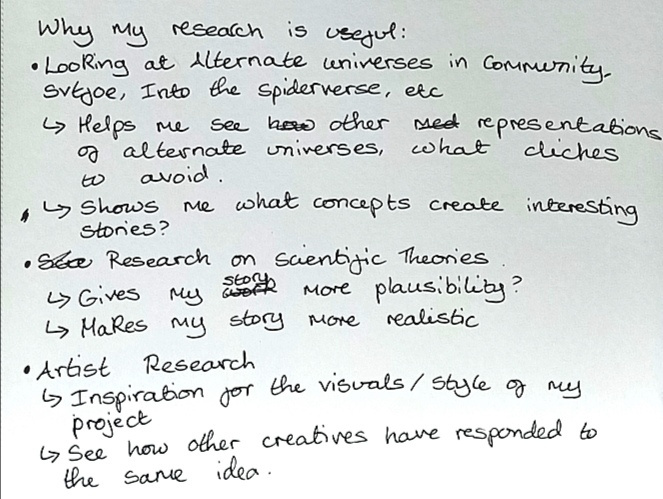
Classnotes evaluating my research
Context | Journaling
Listing the kind of situations that lead me to choose this project brief
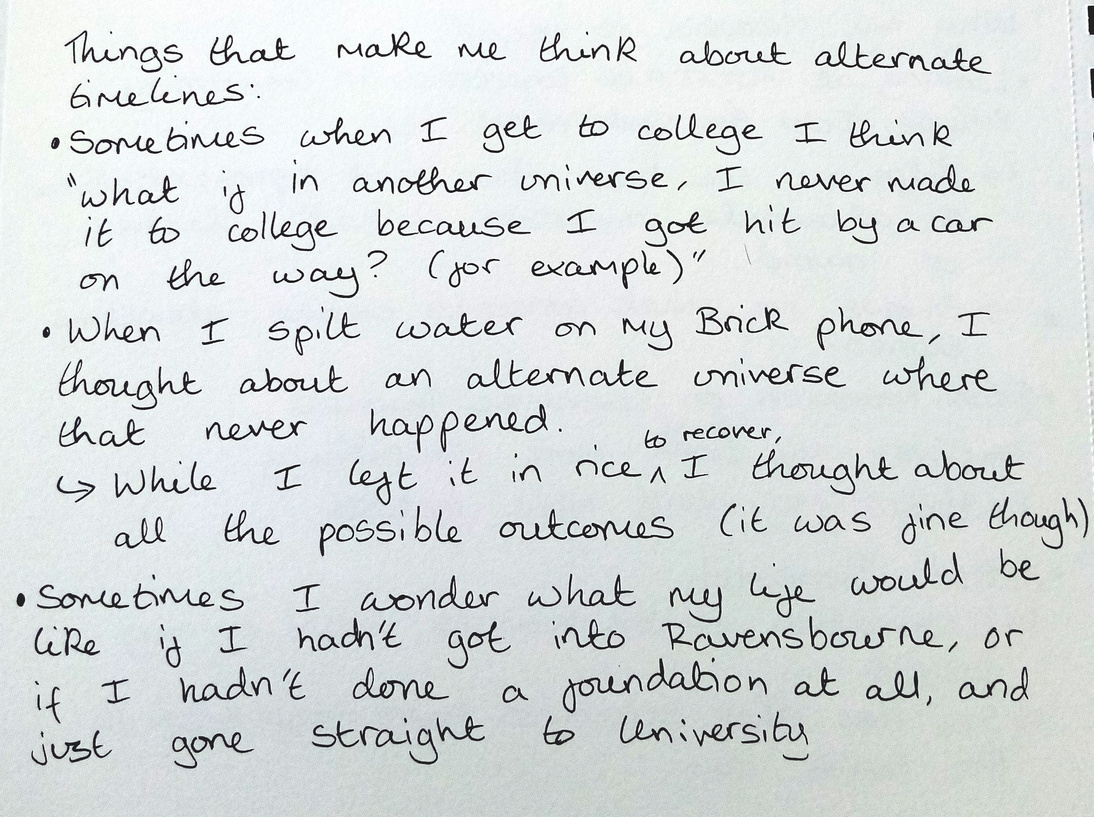
Since the idea for this project came from my personal experiences, I decided to make a note of some of the things that had made me think about alternate universes in the first place. Through this exercise I realised that my ideas were mostly about key moments in my life/things that had happened to me, and how they could've gone differently.
I also listed some of my daily worries
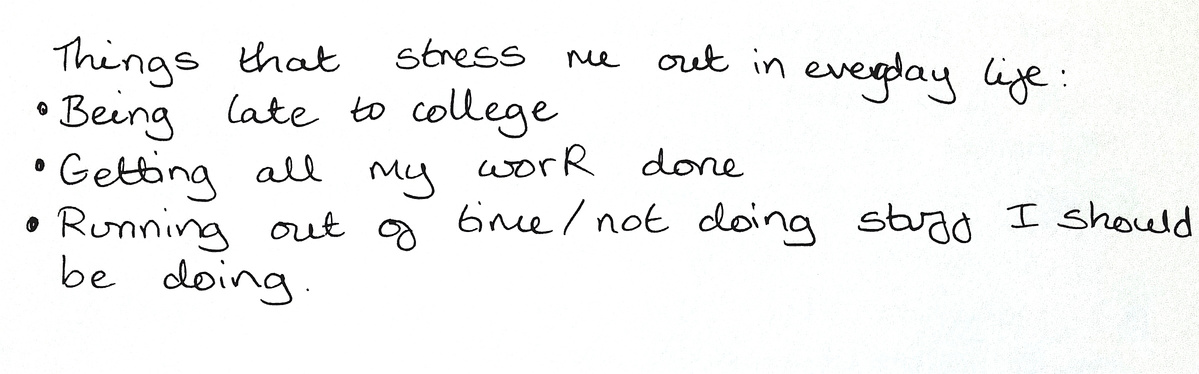
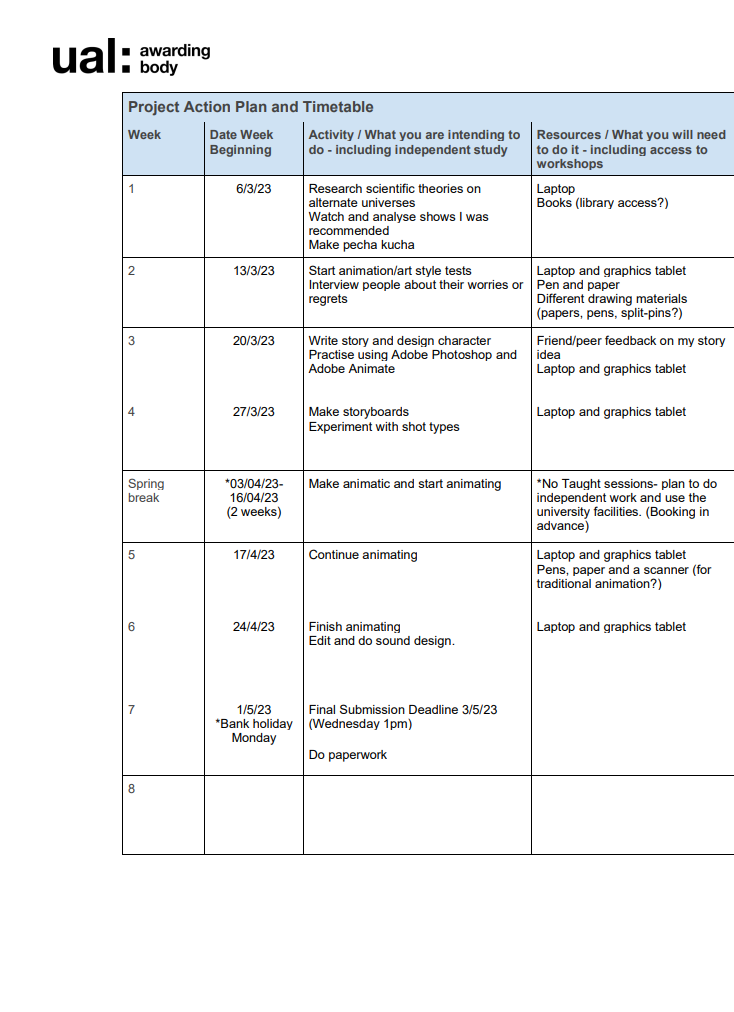
This activity was to give me ideas for the plot of my film, but also to help me write questions for my survey and figure out what kind of information I want from people.
Research | Questionnaires
Initial ideas on what I could ask people
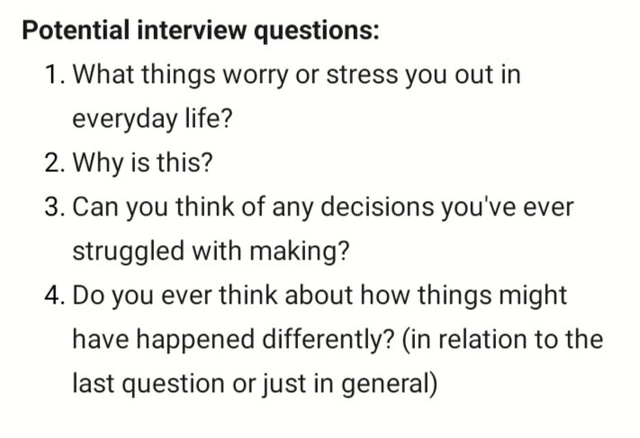
I considered what would be the best way to collect this information:
Asking people about their anxieties can be quite a sensitive topic, and in some ways I think people would be more comfortable talking about them in person. However, this method is also more time consuming, and I've only given myself a week to collect primary research.
While I feel that people will be less inclined to share anecdotes through an online form, it does have the benefit of being anonymous, so participants may be more open in their responses. Sharing a questionnaire online will also allow me to gather data much faster.
I wanted to ask other people about their worries as a form of primary research so I could start to build ideas for the conflict in my story. This is also to make sure that my final outcome would be relatable to others, and not something only I could understand.
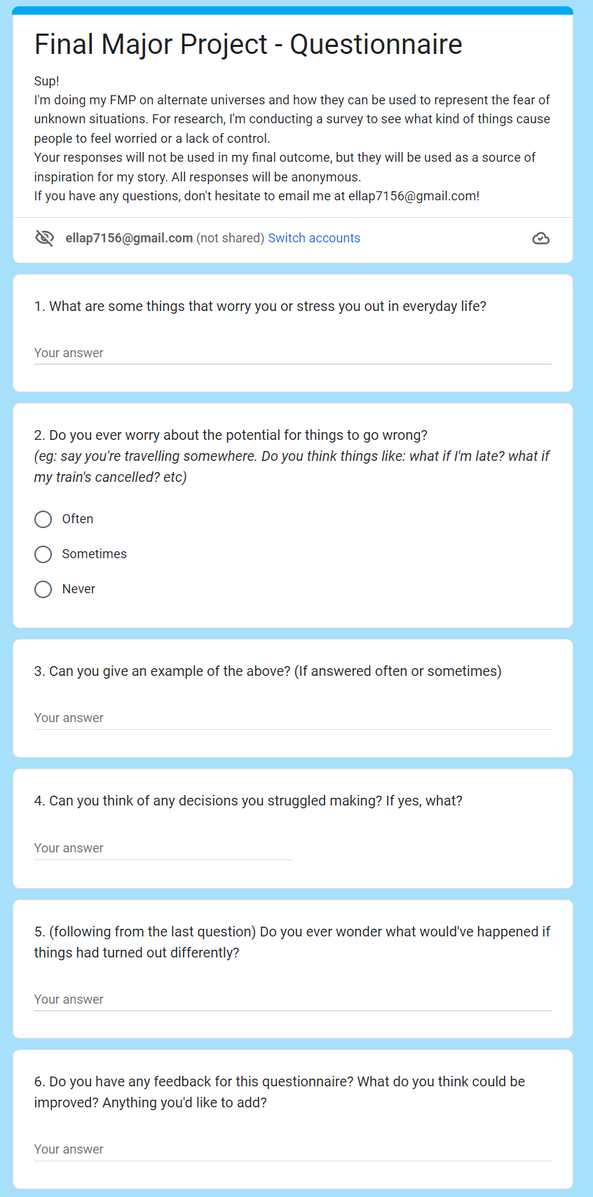
Research & Evaluation | Questionnaire Results
I sent out my questionnaire as a Google Form to my friends. Here are the results.
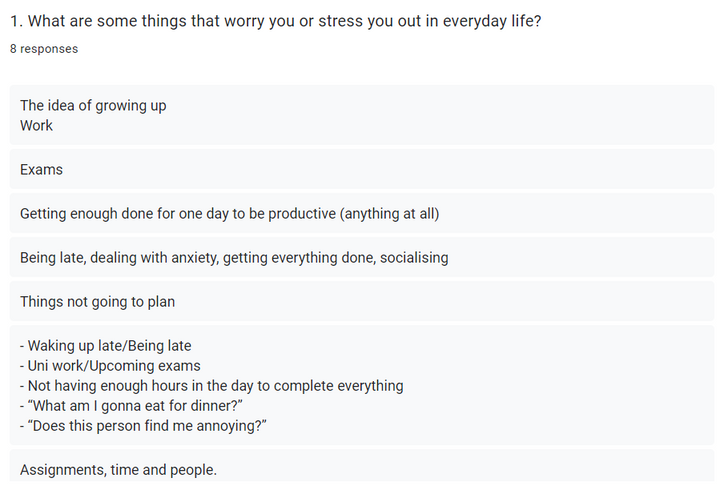
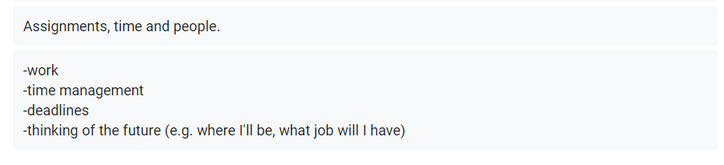
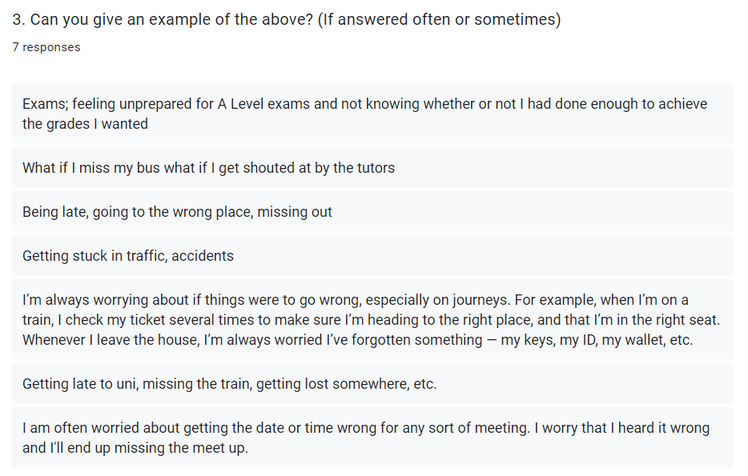
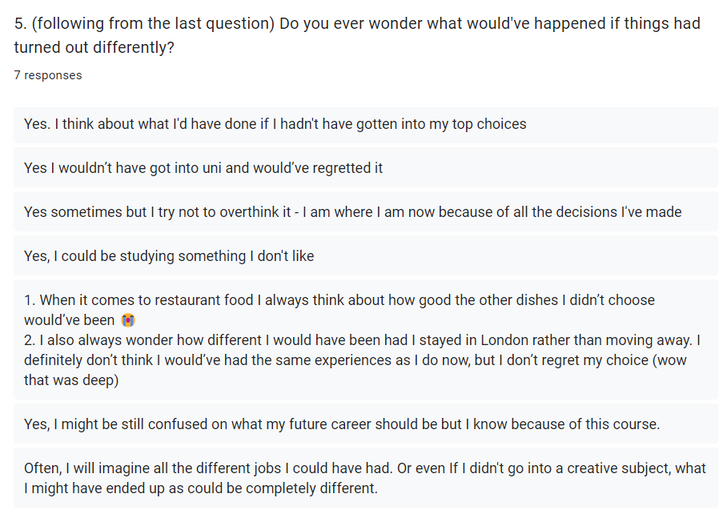
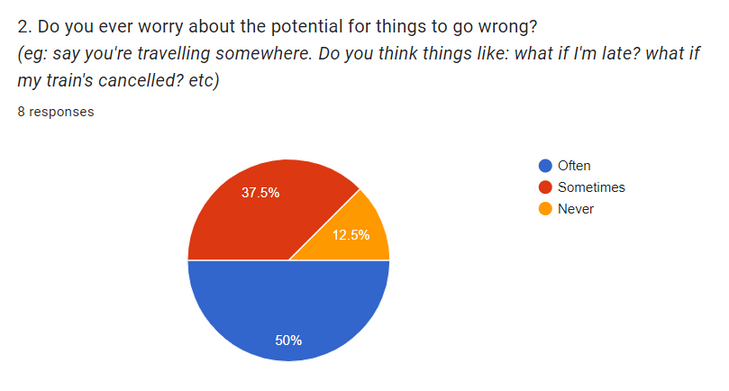
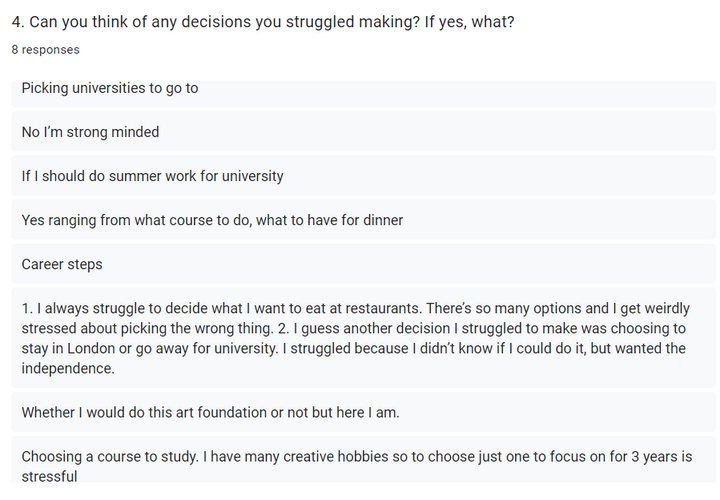
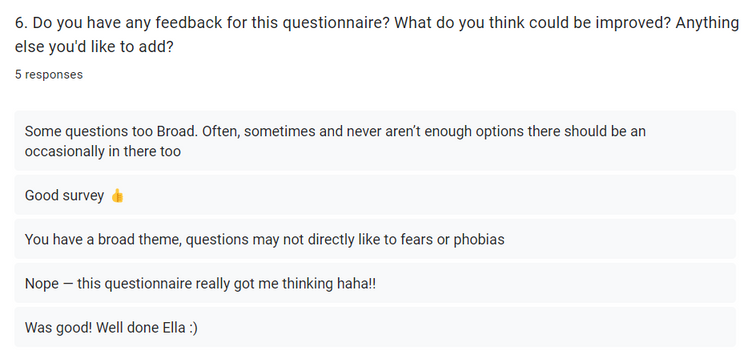
Based on the information collected, the main source of people's worries was school/university: many considered choosing a University or course to be their most difficult decision and schoolwork was the cause of their stress. However, this could be because the people I sent the survey to are all aged 18-19, and if I interviewed a larger demographic, my answers would change.
Another major worry for people was the future, where they'd be, what job they'd have, etc. Though I previously hadn't considered it, I also tend to think about what I'll be doing in the future and if I'll have enough money. However, I think this idea would be too broad to explore in my film.
Travelling was also a worry for several people. Like me, they worried about being late for events and what the consequences of this would be. What I found interesting was that one person worried about ordering food in a restaurant and whether or not they'd made the right decision. This concern was the least important yet I also found it relatable.
The main feedback for my questionnaire was that it was quite broad, which I understand - this is because I wanted people to write more in their answers.
The purpose of this questionnaire was to give me ideas for the main conflict or problem in my story - since my film is going to be based around a key decision that the character has to make, and the different outcomes that could lead to, I wanted this plot point to be based around a relatable concern.
To summarise - potential plot instigators for my film, based on this primary research:
- Choosing the right University/course
- Travelling somewhere
- Managing schoolwork
- Ordering food in a restaurant
Research | Art Styles
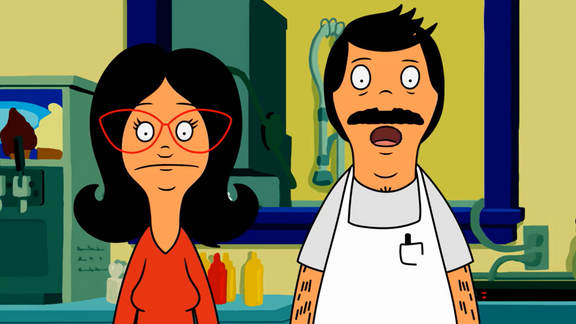
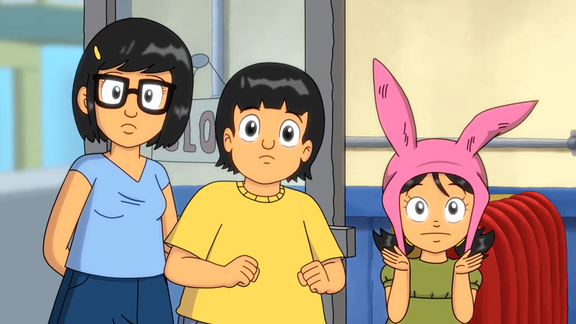
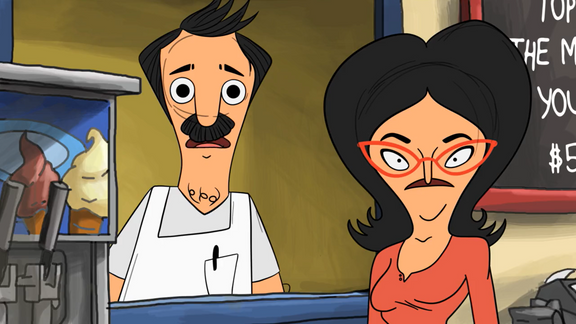
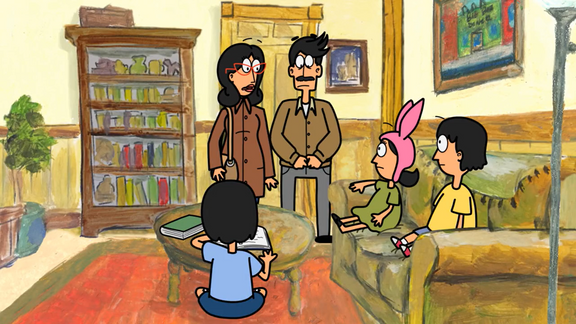
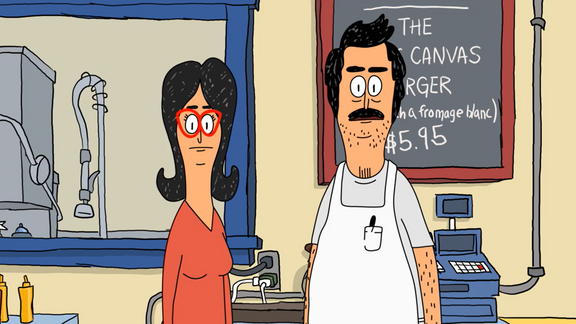
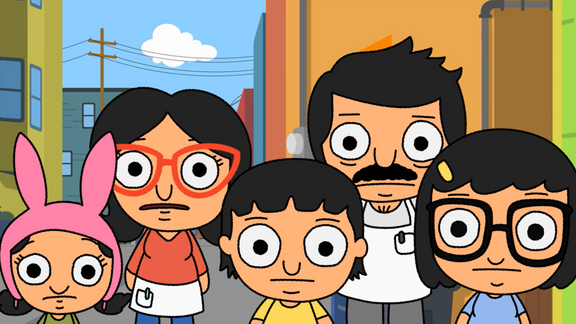
As well as contextual research, I decided to do research for the visuals of my story. Inspired by the feedback I got from my pecha kucha, I investigated different art styles within one piece of media: Brunchsquatch is an episode of Bob's Burgers (2017) created by 62 different artists.
When watching it, the art and background style changes every few minutes. While this is just done as a gag and adds no value to the plot of the episode, I think it could be a useful way to show the same character but in an alternate universe - each time the style changes, the characters are noticeably different but still recogniseable. However, I also find this episode quite jarring to watch, so if I used this idea, I would have to think of ways I could integrate the art styles into the story in a way that made sense to the viewer.
Screencaps from Brunchsquatch (Bob's Burgers, 2017)
Practical Skill & Evaluation | Art Styles
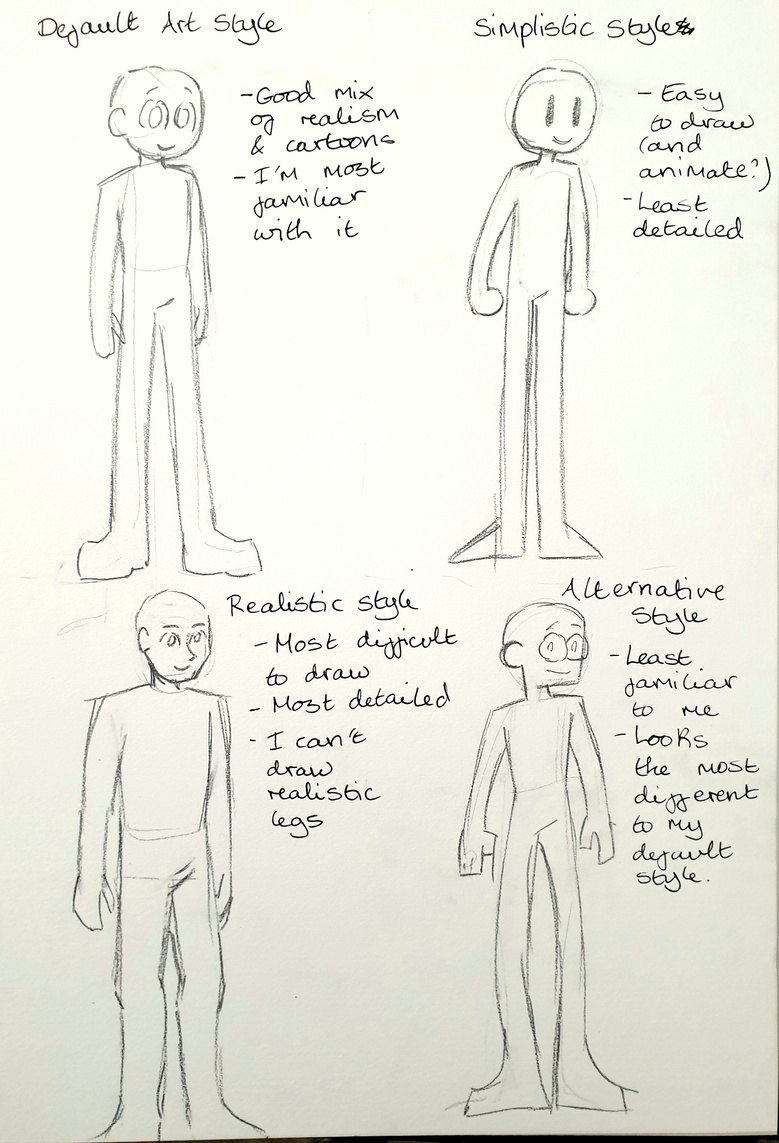
Inspired by my research on Brunchsquatch (Bob's Burgers, 2017) I tried drawing a person in four different art styles. I think using different art styles to show each universe would be quite interesting, but I would have to establish each art style before I started animating.
However, this activity made me realise how difficult and time-consuming this idea would be. Although I am capable of drawing in multiple styles, it usually takes me a lot of practise for my work to look consistent, and this project is only six weeks. I decided to stick with my original idea of using different media to show each universe.
Drawings of a man, each in a different style
Practical Skill & Problem Solving | Animation Software
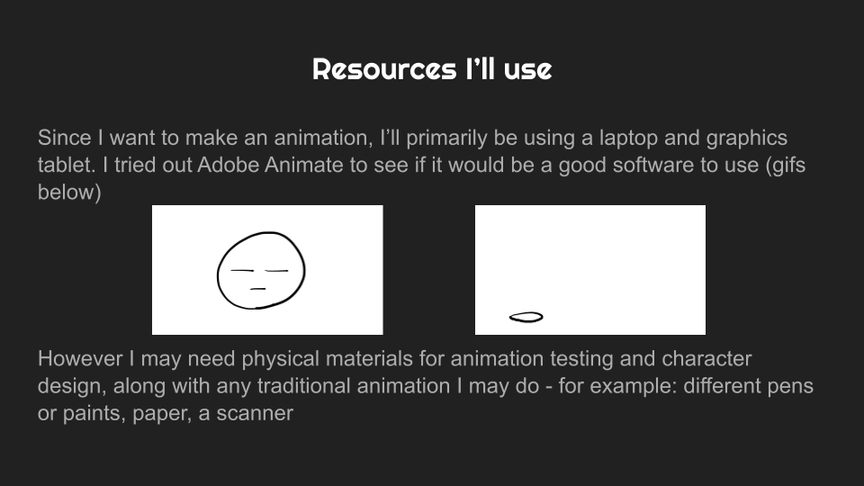
Since I wanted to animate my film, I tested out some animation softwares that could be used to make my film. I'd previously animated on Firealpaca and Photoshop, but Firealpaca is primarily a drawing program and creating a whole animation on it would be too difficult.
A walk cycle I'd animated in Firealpaca
Expression tests and circle moving that I animated in Adobe Animate
I used Adobe Animate to create these gifs. Though I picked it up quite quickly, I found Animate difficult to use. The main reason I like to use Firealpaca for animations is because I'm so familiar with it, and I would worry that using a new program would slow me down. I will try to practice more with the different features of Animate before my final outcome. This program is also the industry standard, so it will be beneficial for me to learn it.
Research | Art Galleries
Kala pani and the blasted egg ceremony, (Zaidi, 2021)
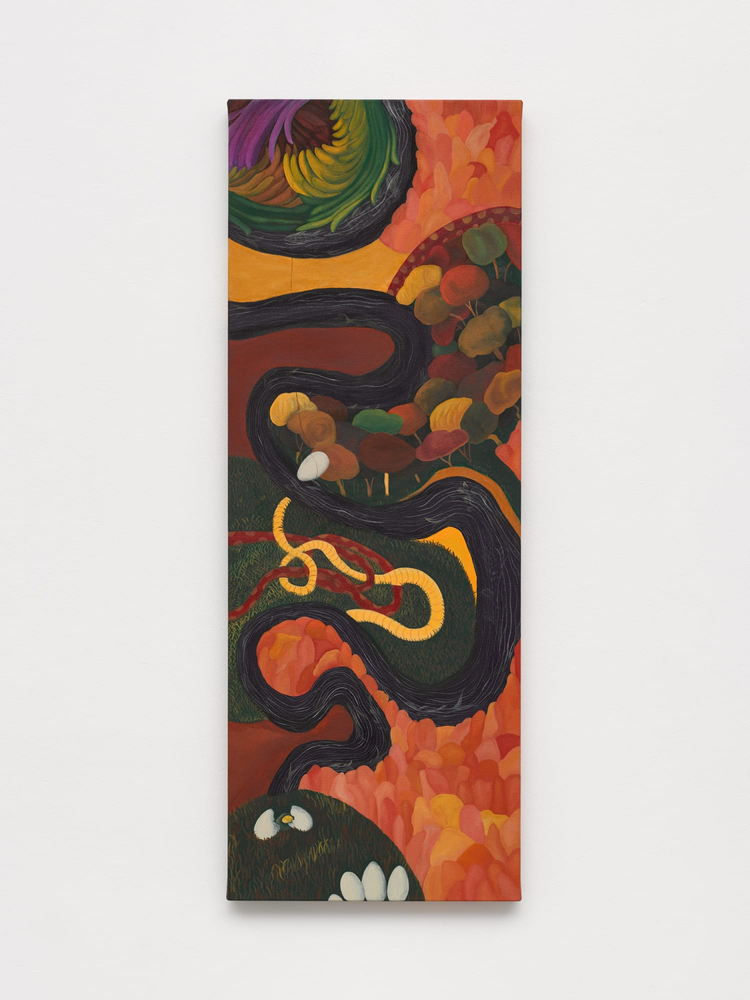
I looked at the Tomorrow 2021 exhibition at the White Cube (due to train strikes I was unable to travel there, and instead looked at the online exhibitions)
I was interested in painter Alyina Zaidi, who creates fictional landscapes inspired by her memories of her homes Kashmir and Delhi, her dreams and her imagination. She uses "fantasy worlds where magic existed to try to uncover certain mysteries" (Zaidi, 2021)
This is in some ways similar to my project because I'm also focusing on fantasy worlds. While my alternate universes will be less magical, I think the idea of drawing ideas from your dreams and memories is an interesting technique and may be useful in my own work.
Practical Skill | Makers Morning
What did I play/test with and how has it impacted my process in my FMP?
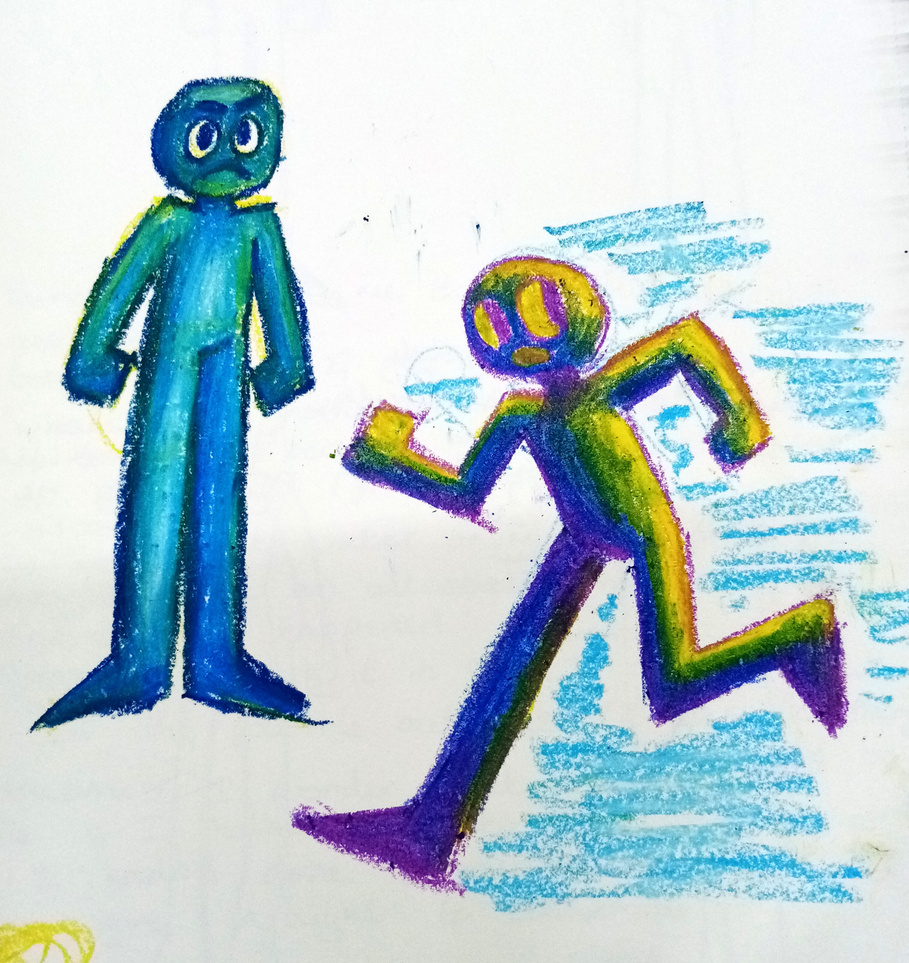
I experimented with using oil pastels to draw characters. Since I haven't yet designed my character, I practiced colouring and creating dynamic poses. This was useful because I am planning on using different textures or mediums in my final outcome, and oil pastels are good for this. Oil pastels are commonly in bright colours so I made the characters more vibrant and colourful, but I liked the abstract effect this created and may use it in my final outcome.
Oil pastel character drawings
My lumen prints, before and after
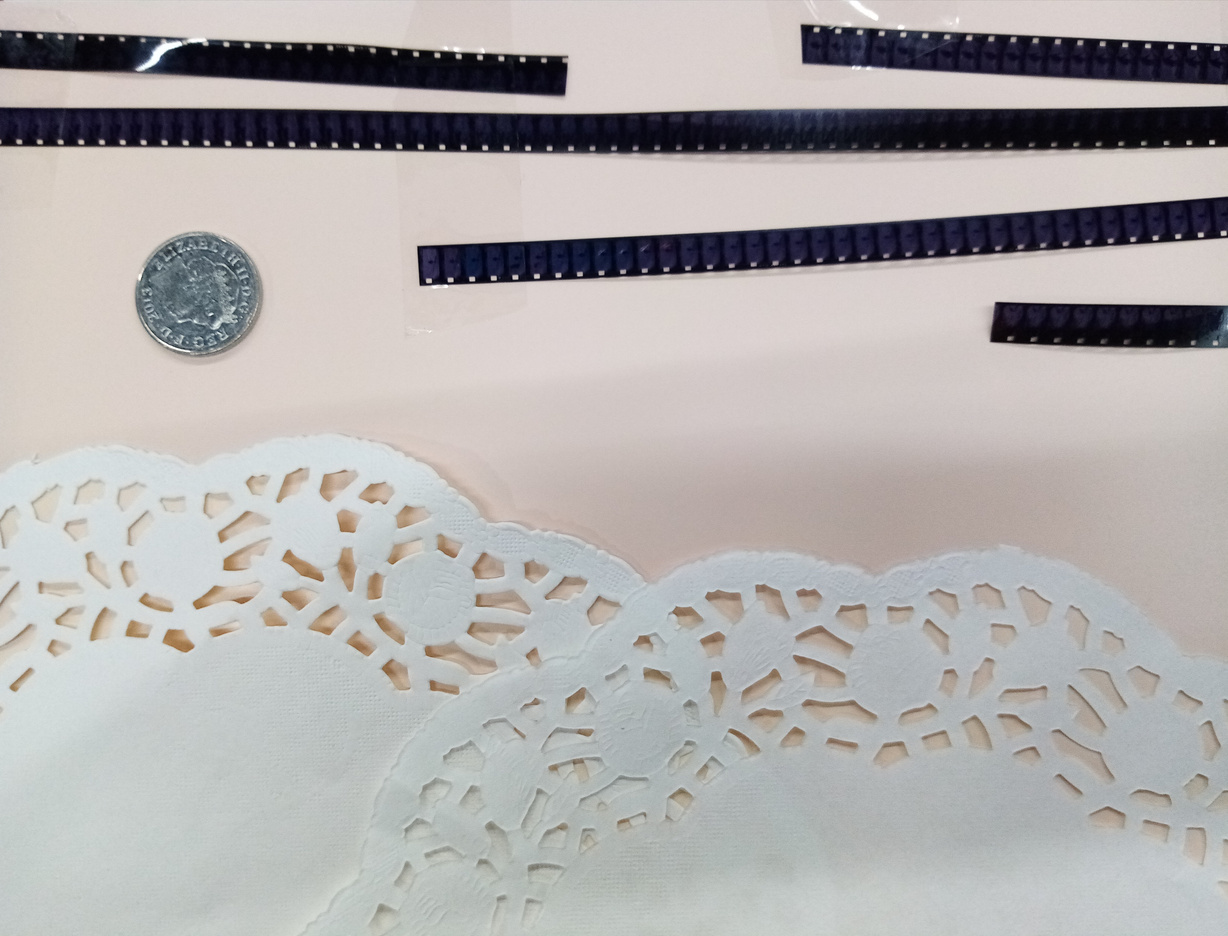
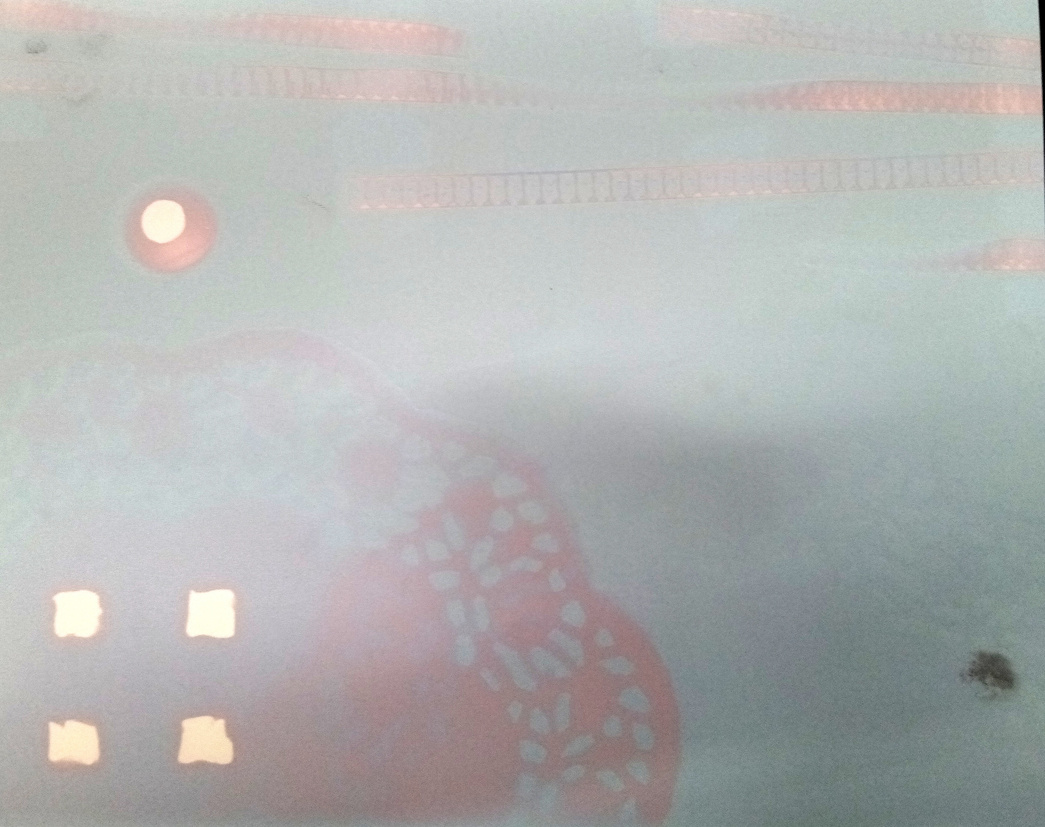
I experimented with using lumen printing to create an abstract background. I used doilies, film reel, blue-tack and a coin to create shapes.
This was somewhat successful; my materials did create interesting shapes, although they were a bit pale. I noticed that the blue tack was the strongest at preventing light from touching the paper.
Unfortunately there wasn't any solution for me to seal the print in, and when I did lumen printing before, this helped make my print stronger.
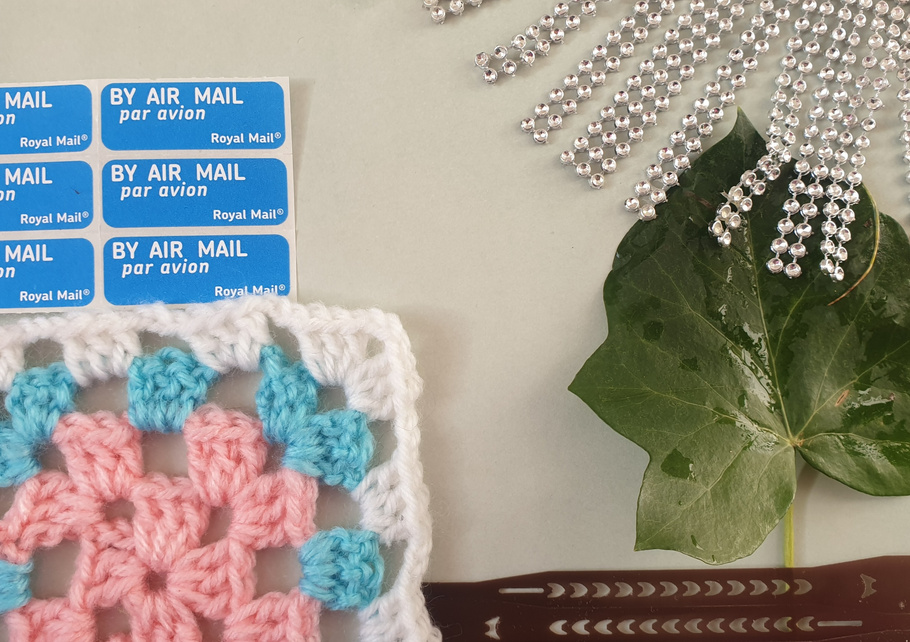
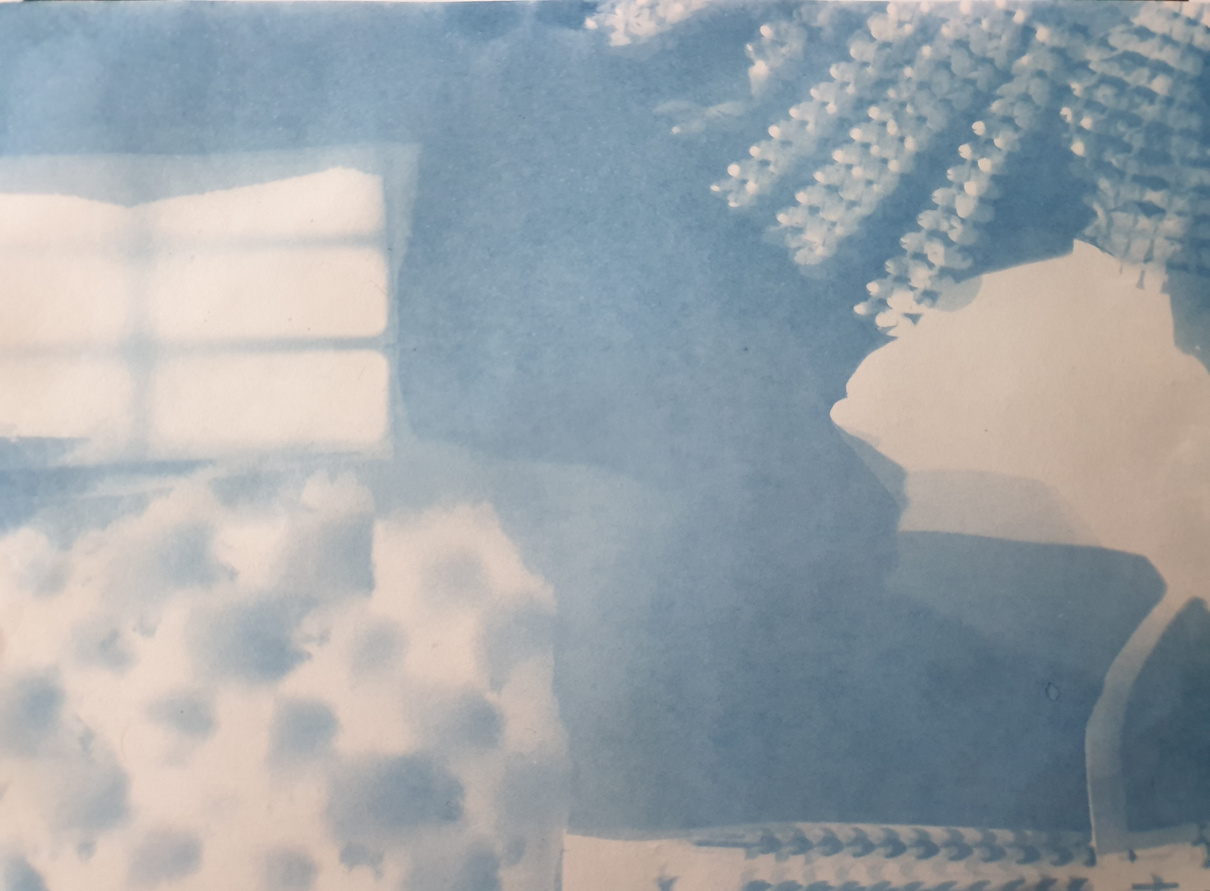
As well as lumen printing, I did a cyanotype print, using a crochet square, some stickers, a leaf, a plastic stencil and some beads. When I made this, the sunlight was slanted, which created shadows on the paper that affected my final print.
I'm happy with this picture because of the stronger contrast in it. Though I tried to arrange the objects in the shape of a landscape, my outcome is quite abstract and can be interpreted as many different things.
My cyanotype print, before and after
Context | Worldbuilding
I've decided to base my story around 2-3 different universes, and the main character comes to the same dilemma in each one. For this, I took inspiration from Mathmagic (Star Vs the Forces of Evil, 2017) but instead of all the alternate versions of the character reaching the same conclusion, their stories will go in different directions. These timelines have existed separately previously to this event, rather than being created by its different outcomes like in Remedial Chaos Theory (Community, 2011).
The main character will not be exactly the same in each universe - this is because their personality will be shaped by the things that happen to them, and the same things will not have happened in each universe. However to make sure that they're recognisable to the audience, they will have the same base and similar mannerisms.
Planning & Production | Writing
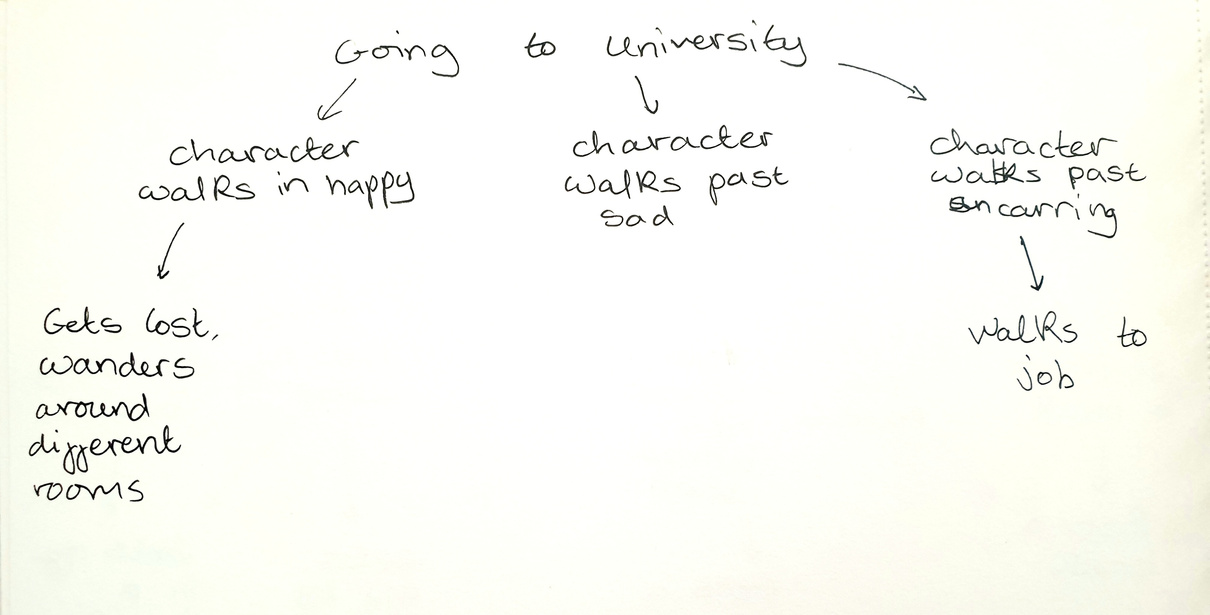
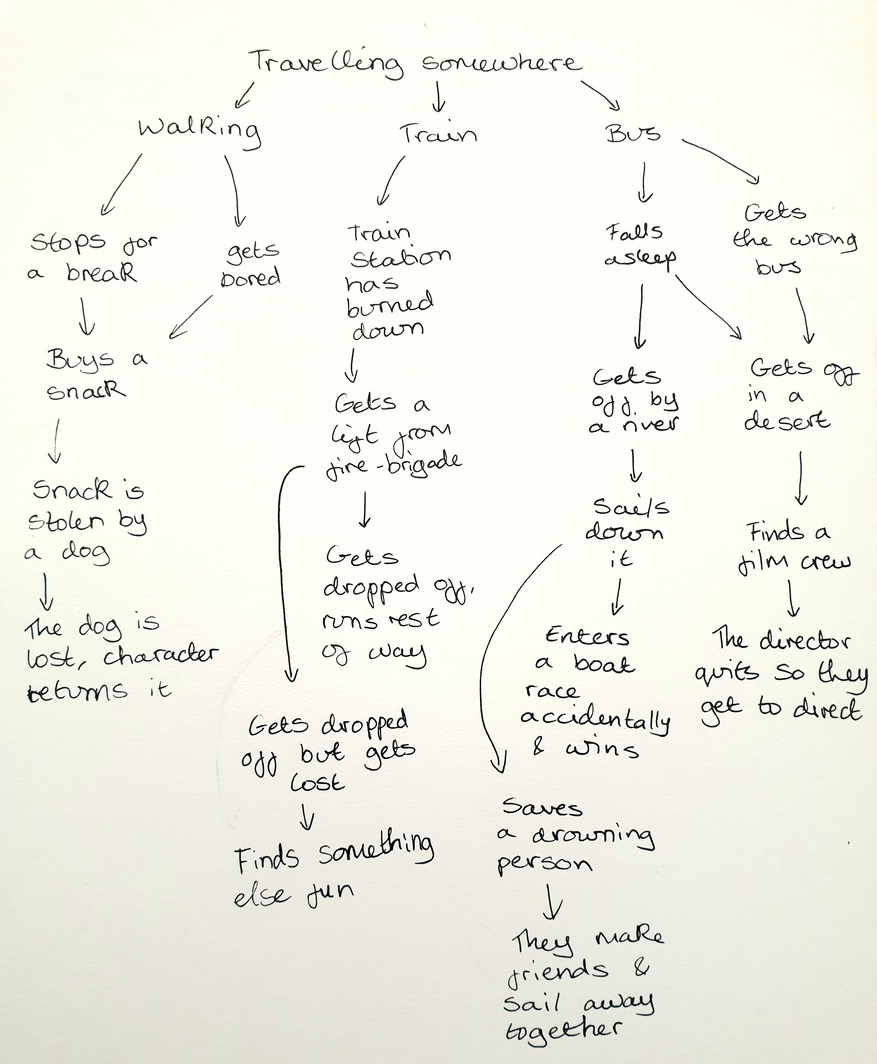
I started brainstorming the plot for my film by drawing a kind of flow chart. This worked quite well because it allowed me to visualise all the different outcomes of an event, and where they could go. I chose to focus on a story about a character either choosing the best method of travel, or the possible outcomes of a character applying to university.
Flow chart of ideas for a story where the character goes to university
For the travelling-somewhere plotline, I took inspiration from animated sitcoms like The Simpsons (1989) and Bob's Burgers (2011), where the events that happen are highly unlikely and unusual but not impossible. This is because my story is inspired by people's irrational worries and because I wanted my story to have a slice-of-life like feel. In this story, the main character is travelling somewhere and their chosen method of travel dictates the story. Each universe ends well for the character, but in none of them do they reach their destination - this is to make it clear that there is no "correct" timeline, and they're all just different.
I found it much easier to generate ideas for this story, although it may be more cliche.
I chose not to use the going-to-university plotline, even though it was a main worry in my survey. This is because it's particularly relatable to people who didn't get into their chosen university. Although I know that people end up in a good place whatever university they go to, and would want to show it through my film, I think this moral would be difficult to represent in a 2-3 minute animation. I also found it hard to generate ideas for this storyline.
Flow chart of ideas for a story where the character travels somewhere
Problem Solving | Talking Mornings
How have I solved problems so far?
How will I solve problems in future?
I struggled with writing the story because I didn't want it to be too complex but I also didn't want it to be cliched. To solve this I'm going to get feedback from my peers.
Choosing which software to animate on also created problems for me, because I thought Firealpaca (the program I'd been using previously) would be unsuitable. To solve this, I started practising using Adobe Animate.
My main concern with this project is timing, and whether or not I'll be able to complete my film. To solve this, I tried to give myself the maximum amount of time I could schedule for animating. However, I may have to have a back up plan, eg: a list of shots that can be cut easily, in case I run out of time.
I also worry that my animation plans are too ambitious, and I may encounter problems trying to animate with analogue materials, or a mix of analogue and digital.
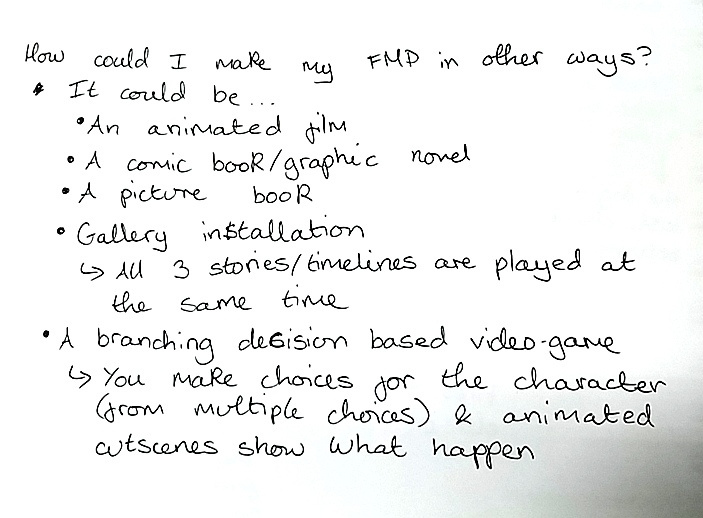
Alternative ideas for my outcome
Problem Solving | Talking Morning
My prompt cards
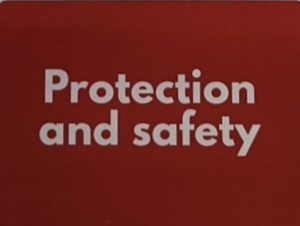
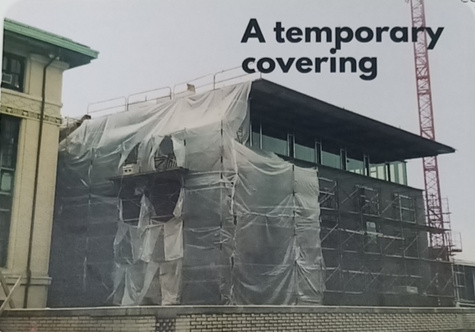
Using a random theme and visual - Protection & Safety and A Temporary Covering - we had to plan out an idea for a game, storyboard, character, etc.
My first idea was to use the visuals on the card and create a game about a homeless person squatting in a building's construction site, because while the covering shelters the building, it also hides them from the authorities. However this is a temporary home for them, because when the building is finished, they'll have to move out. However, I didn't like this idea because I thought it was too literal.
I instead decided to make concept art for an animated film about a rare, mythical creature that has been captured and lives in a cage under a sheet. They're safe while under the sheet, but this is temporary because once they're unveiled to the world, they will be exposed and open to the public.
For the creature's design, I started with creatures from myths and legends, that people have always wondered about the existence of and therefore would be excited to find. I then realised that aliens would be a much better creature to represent this idea.
Concept art of my idea
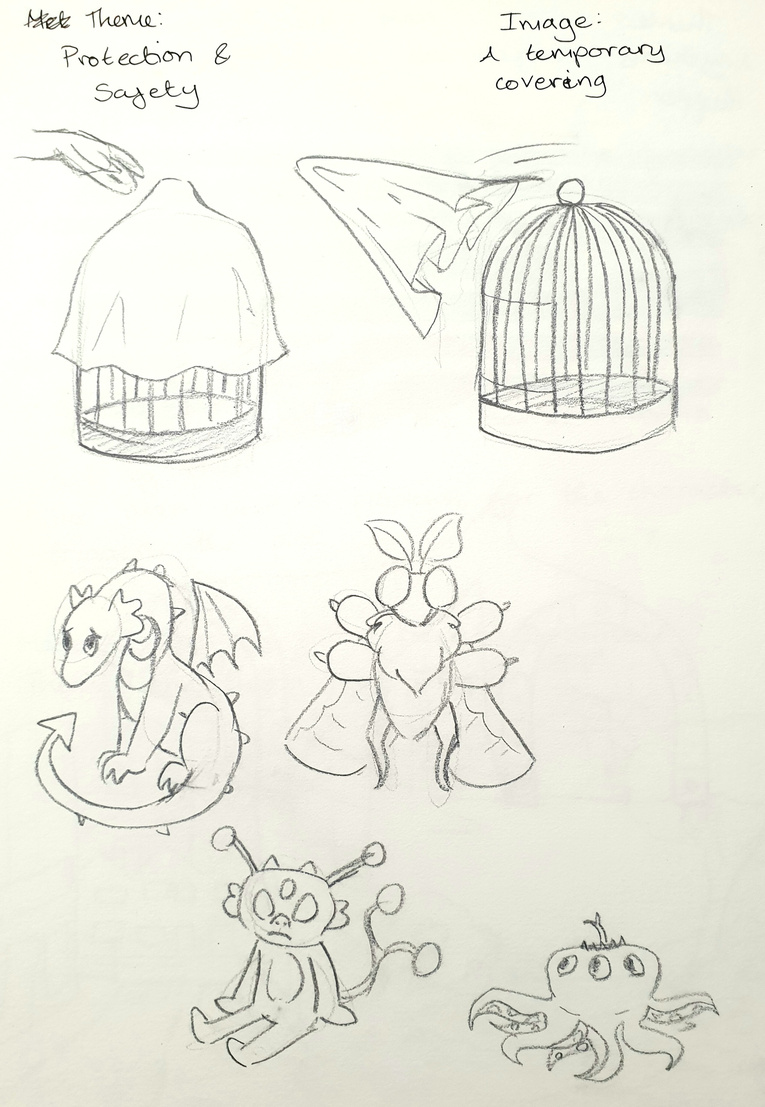
Prompt and concept art of my idea
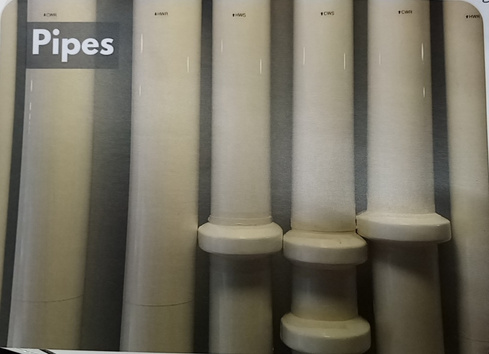
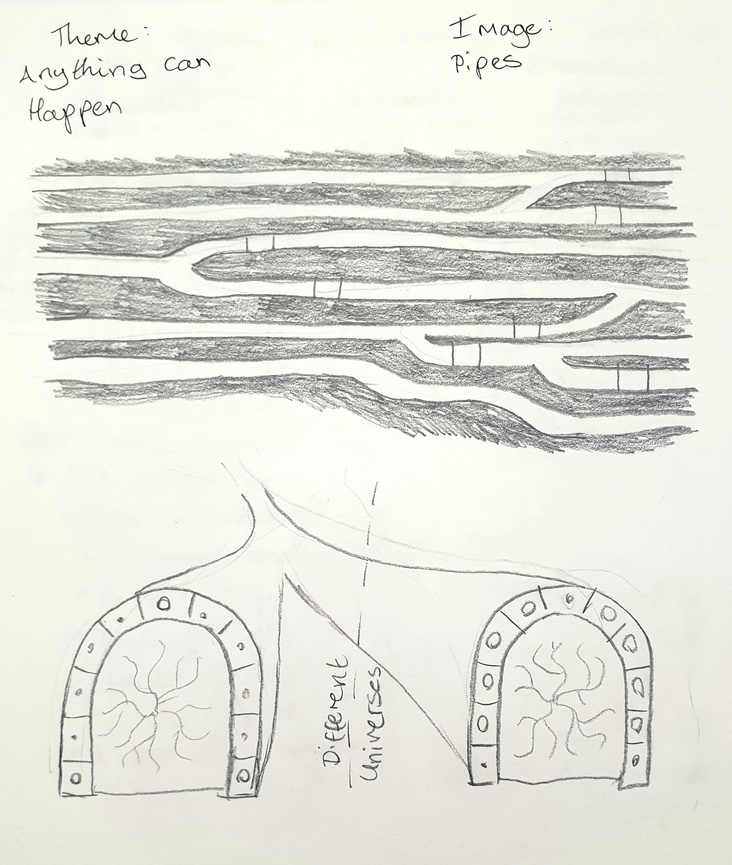
We were then given a random image and had to find a way to relate it to our projects. I chose "Pipes" because visually they reminded me of many timelines running alongside each other and diverging at points.
I used this to make an alternate version of my idea where the character can use these pipes to travel between timelines and see what would've happened if they had made different choices.
My ideas for how the theme "men" could influence my idea
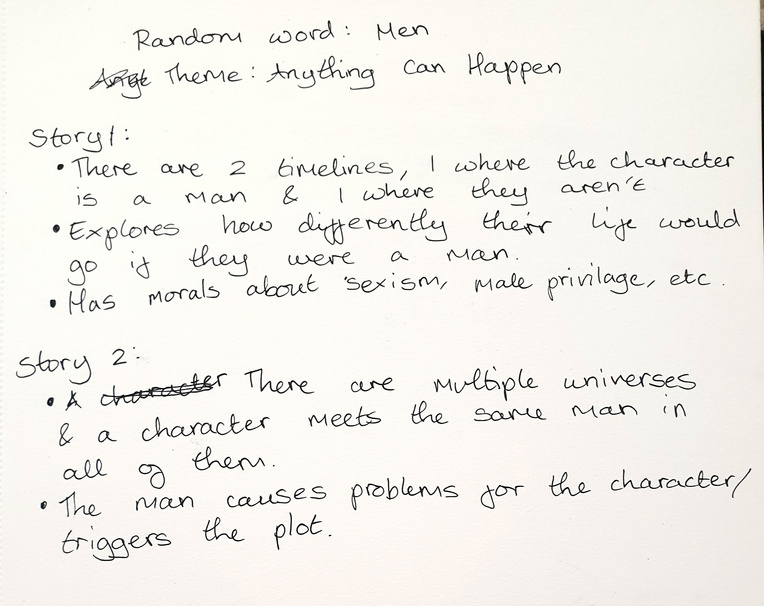
I also had to incorporate a random word into my project. I got "men" and used this to think of a few story ideas. I think Story 1 would work well as a film, while Story 2 would be more interesting as a series.
Concept art based on the scent and texture
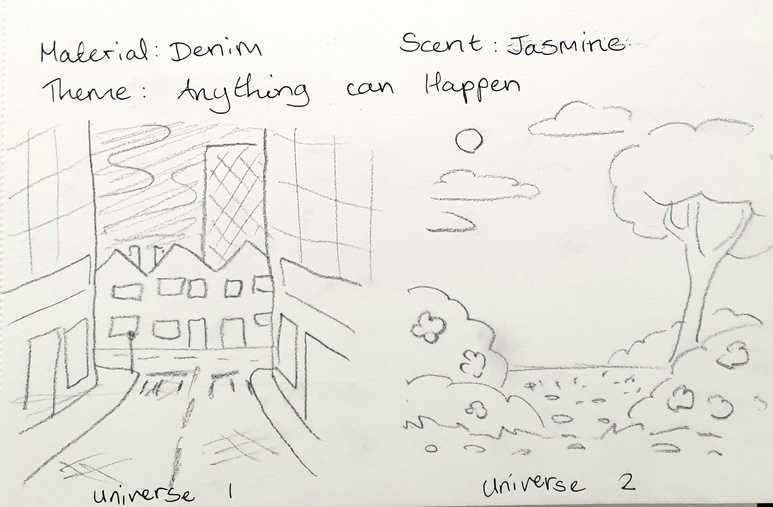
For this task, we were given a texture and a scent, and had to use our connotations of each to influence our FMP ideas. I got denim as a texture and Jasmine as a scent.
To me, the denim felt rough, tough and quite thick, and the jasmine scent reminded me of being in my garden in the summertime. I created to environments based on these ideas: one unforgiving, cold, gloomy urban area inspired by the denim, and one lush, overgrown garden/meadow inspired by the jasmine. I thought these could be two contrasting timelines that a character could visit.
This talking morning made me realise that incorporating an interactive element into my final film to make it more video-game-like may be a good idea.
I also found thinking of unusual ways to show certain themes a useful activity, because it helped me generate more unique ideas. I will take this skill forward through the rest of FMP.
Evaluation & Problem Solving | Adapting my Idea
Having shared my story idea, I received the feedback that it was good, but would be a lot to animate - this was something I was already aware of and concerned about. I was told that all the random events that took place in my story distracted from the moral, and my idea would work better as something where the viewer can make decisions for the character, like a game.
It was suggested that I instead made either a tabletop game or board/card game (with animated elements), pre-production for a video-game, or a zine/graphic novel. Given that one of my aims for this project was to improve at animation, I would still like to include some in my project, rather than create something like a graphic novel. I'm thinking of making my idea into a video game, and my outcome will be a demo of game-play footage, perhaps with physical elements too.
Planning, Production & Problem Solving | My New Idea
Since I was making my story into a decision based videogame, I wanted each choice to be less linear and more varied. So I used my previous choices chart to make a new one that followed a similar structure but was much more interconnected. This way, it's much more interactive and interesting for the player.
Flow charts of my story/game: initial draft vs. finished diagram
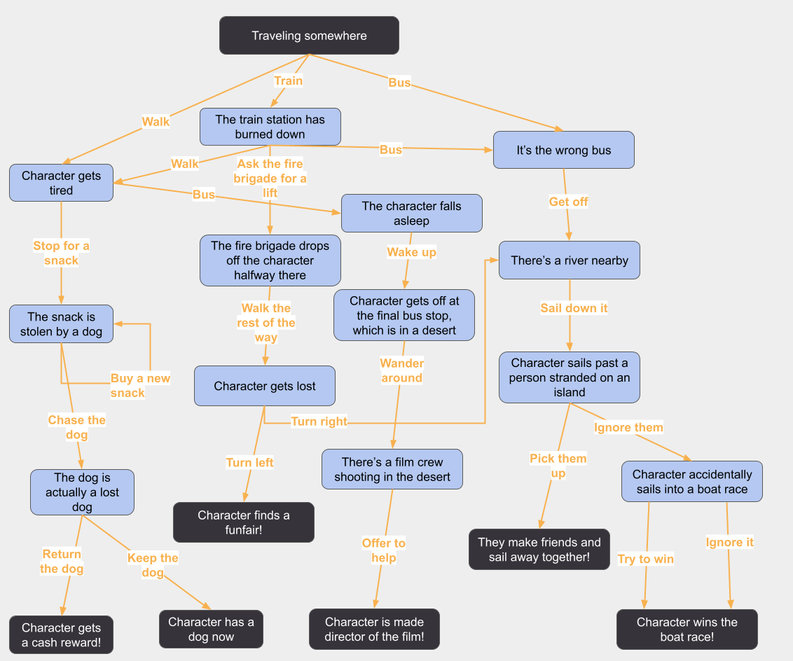
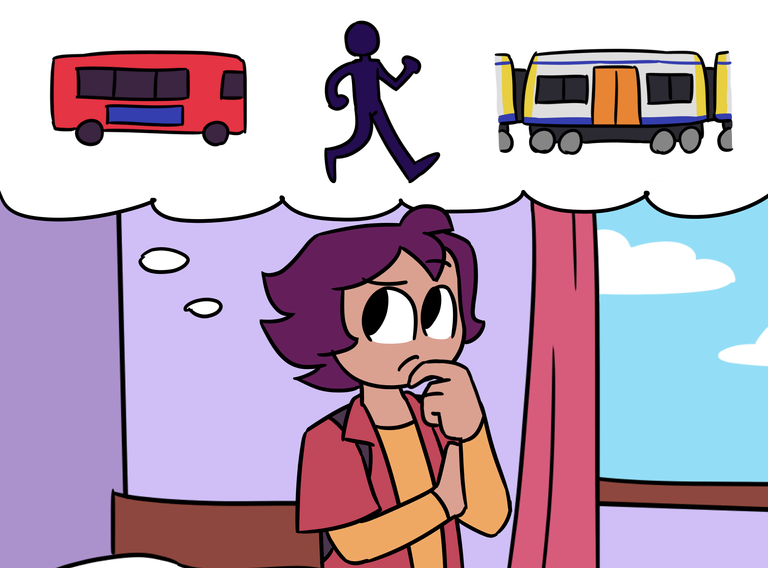
Despite the changes, my game will still follow the same plot as before: a character travelling somewhere is given three initial options - walking, bus or train - that each diverge into different stories, and in none of them does the character reach their destination.
The main difference to my idea is that its story is now player driven, and there are more endings available.
Evaluation | My New Idea
What do I want to say?
I want my story to confront the player's fears about events going wrong and there being no way to control them, but at the same time give a hopeful ending that shows how even in the most unpredictable scenario there can be a fun, happy outcome.
How will it be perceived?
I think my game will be perceived as similar to other decision based games, except mine focuses on a quite mundane plot - the different methods of travelling - which will be more relatable to the viewer and allow them to get more invested in the character and the game.
What are my strengths?
My strengths are in writing comedy, and I wanted all the story outcomes to be quite unusual, so this skill will be useful in making my game funny and lighthearted.
Has it been done before and how do I make it unique to me?
I think decision based games/stories like mine are quite common, however, they all usually have at least one correct or more successful ending that the player has to aim to. In my game, there will be no way to actually reach the desired goal (getting to the location) but instead every ending will be something pleasant.
I would also like to continue using my ideas about alternate universes, and show the character design or art style developing as the story progresses, but in different ways depending on which choices the player makes.
What is the end goal for this?
My end goal is to create the concept for a decision based game. I have no experience in coding and my whole idea is too much to animate in the time frame, so I will probably only create a tutorial or demo version of it.
I made sure to reflect on my idea now that so many changes had been made to it - this is so my ideas and intentions will stay consistent, and if not, I'll be able to see how they've changed.
Planning & Production | Writing for Character
I decided to write a personality for my main character so that they would be easier to design. I found this activity difficult because the character doesn't have much agency - the player makes their decisions for them. Some of the character's personality is also dependent on the choices the player makes, eg: whether they're selfish or selfless. I tried to use the character's motivations and the options the player gets to choose from to write their personality.
Character template (cparrisart, 2021), filled in by me
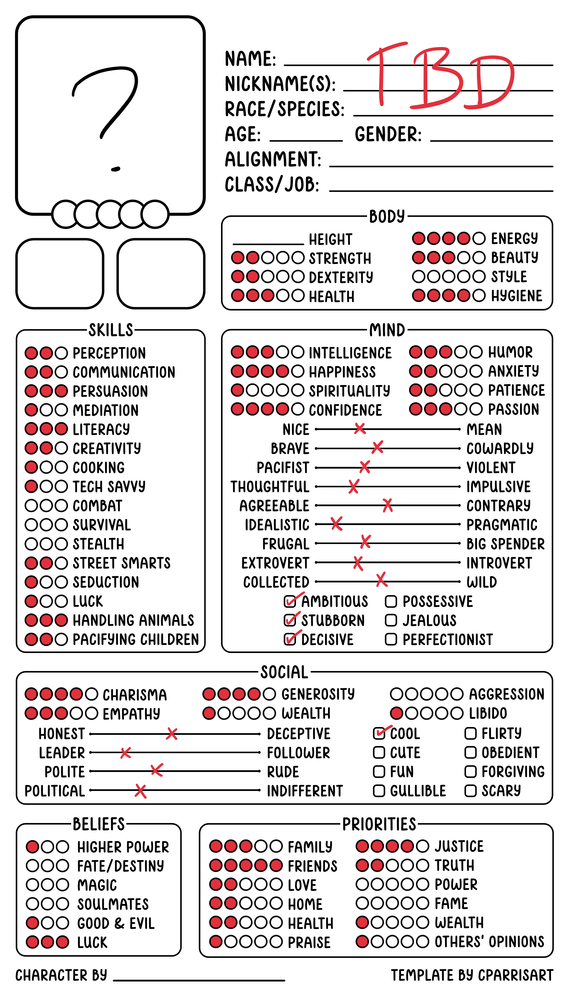
Character Bio:
The character is very motivated to get to their destination, and they don't give up easily. They're also quite extroverted and open-minded - they don't mind trying unusual methods to reach their goals. The place that they're trying so hard to get to is their college, but this is not out of a fear of being reprimanded; they enjoy being there and spending time with their friends. This makes them a lot more chill and willing to accept the things that happen on their journey, rather than panicking. All their options of travel were public transport, which suggests that they're frugal or can't drive.
Planning & Production | Character Design
I started by doing lots of different designs, all based off my character's bio. I then used my 2 favourite designs to create 2 more characters, and then combined them to create my final design.
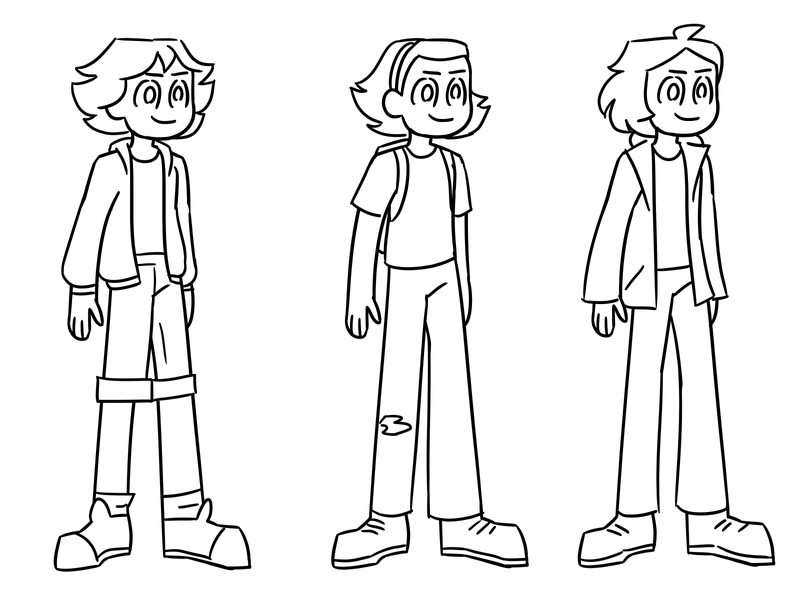

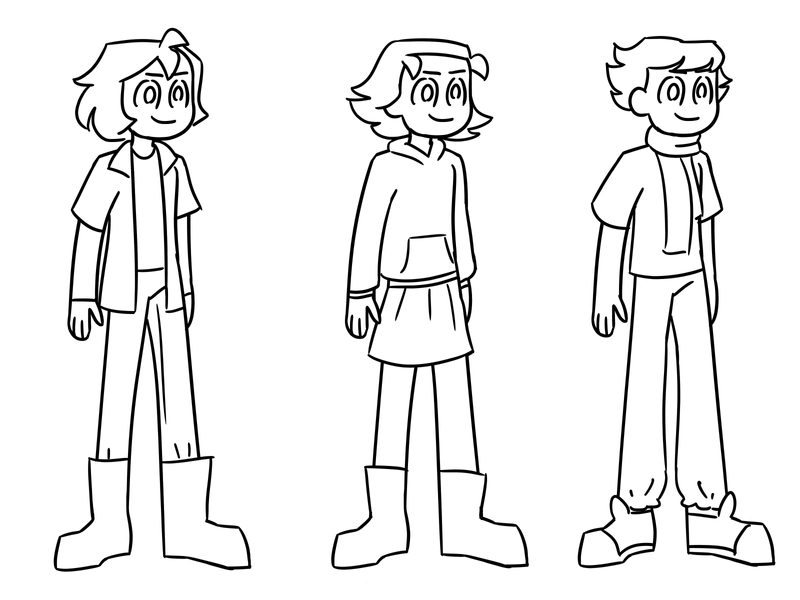
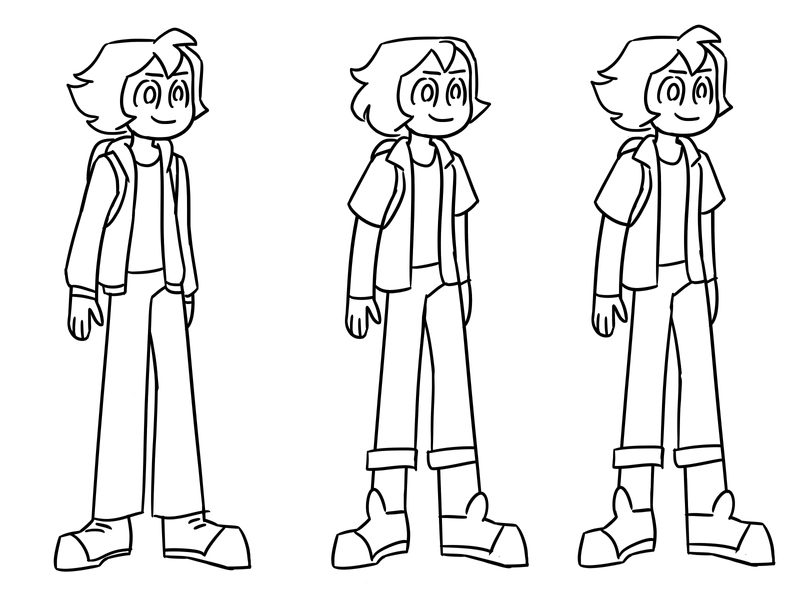

My initial character designs.
The red arrows indicate my favourite designs. The red circles indicating what features I used for my final design.
For colour tests, I started randomly, to see what worked well. I then compiled my most successful palette and started to refine it.
Colour tests for my character design
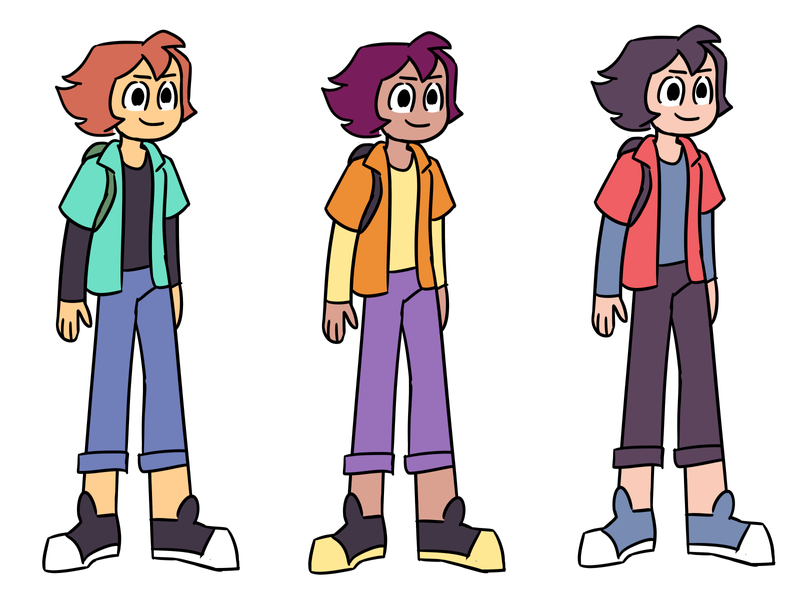
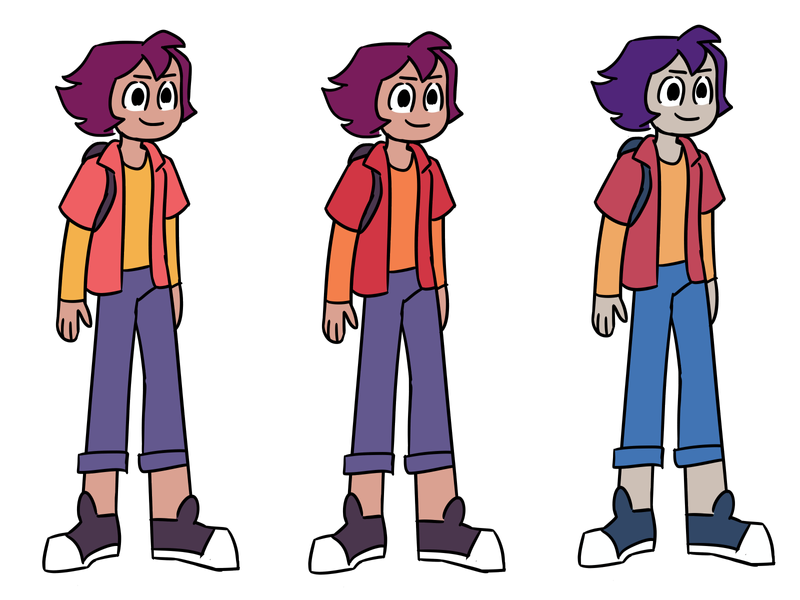
Thoughts on my final design:
- I'm relatively happy with my design.
- The story the character's in in quite mundane and I wanted their look to reflect that, but I also wanted them to look unique enough that it was clear they're the main character.
- Their outfit has detailed elements, but they're still simple enough to easily animate.
- I managed to use lots of bright colours without making them look over-saturated.
- I haven't decided on their gender so I wanted them to look androgynous.
- My main concern is whether or not my character has appeal. I also could've taken their shape into account more when designing them.
My final character design
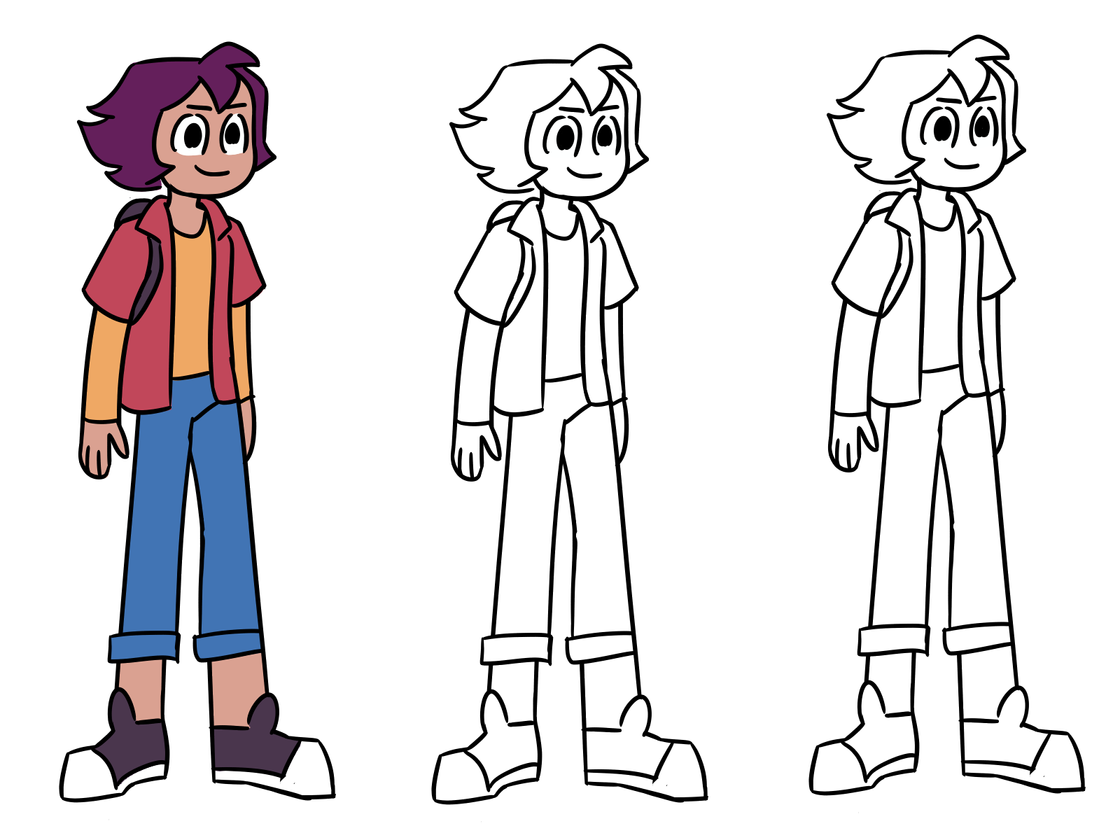
Character turnaround sheet
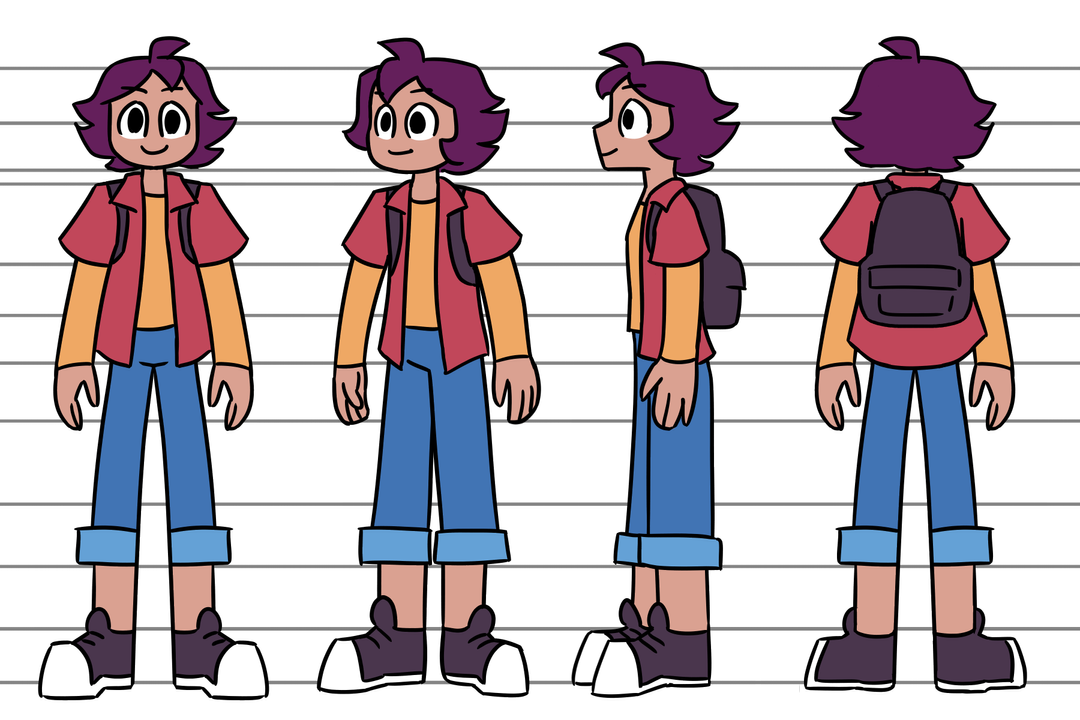
To represent the alternate universe aspect of my story, I thought that features of the character's appearance could change depending on what decisions they make. Since I'll only be animating the first part of the story, I won't need to draw these, but I wanted the idea to be included.
Editable features:
- Their trouser leg could get a hole
- They could lose/take off the backpack
- Their hair shape could change (eg: get more messy)
- The design on their T shirt could change?
Problem Solving | Character Design
To improve my character, I tried redesigning them but using shapes as inspiration.
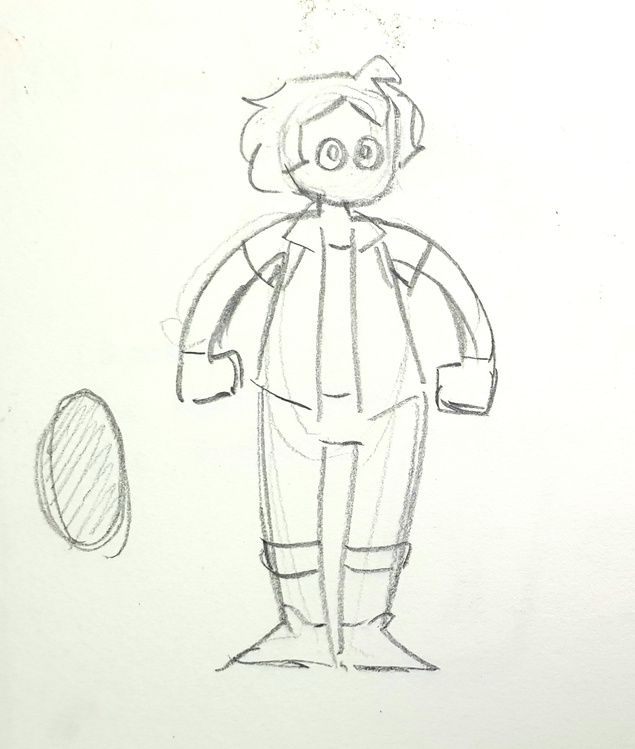
Oval:
They look quite cheerful and friendly, but the stance makes them look extroverted.
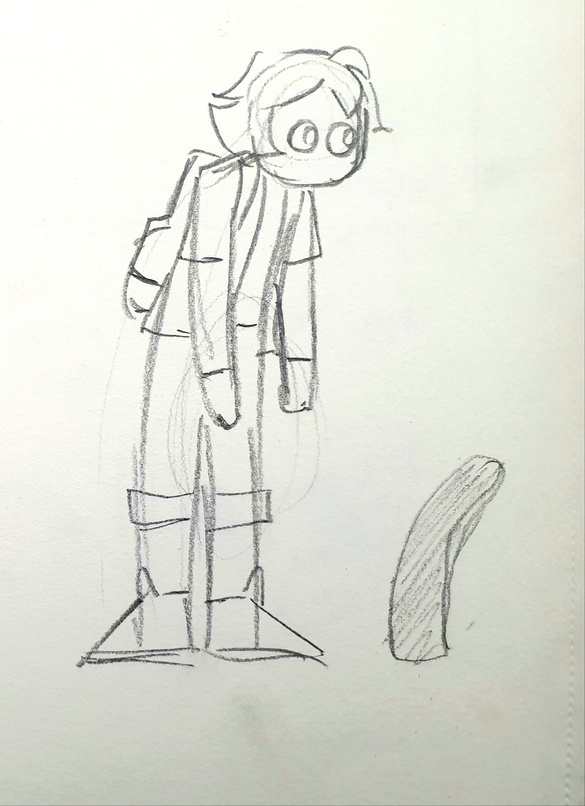
Curved shape:
They look much more fluid, but also quite tired.
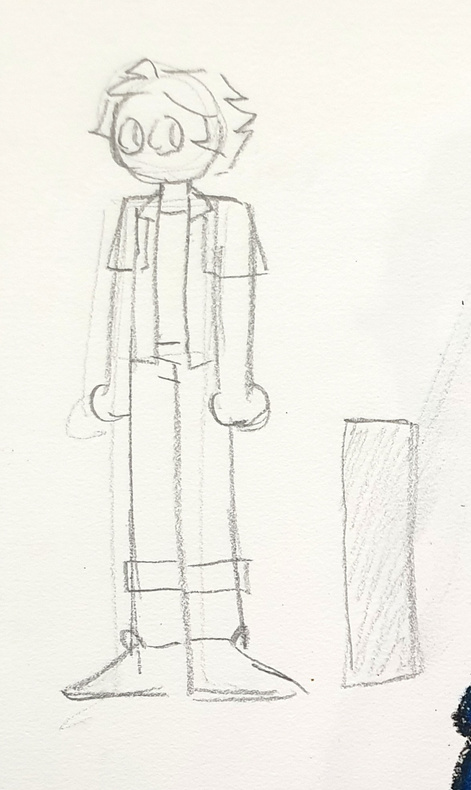
Rectangle:
They look very rigid, uptight and nervous.
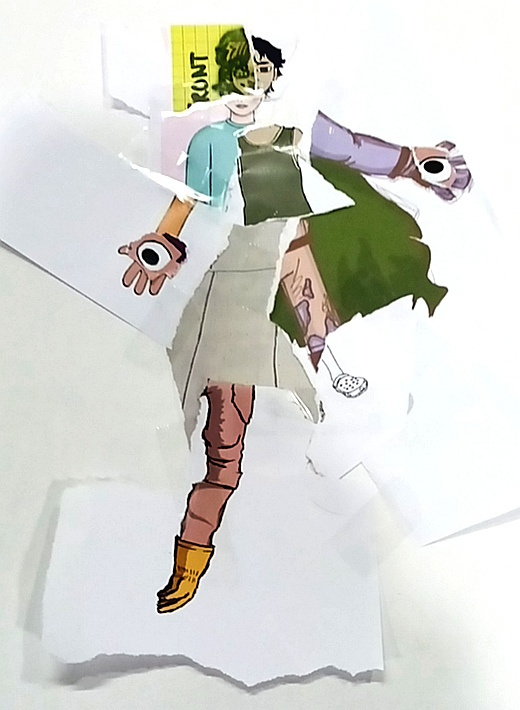
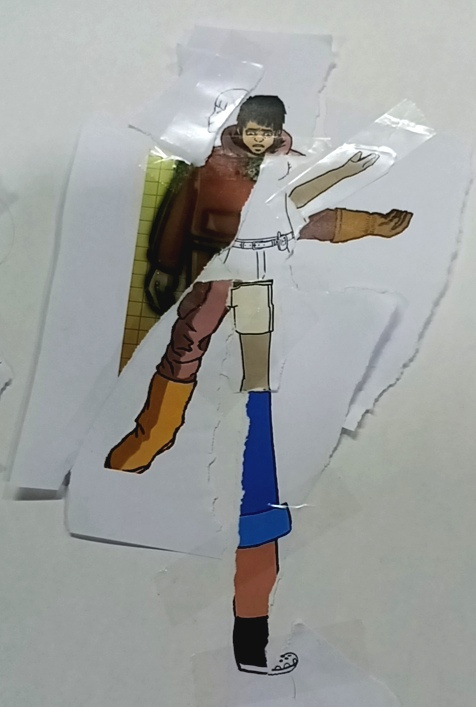
I then tore up my character and made a collage using it and other animators' designs, to create a new character. This was to prevent us from getting attached to our current design.
Some new characters, collaged out of lots of different designs
Context | How to Solve Problems
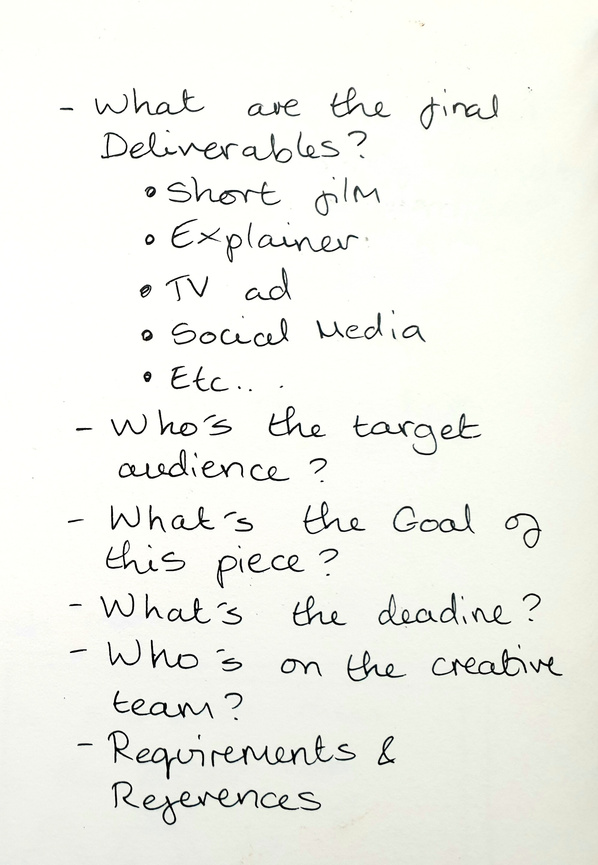
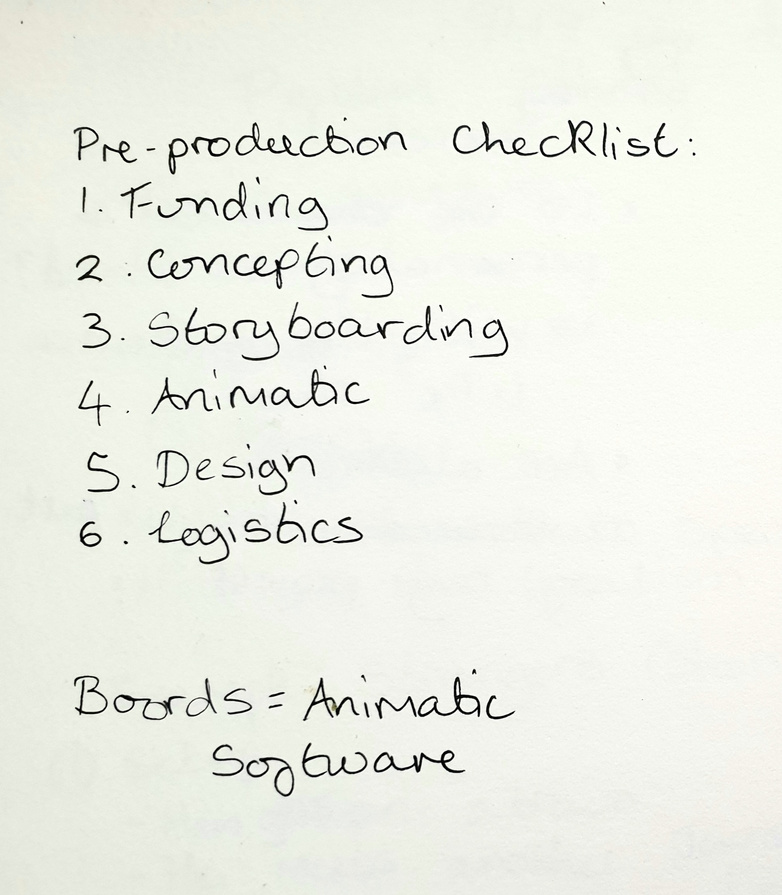
Classnotes on pre-production for animation
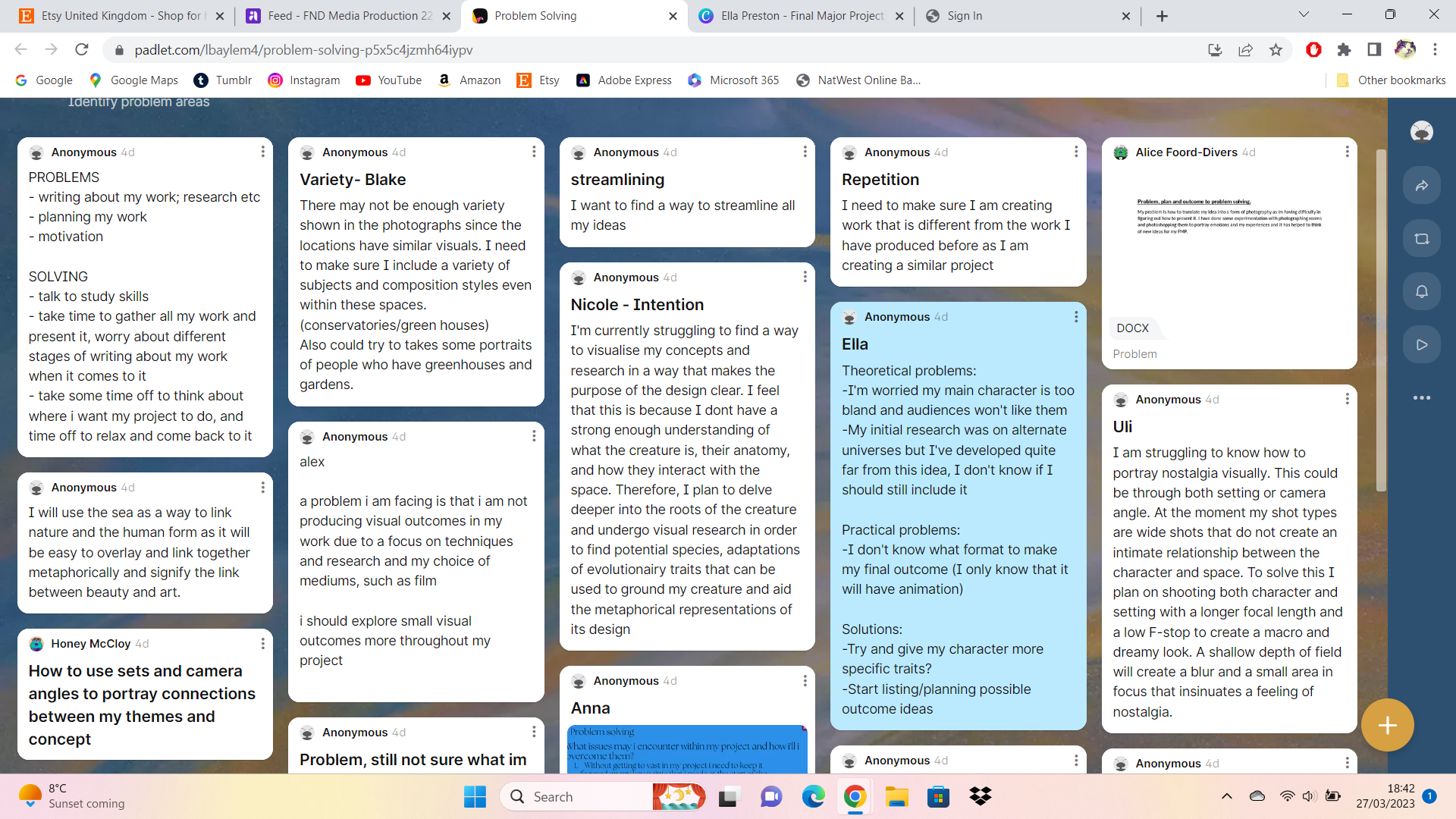
Classnotes on problem solving
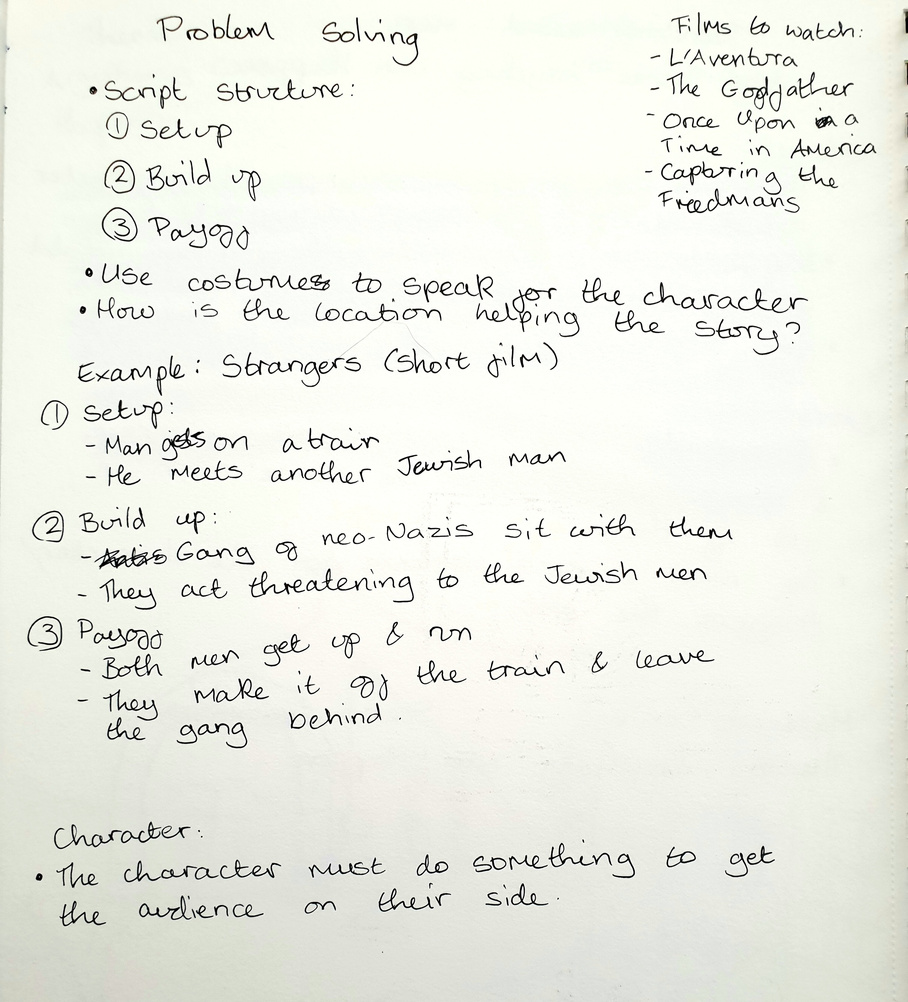
I made notes on the problems within my project, and how they could be solved
Planning, Production & Problem Solving | My Final Outcome
Since my final outcome is no longer going to be an animated film, I needed to narrow down what I was going to make instead. I wanted to make my idea into a game format, so I started to evaluate the best way to do this.
Idea 1:
The story is told in the format of a pick-your-path zine, that also has digital elements: you scan a QR code in the zine which presents a short animation showing the character's situation. The animation then tells you which page of the zine to go to in order to make the next decision.
Rough sketch of my idea
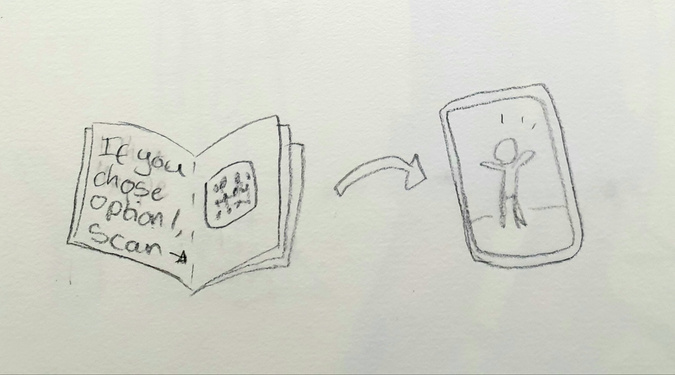
Pros:
- Allows me to bring physical media into my piece
- Makes my idea more unique and exciting
- I don't need to know game coding to create it
Cons:
- The zine may take away from the story; it allows people to skip ahead in the story or go back if they make a mistake. I want my game to reflect the high stakes of everyday life, where you can't do these things
- Needlessly complicated - will be more annoying to use than if the whole game was online
- Illustrating the zine will give me more work
Idea 2:
I use a randomiser to select a story route from my flow chart, and animate this. This one story will serve as a tutorial or demo game for how the game would work, with each choice and outcome included in the video.
Rough sketch of my idea
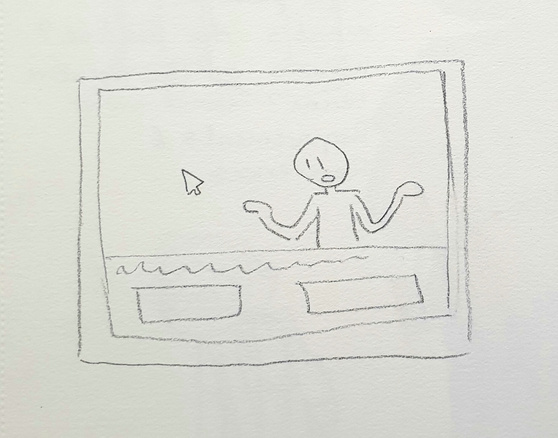
Pros:
- Allows me to show my full idea without having to animate the whole thing and then code it.
- Lessens the amount I have to animate.
Cons:
- I feel that only showing 1 storyline takes away from my idea about the many choices in life.
Idea 3:
I animate and code the first choice (i.e. bus, train or walk) in the story only. This would act as a preview or taster of my game.
Pros:
- Manages to present my theme/moral without having to show the whole story/game
- Gives me less to animate
- Combines my first two ideas
Cons:
- I will have to learn how to code or find a website to host my game.
- I'm planning on changing the art style depending on what choice the player makes - this will be difficult to show without going deep into the story.
I've decided to produce idea 3 because I think it conveys my themes the most effectively, while still being doable. The smaller work-load will also allow me to complete each animation to a higher standard.
Practical Skill & Problem Solving | Makers Morning
How did my testing help solve any problems?
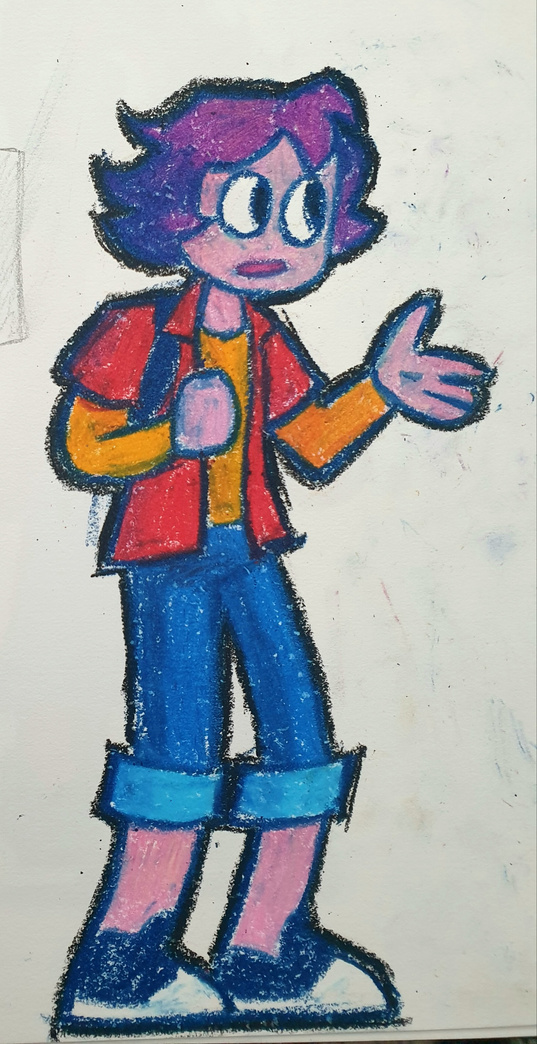
I drew my character in oil pastels to see how they would look in an analogue medium. This is because I want to include a variety of media in my outcome. I also tried to build on my character designs inspired by shapes, and give my character a more interesting pose. I think this pose makes my character look a bit anxious, which isn't what I was going for, although the pose itself is more natural.
Oil pastel drawing of my character
Practical Skill, Planning & Production | Animation Testing
Oil pastel drawing of my character, which I turned into a transparent PNG
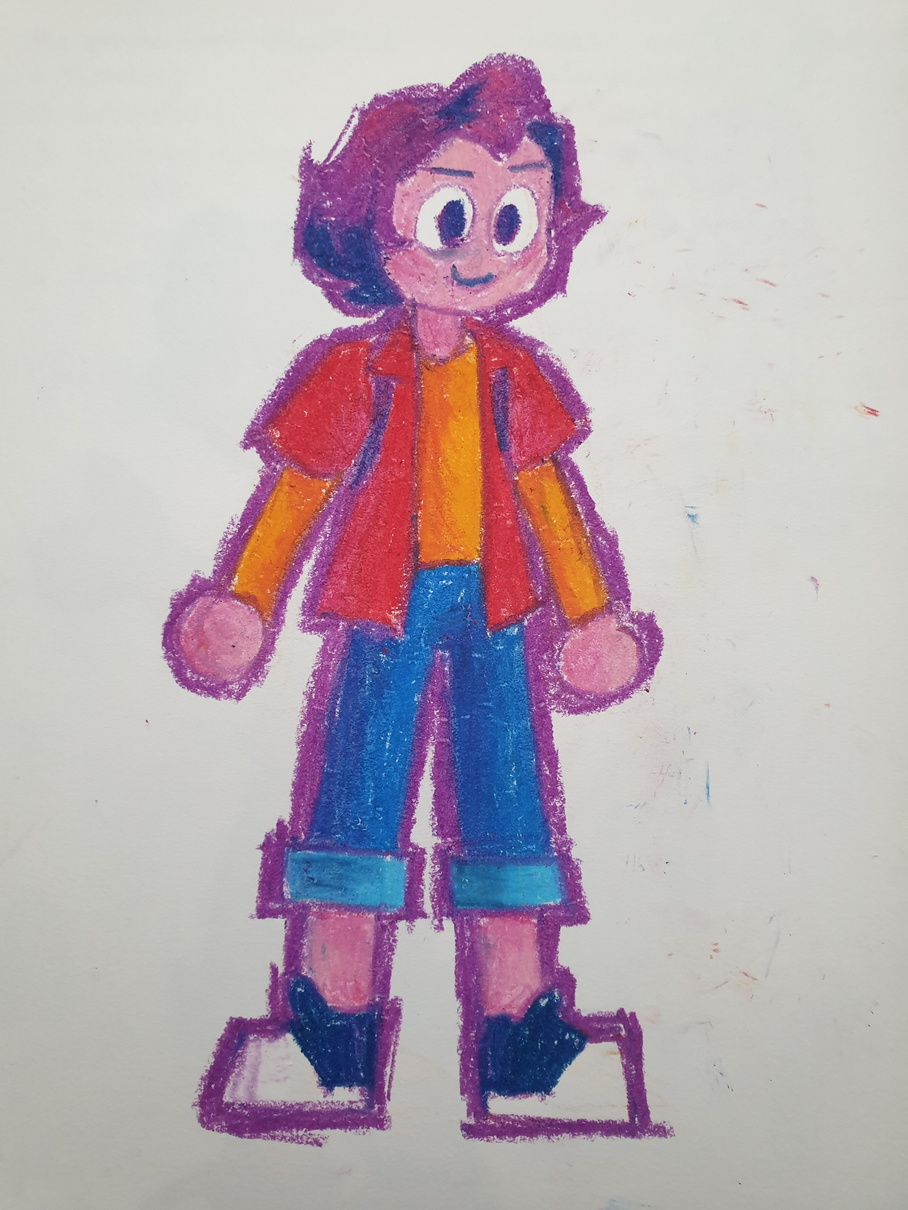
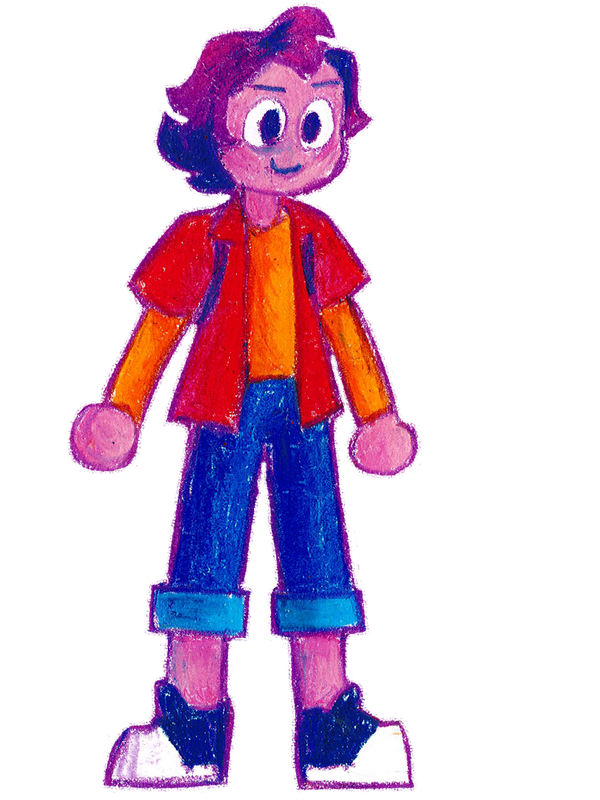
Since drawing my character in oil pastel worked well, I decided to do an animation test of it. I did a new drawing that would be easier to rig, scanned it (which made the drawing much more vibrant, which I liked) then set it up in Adobe Animate.
Screenshot of my character rig in Adobe Animate
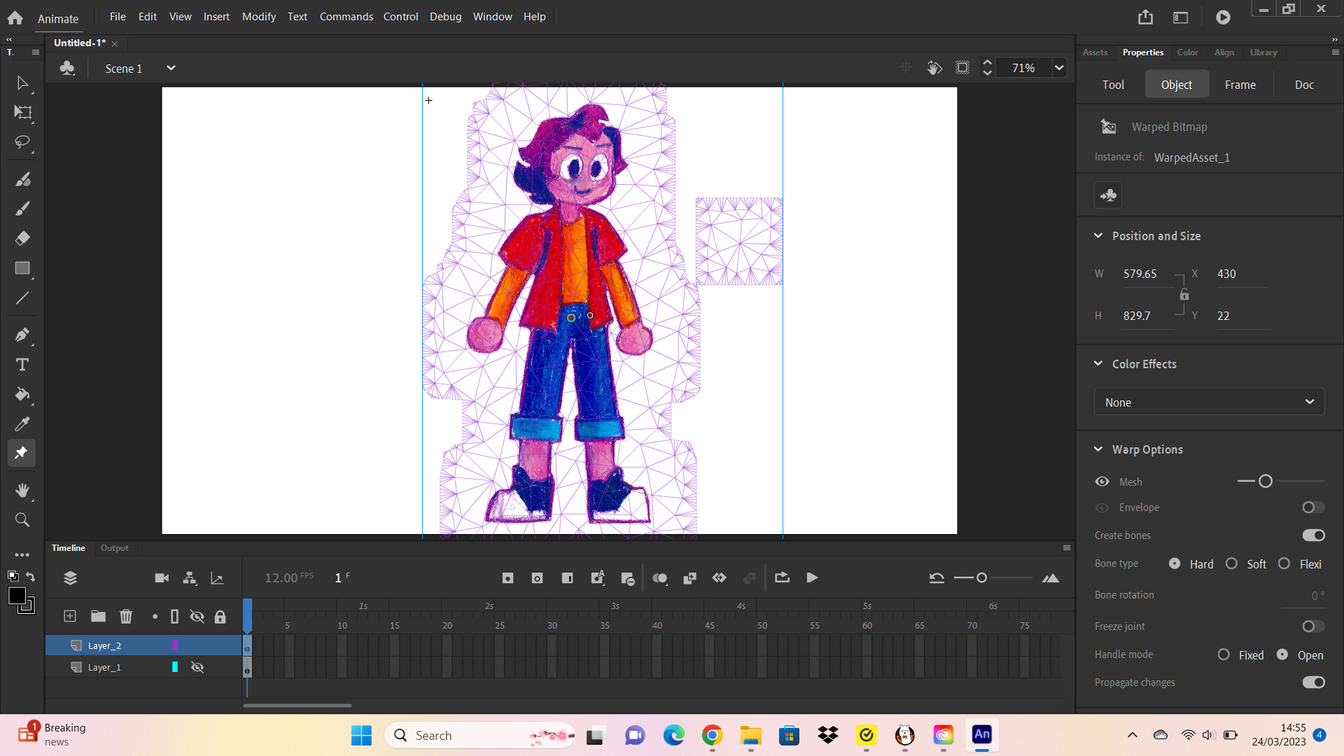
Unfortunately, this test was unsuccessful. The program couldn't recognise the silhouette of my character (even though the image was transparent) and set up the rig all around the character - this meant I couldn't animate them. This process has previously been successful for me, but in this instance I couldn't get Animate to work. This means I may have to find another software to animate my final outcome on.
Planning & Production | Developing my Character
I answered a set of questions about my character, with the intention of fleshing their personality out a bit more. Questions were found on weaver-of-fantasies-and-fables (Tumblr, 2022)
What is your character’s favourite food and why?
Garlic bread, because it's comforting and tastes good
Does your character indulge often in the things they like?
Occasionally, when they feel they've earned it.
What makes your character’s skin crawl?
They're not a fan of social medias like Instagram, where people constantly share what they're doing.
What is your character’s fondest memory?
Growing up, when their family got a puppy
Is there something your character deeply regrets from their past?
They have a few regrets, but they usually try to stay focused on the present and not dwell on the past
If asked, would your character say they were happy as a child?
Yes, although they used to worry about what they'd when they grew up
What were your character’s favourite and least favourite parts of their education?
Their favourite part was hanging out with their friends and studying together, their least favourite part was exam pressure.
Who are your character’s most important people?
Their friends
Who would your character consider as part of their family?
Close friends that have always been there for them
What is your character’s relationship with their parents/the people that raised them?
They're not super close, but they have a good relationship.
Does your character have many friends? Best friends?
They don't have tonnes of friends, but they do have a close group.
Does your character have any significant others?
No
Does your character have trust issues?
No, but they aren't too naive either.
What is your character most afraid of?
Never achieving anything
Does your character have any pets?
No but they would like a hamster
What do they like about their appearance?
Their sense of style
Do they play any musical instrument?
They used to play the guitar, but gave up
Pronouns?
They/them
This activity helped me think more deeply about my character, and I can refer back to it when I write them. However, I don't think I will adapt their design too much based on this.
Planning & Production | Storyboarding
First part of my storyboard
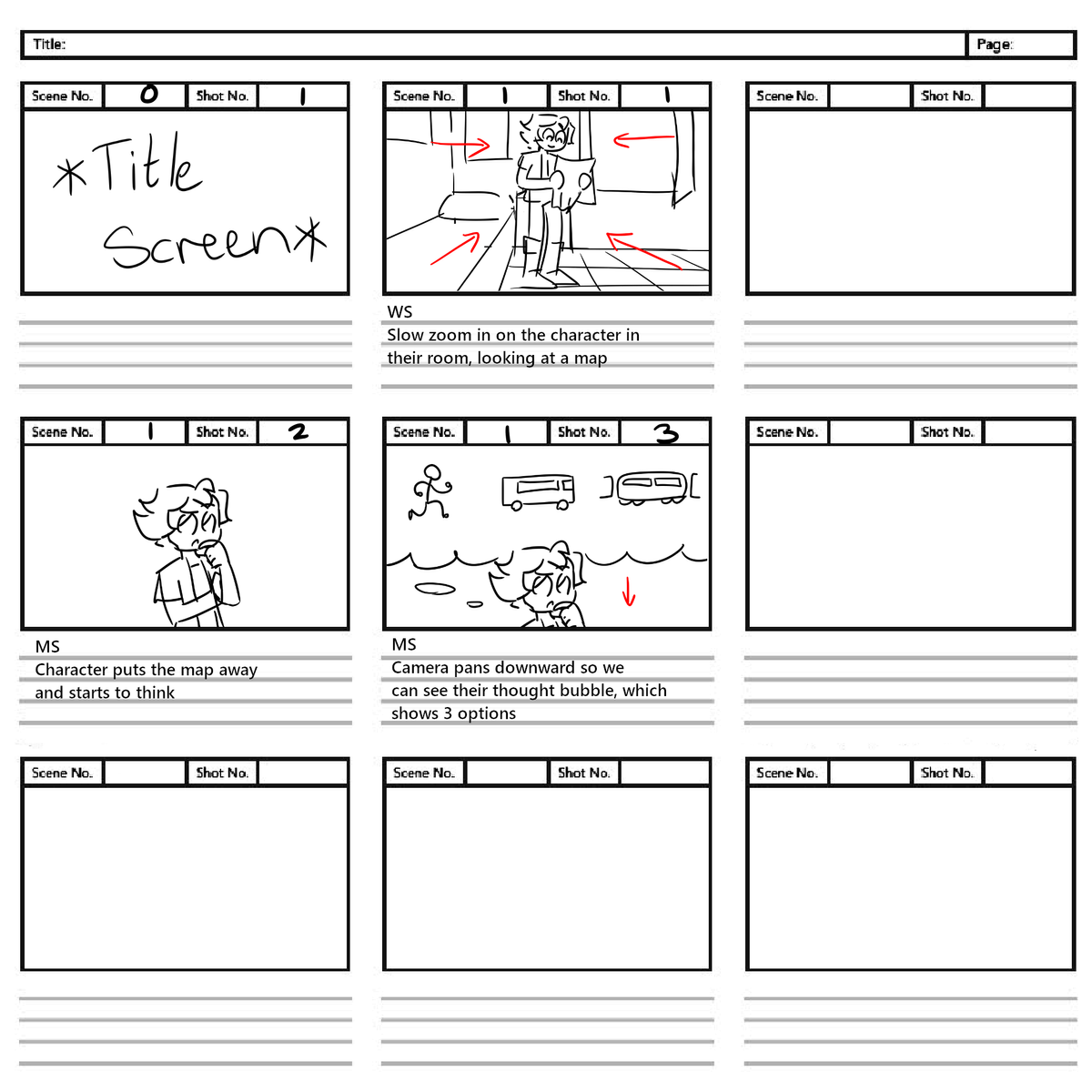
This is the first scene of my game, after which, it will separate into three different storylines. I left the title screen in asterickses because I plan on doing various designs for it later.

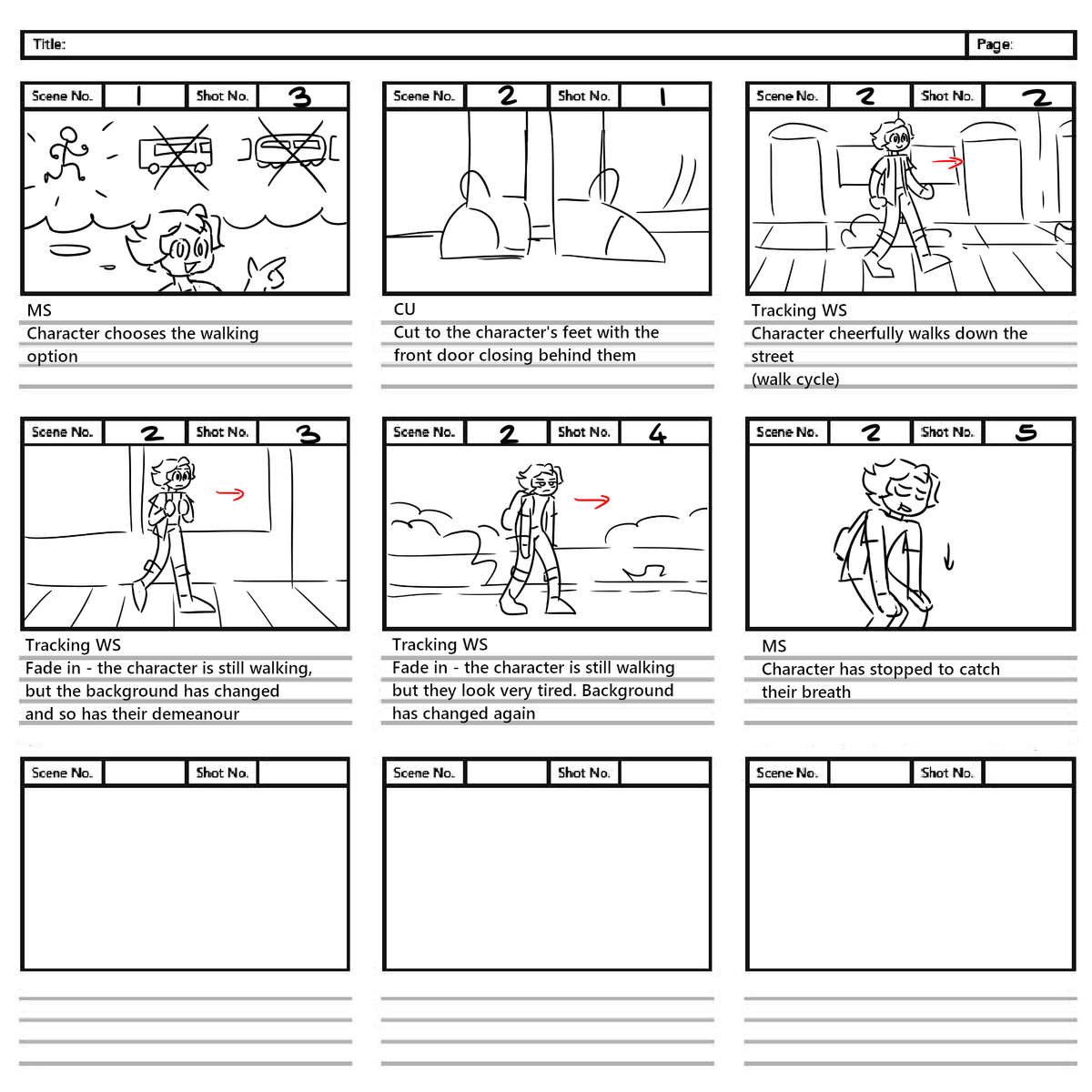
The story option where the character walks
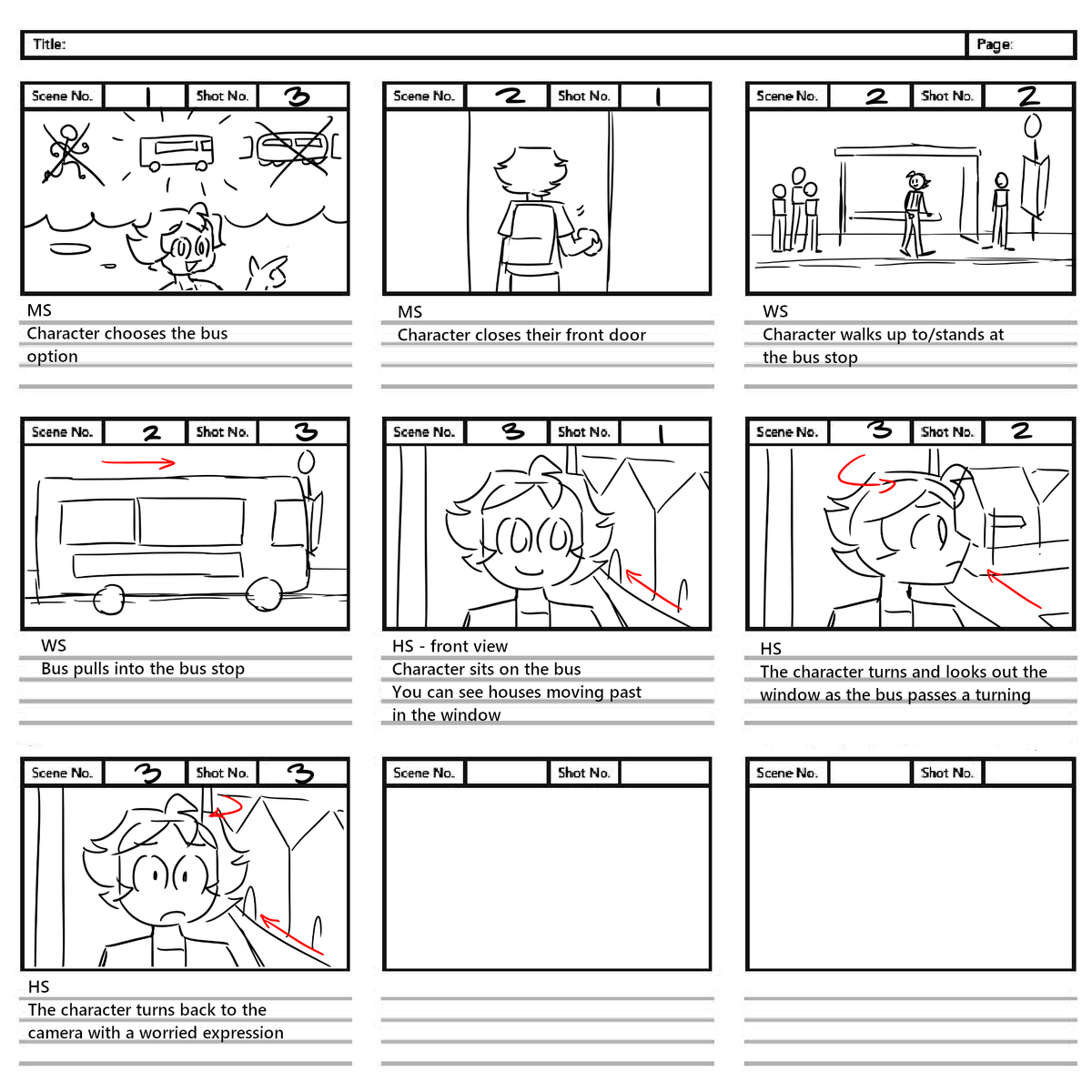
The story option where the character gets the bus

The story option where the character gets the train
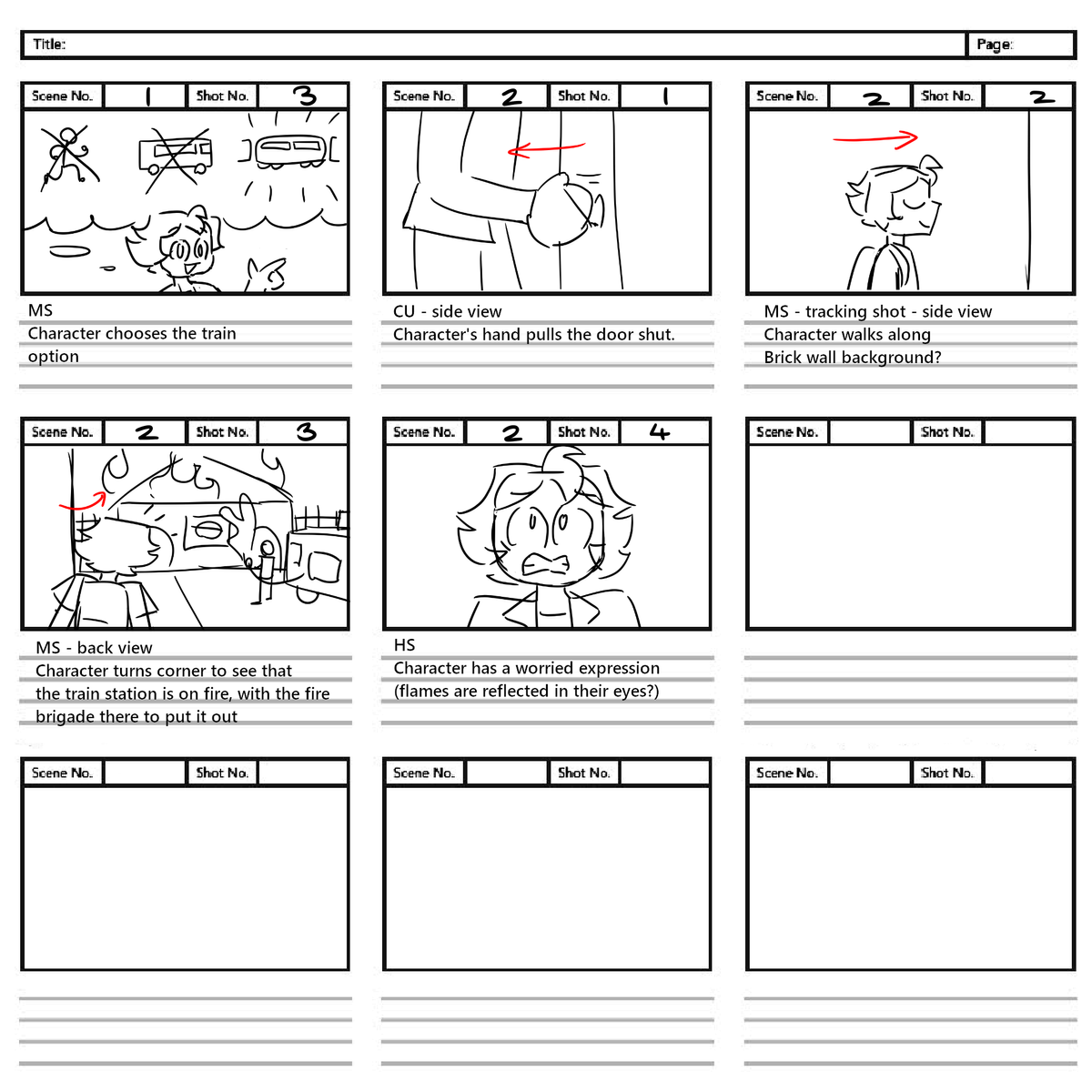
Each option here would end with another decision, which would lead to more story routes. However, since I'm not going to animate the whole game, all possible decisions will just lead to an end screen.
Evaluation | Talking Mornings
So far, my project has been going quite well, although it has undergone a lot of changes. I've currently been making storyboards, which are useful because they've allowed me to gauge how much animating work I will have to do.
So far I have been on track of my work schedule, and would like to continue with this pace during the second phase. I also hope that I can figure out how to make Adobe Animate work, or else find a new animation software.
What do I wish I'd done differently?
Now that I've changed my idea from a film to a game, I wish I'd done more research to reflect that. My idea has also developed so much that alternate universes are much less relevant in it.
How will I change my next steps?
I would like to still include alternate universes in my final outcome, but their presence will have to be much more subtle. I will also do more clean, finished animation tests, so that I can start to estimate how long animation will take me.
Practical Skill, Planning & Production | Character Tests
Expression and art style tests for my character
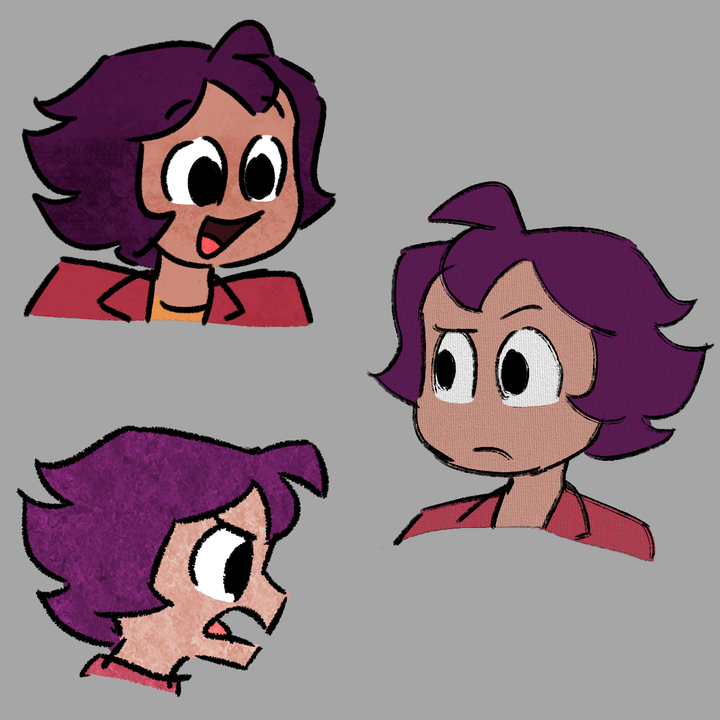
Having designed my character, I started to do expression tests for them. I also experimented with different textures for them, since the art style for each option will be different. I struggled with this idea because I want the character to look significantly different, but I also want the art style to be easy to animate.
I think the style in the bottom left corner was the most successful because it achieves both these things. The colours in it are also the most consistent.
Planning & Production | Title & End Screens
Since my idea is now in a game format, I had to design title and end screens for it.
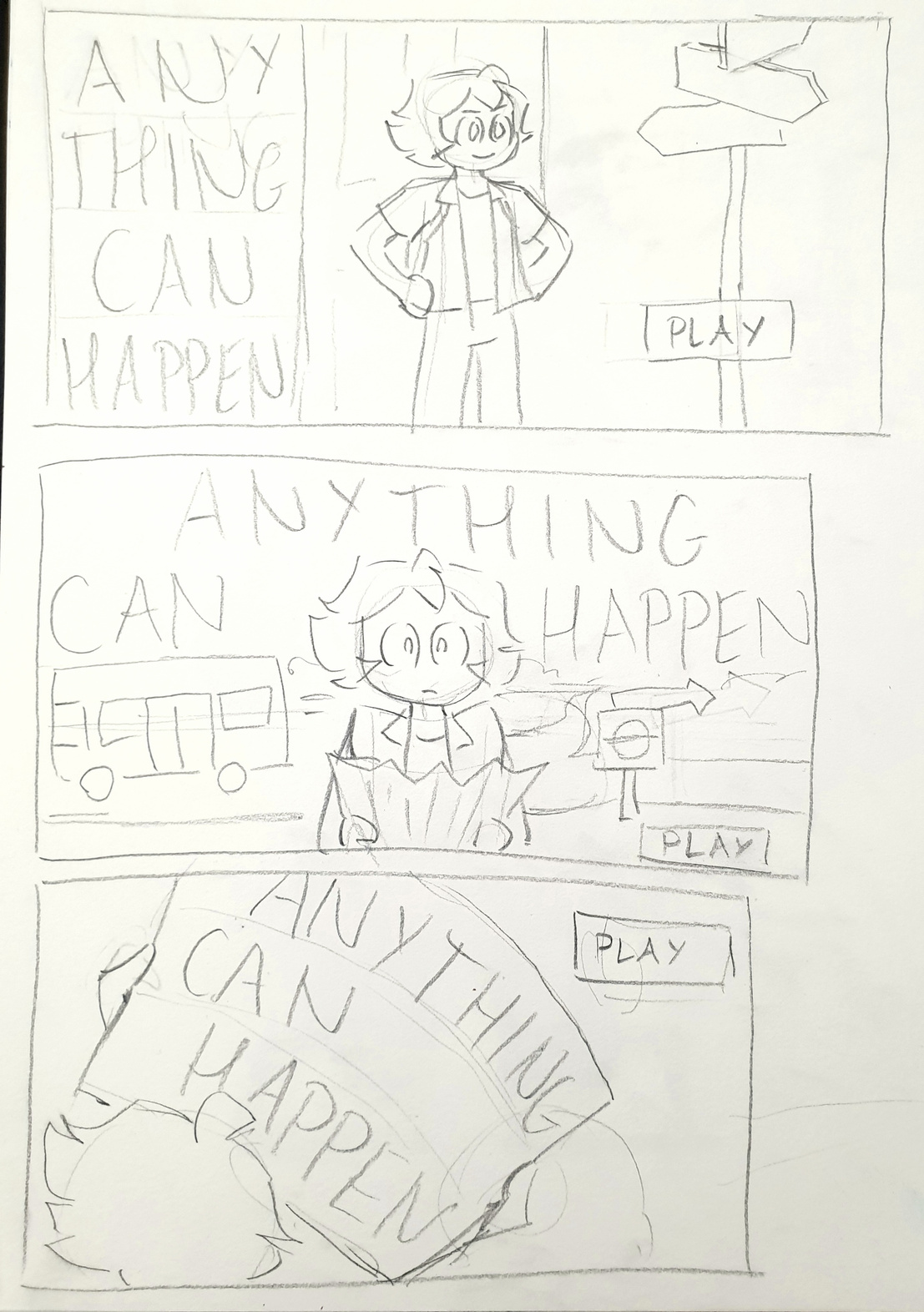
Idea 1:
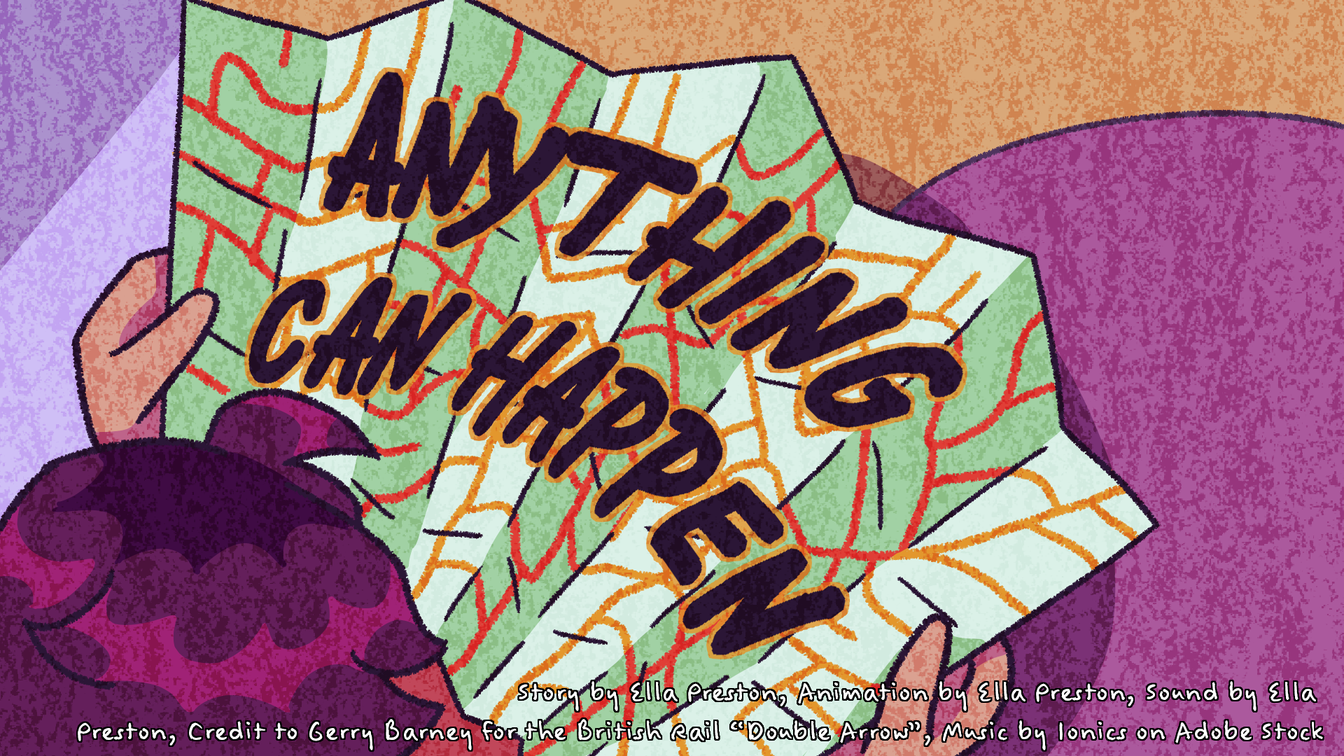
View from above the character looking at a map, which reads "Anything can happen". This is the same map that they look at in the beginning of the game, and the letters in "Anything can happen" are in mismatching fonts, to reflect what they're saying. I like the simplicity of this idea
Idea 2:
The character stands looking at the camera with a worried expression, holding their map. In the background, elements of the story can be seen (a bus, a train station). I would try to draw this one using the multiple art styles in the game.
Idea 3:
I thought my character in idea 2 looked too worried, so in this design, I tried to give my character a more confident stance. The signs on the right indicate the decisions the character has to make. However, I don't this the composition of this design is as successful.
Significance of the map:
At the beginning of the game, the character is looking at a map, which tells the viewer that they have a specific destination in mind where they want to go to. However, at each different story end, the character throws away or scrunches up their map, suggesting they no longer want to go there and are content to stay where they are. Although I'm not actually animating any of the story endings, I thought it was important to make a note of this. This is also why I chose to feature the map on potential posters for the game; it's an important symbol in the narrative.
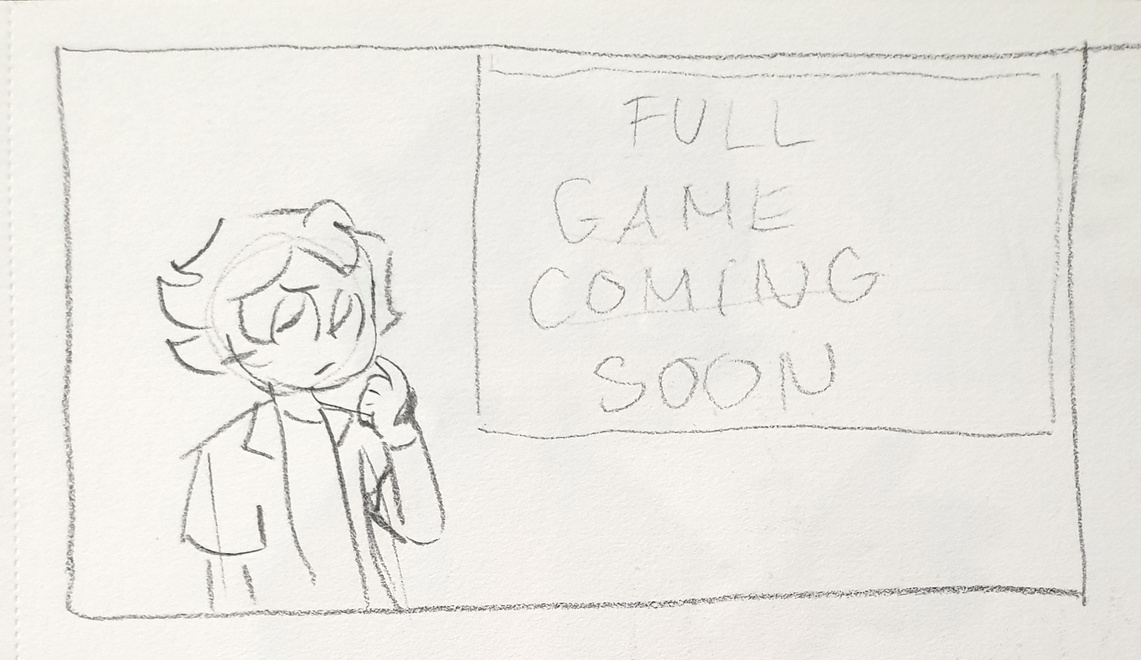
Since I'm not creating the full version of my game, I'm going to create an end screen that will say "full game coming soon", "end of demo game" or "buy the full version of the game" (I'm not sure which message will be the most appropriate yet)
Idea 1:
The character stands thinking, with the message to the right. I'm not very happy with this design as I feel it's too simple.
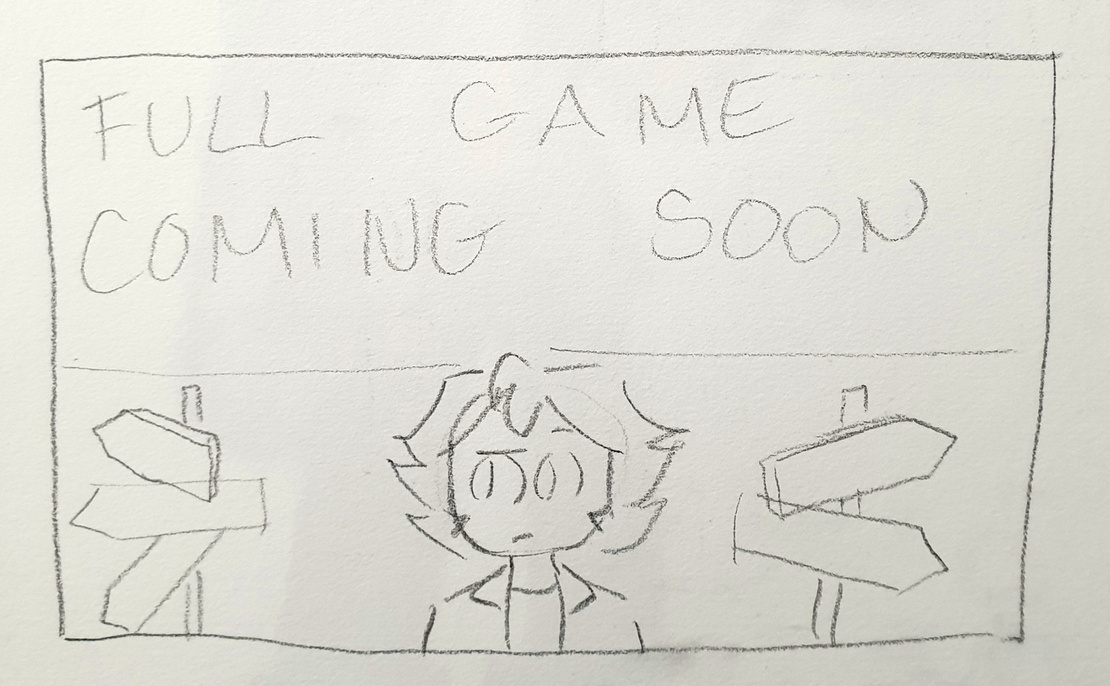
Idea 2:
The character is surrounded by signs going in different directions, which represent the different choices they can make. I thought this design would be easier to incorporate the game's different art styles into.
I don't particularly like either of my end credit designs, however I think my first two ideas for the start screen were the most successful, so I think I will use one of them as an end screen.
Planning & Production | Animatics
Intro to my game
After watching this clip, the player will get to choose out of the bus, train or walking options, which will take them to the corresponding animation.
Travel by bus option
Travel by train option
Travel on foot option
These animatics made it much easier for me to visualise how much work I would have to do, how I would animate each section, the timings of my animations, etc.
Planning & Production | Character References
I decided to adapt my character's personality a bit to better fit the narrative. I originally wanted them to be quite confident in their decision making, because I thought watching a character stressing over decisions would not be fun for the viewer. However, in a game format, the character has much more reason to be indecisive because otherwise there would be no need for the player to choose what they should do. I also think this trait will work better with other aspects of their personality - they're very determined to reach their destination and this drive makes more sense when they're held back by their decision-making skills.
(From left to right) Character in the train storyline, Character in the bus storyline, Character in the walking storyline
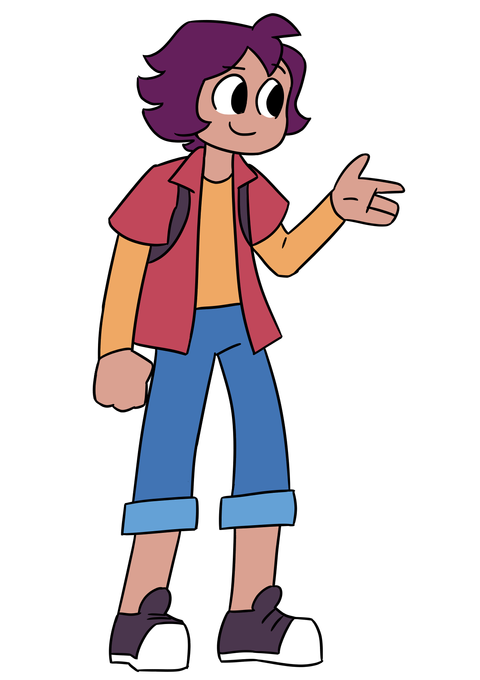
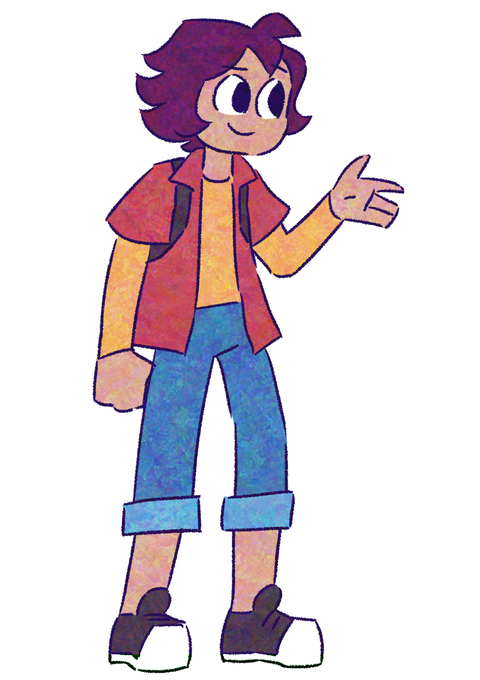
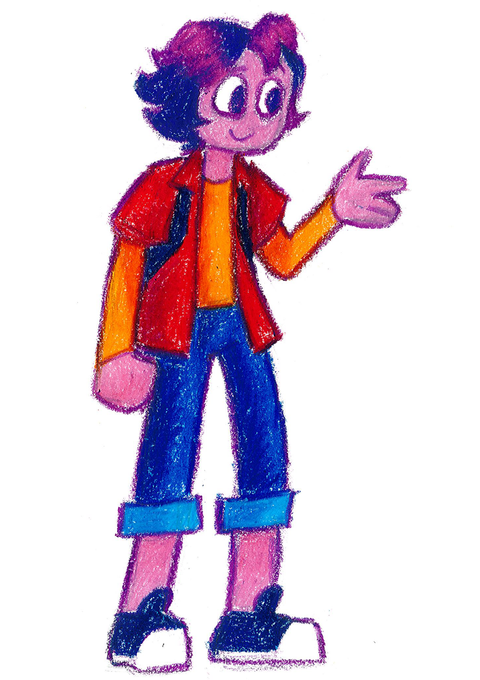
Using this new information, I tried drawing my character in a pose that better reflects their personality. They're slouching more, because of their backpack. The hand at their side is balled into a fist - this is meant to suggest they're determination - while their other hand is lifted in a friendly gesture, showing how they're willing to make friends.
This also acts as a reference for the different art styles I'm going to use in my game. Where each style is used depends on how easy I think it will be to animate.
Planning, Production & Problem Solving | Animation Tests
Walking test - key frames vs finished animation
I did another test on Animate, although this time, I put all the limbs on separate layers, so the character had more of a puppet effect. This was useful because it gave the character much more movement, and I would like to use this technique to make a more refined version of this gif.
]
(from left to right, top to bottom) The process of creating my gif:
rough sketch, then key frames, then different attempts at making the walking smoother
To make this walk cycle more realistic, I started by drawing the key frames of a walk cycle. I then used this as a guide for positioning my character. After I had all my key frames, I used Adobe's auto-tweening tool.
The leg movement looks good, but I struggled the most with the body movement, and keeping it in time with the rest of the limbs. Although I think the final gif is a lot better, the limbs still don't look very attached to the body. I also couldn't get the walk cycle to loop.
These tests will help prepare me for when I have to animate my final film.
Evaluation | Storyboarding
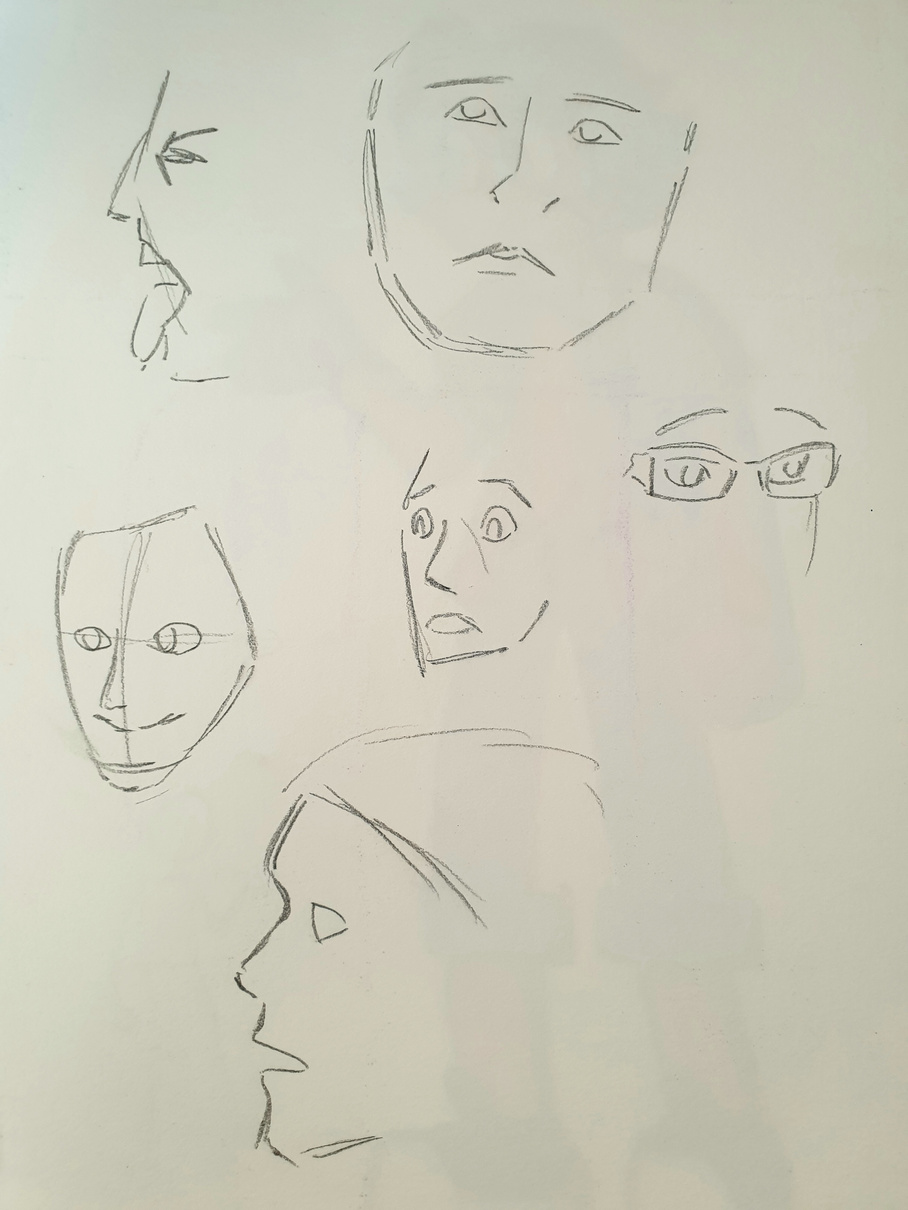
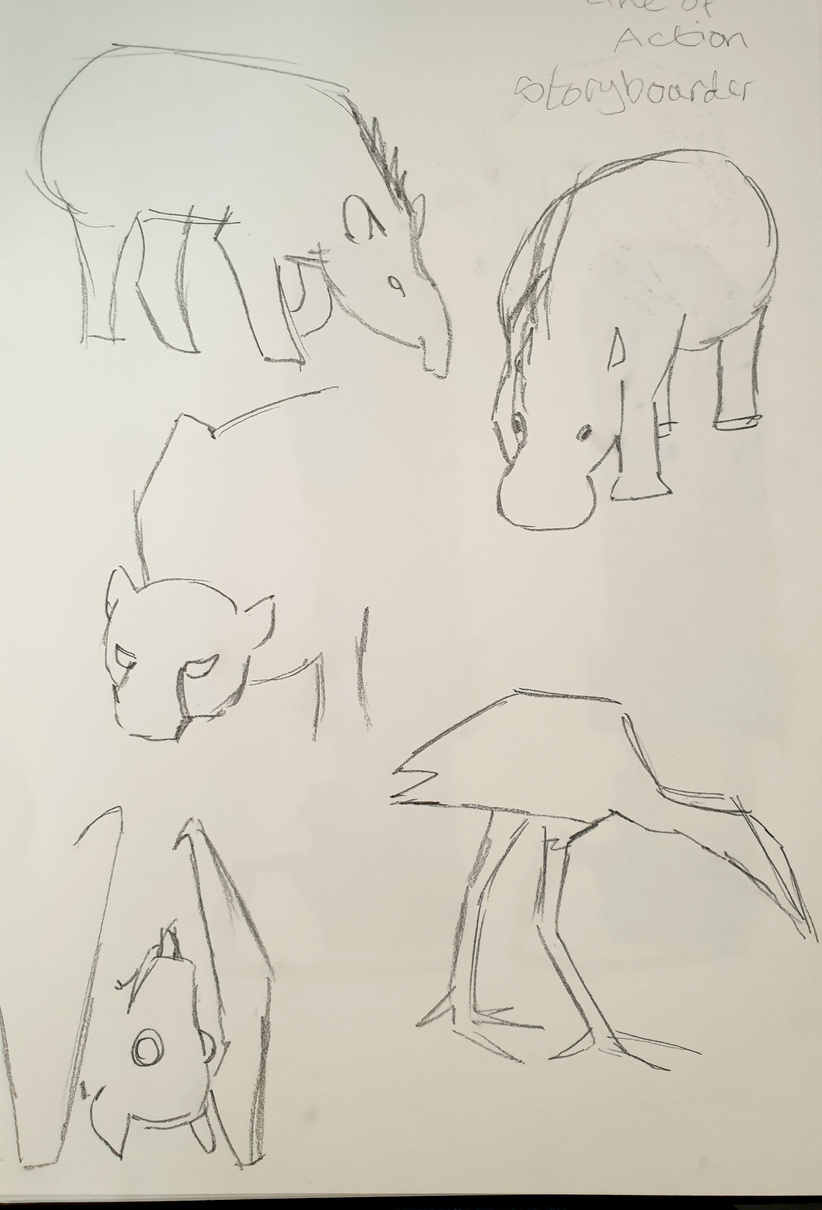
I did some exercises aimed at developing my storyboarding skills. For instance, we took photos then used then to create a rough storyboard.
30 second sketches of expressions and 60 second sketches of animals
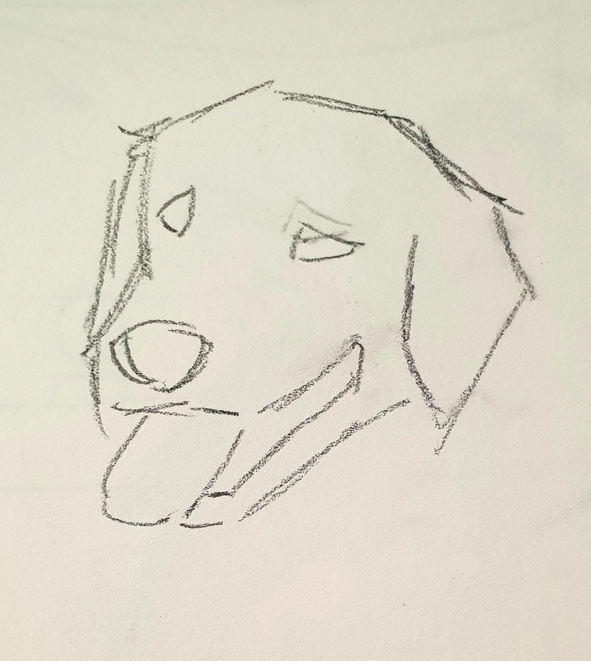
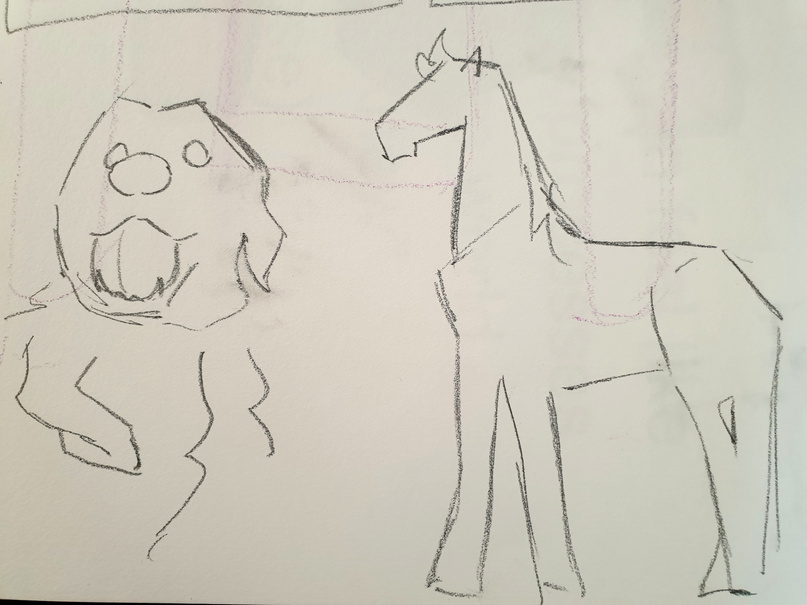
Quick storyboarding exercise using the prompt "spicy ramen" and my photo references
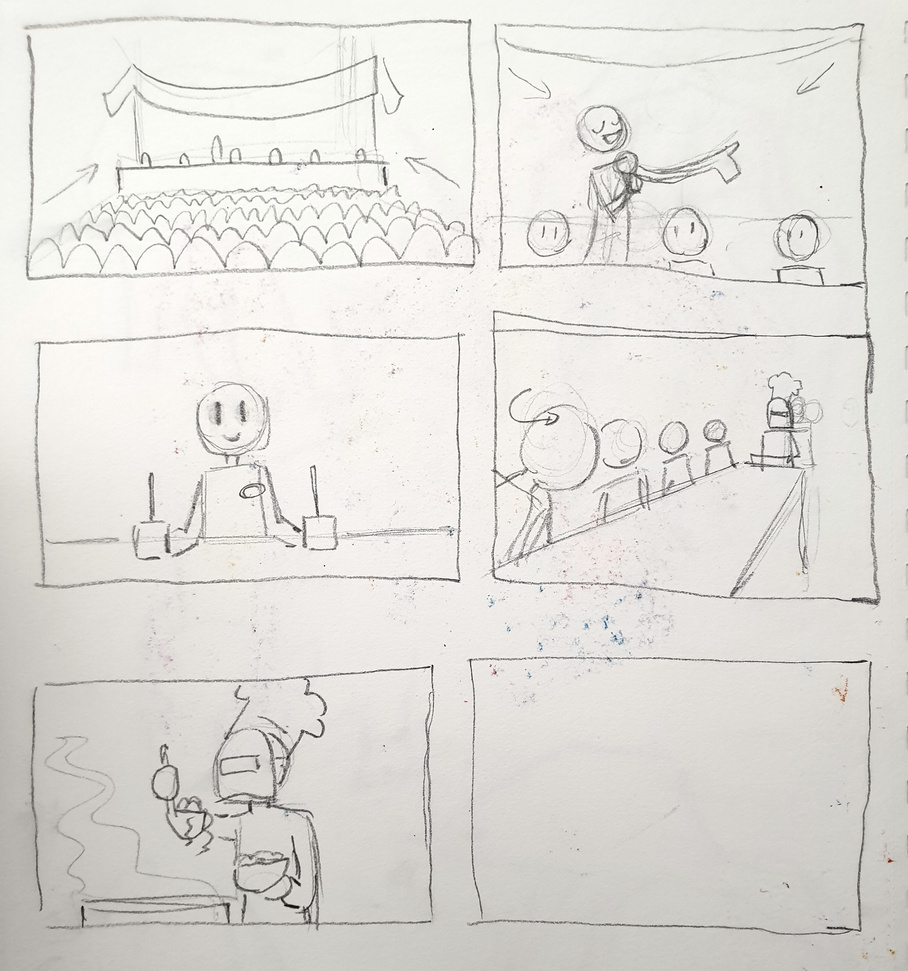
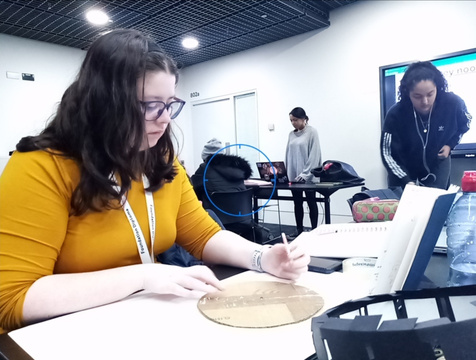
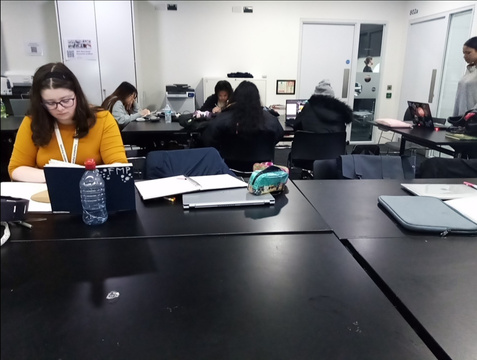
I decided to evaluate some of the shots in my film. I used a 3x3 square grid to analyse the composition of my shots, see what worked well and what I could improve.
Some shots from my animatics that I think were successful
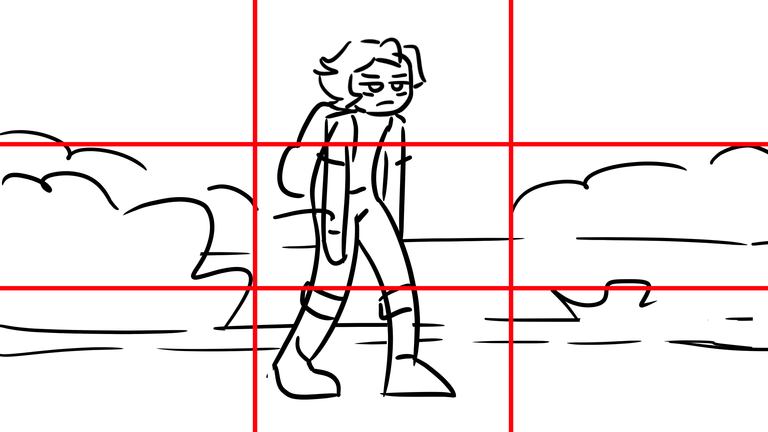
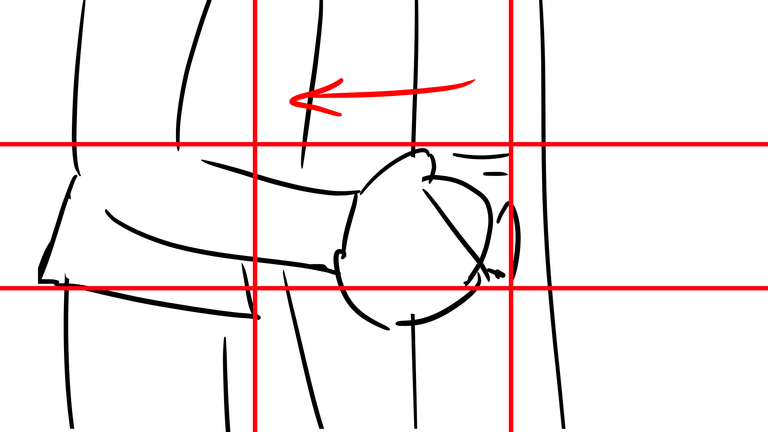
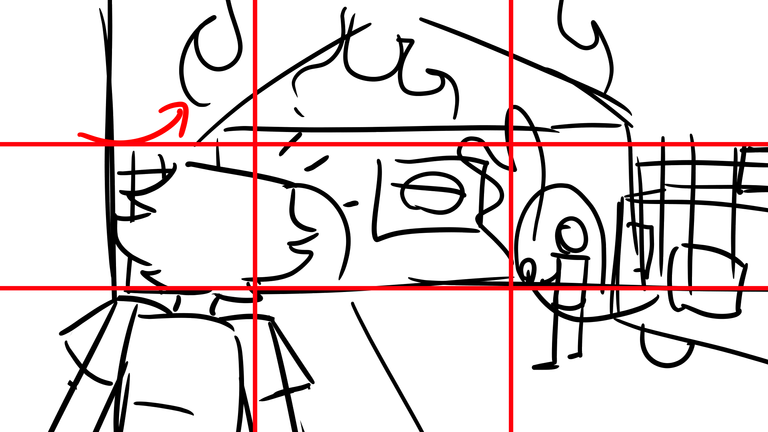
I like these shots because they work well with the 3x3 grid, but also look quite interesing and original.
Some shots from my animatics that I think weren't so successful
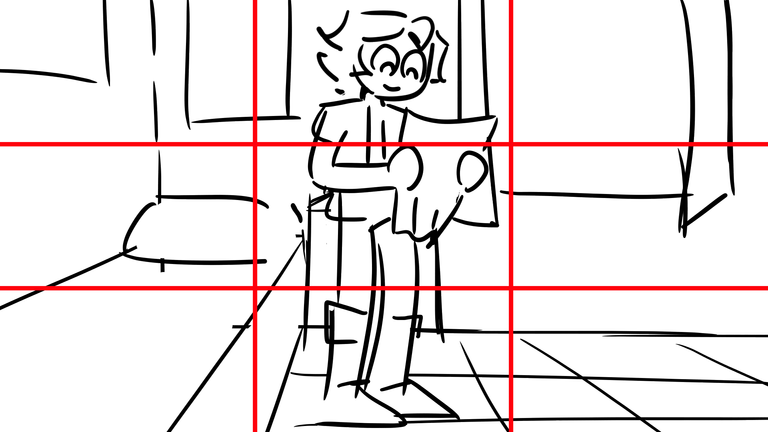
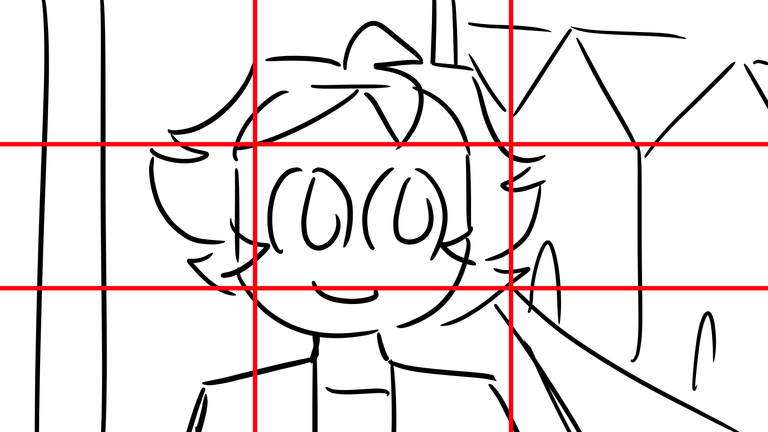
I wasn't as happy with these shots. I think the one on the left fits into the grid too perfectly, and it could be more interesting, while the one on the right centres the main character too much, making it harder to focus on what's happening out the bus window. Using the grid as guidelines, I adjusted these shots to make them more effective.
Improved shots from my animatics
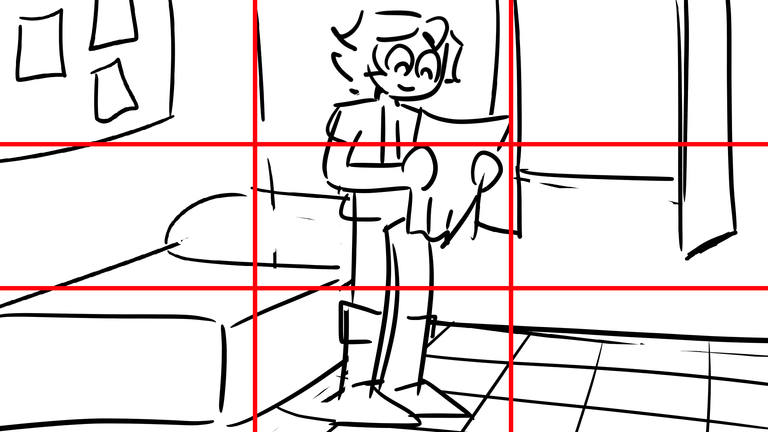
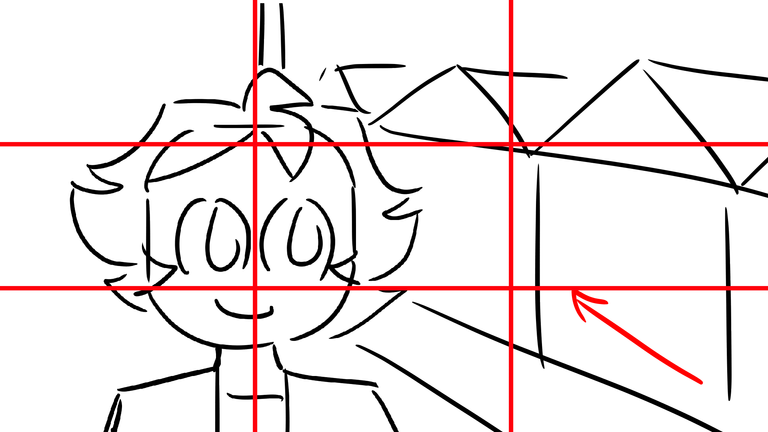
I redrew parts of these shots to make the composition more interesting. For the scene on the left, I redrew the background from a different angle that makes the room feel more immersive for the viewer. In the shot on the right, I made the bus window take up a larger portion of the screen, so that it would draw the viewer's attention more. I think these shots are much better than they were previously, and I will include them in my final animations.
Problem Solving | Animation
Scene from my animation that I made a mistake in (note: timings here are not correct)
I accidentally used the wrong art style to animate this part of the animation (this art style is used in the train storyline, but this scene is from the bus storyline). To resolve, I could either swap the art styles used in each story, or swap the scenes from each story (since each story has a different shot of the character closing their door)
I realised that neither of these solutions would work as well as my original plan, so I had to redraw the scene with the correct art style.
The same scene, redrawn with the correct art style
In future, to prevent these kind of mistakes from happening, I'm going to pay closer attention to my storyboards and plans while animating.
Practical Skill, Planning & Production | Animation
References I used to create a scene of my animation (right: photo of myself, left: screenshots from MagicPoser, a references App)
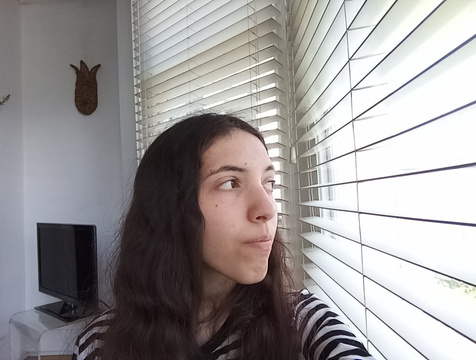
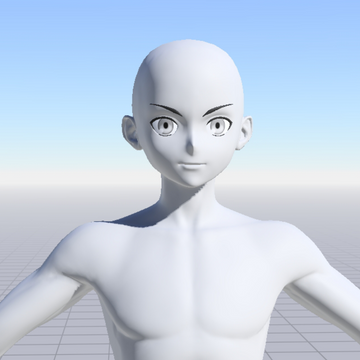
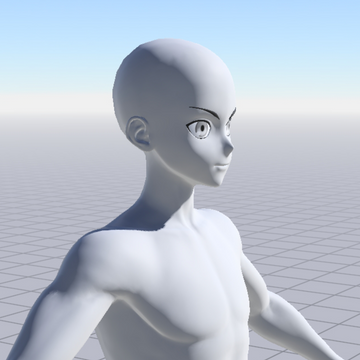
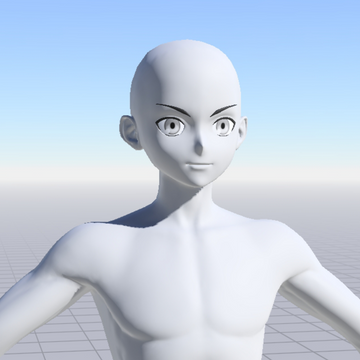
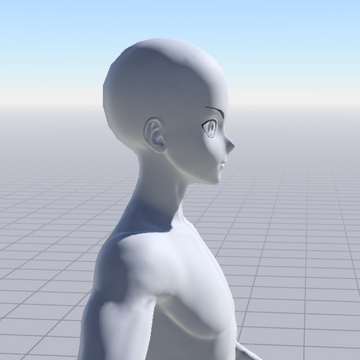
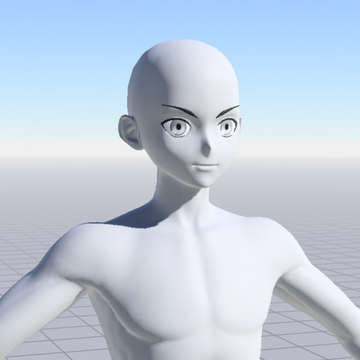
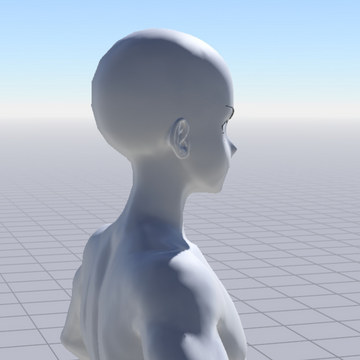
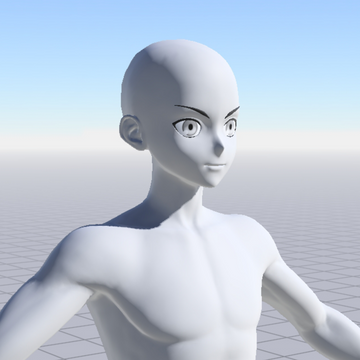
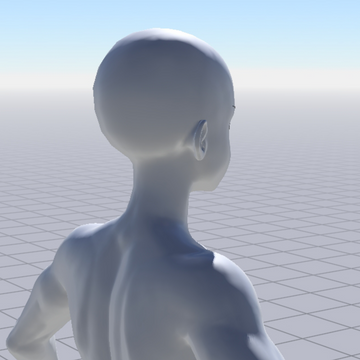
The animation I made using these references
I found this particular scene quite difficult to animate, so I used lots of references to help. The photo of myself helped me place the character in the scene, and the App MagicPoser helped me draw the character's head in different positions. This was successful because it helped me animate this scene.
Problem Solving & Evaluation | Backgrounds
Animated scene from my game (note: colours here vary to colours in final animation)
The background for this scene was drawn using frame-by-frame animation, meaning it was very time-consuming. To ensure that I would finish, I had to draw the houses without any details (like doors and windows) Although this is noticeable, I don't think it affects the overall animation too much, and I intend to go back and draw them in if I have time after everything else is finished.
Problem Solving | Animation
Two shots from my animatics
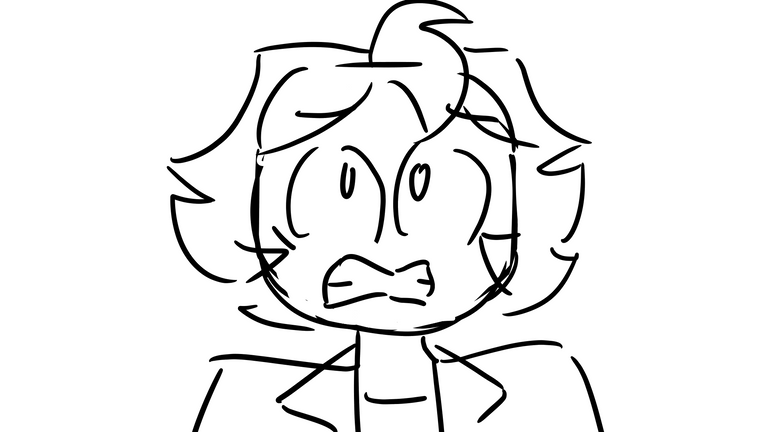
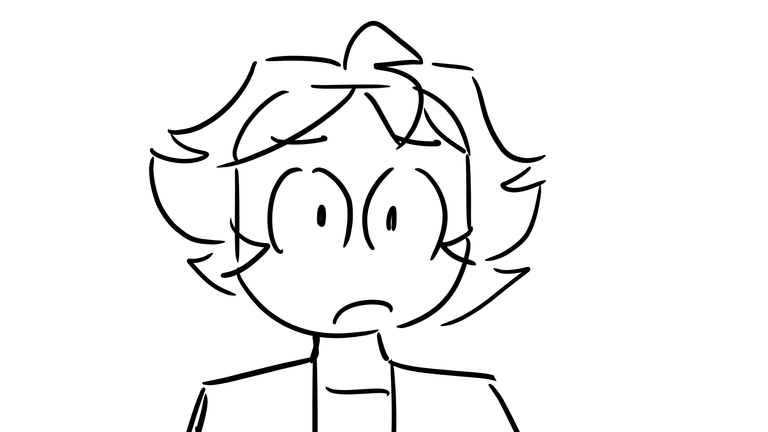
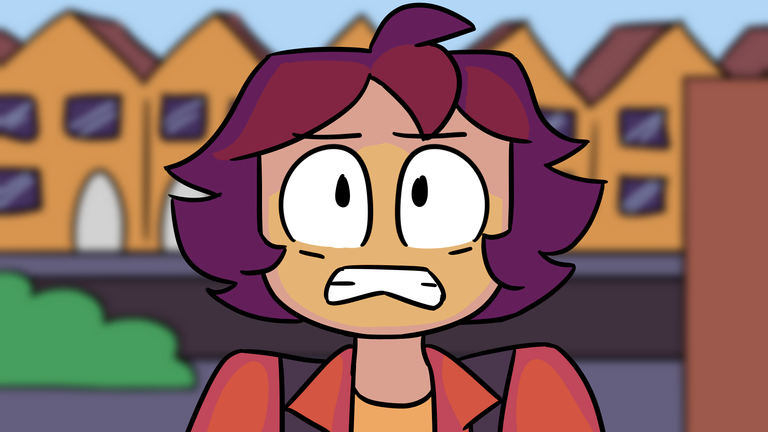
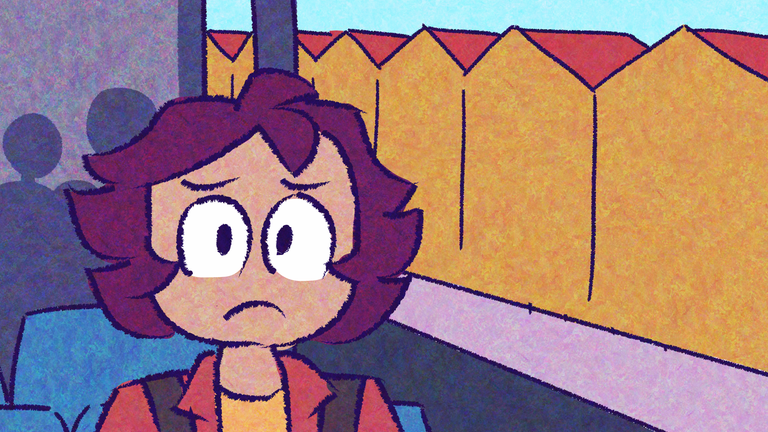
These are two shots from my animatic: the right is the character's reaction to seeing their train station on fire, and the left is the character's reaction to realising they've missed their stop. I was worried that these two facial expressions were too similar, especially since they're used in different situations. When doing the final animation for my game, I tried to make them more distinguishable. Although there are still similarities, I think I was mostly successful in this.
The same shots in my final animations
Practical Skill | Animating with Traditional Media
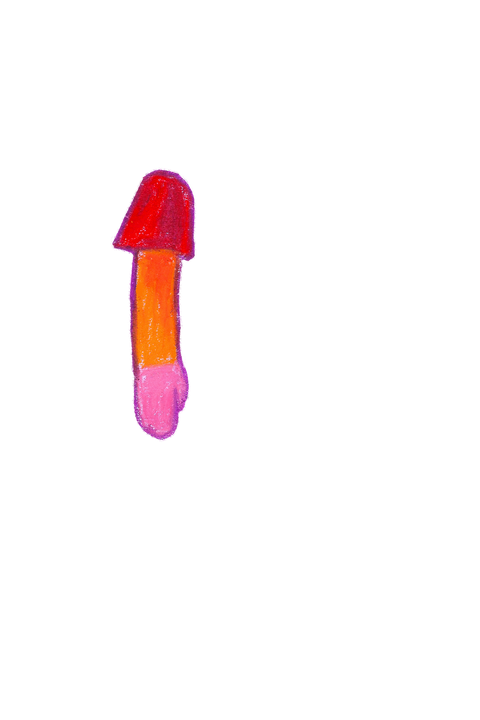
The different elements used in my character rig
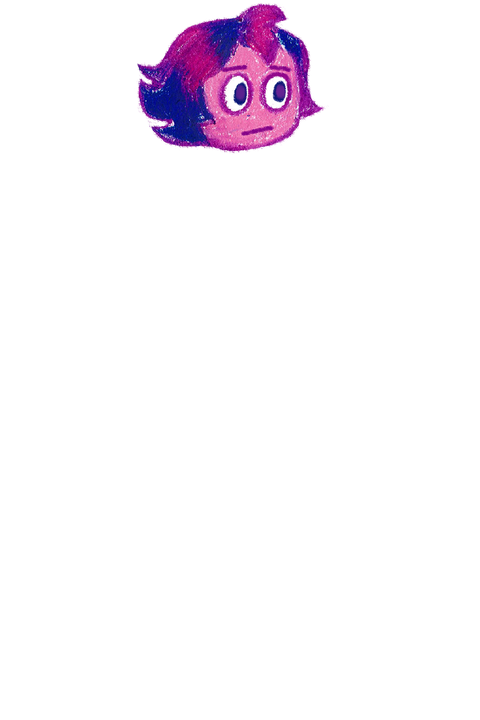
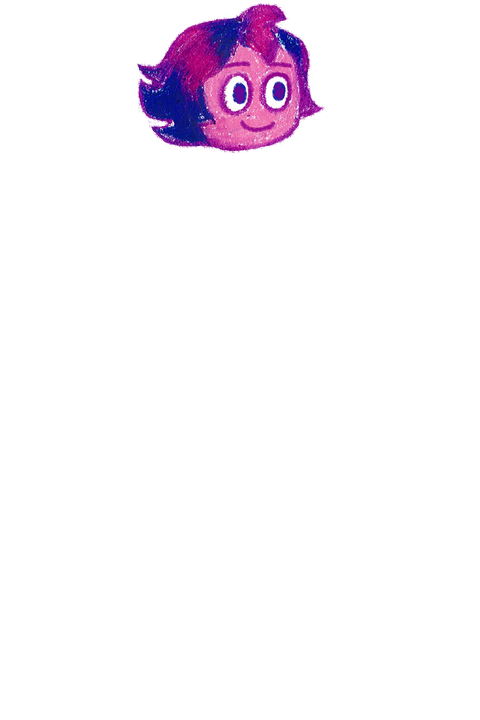
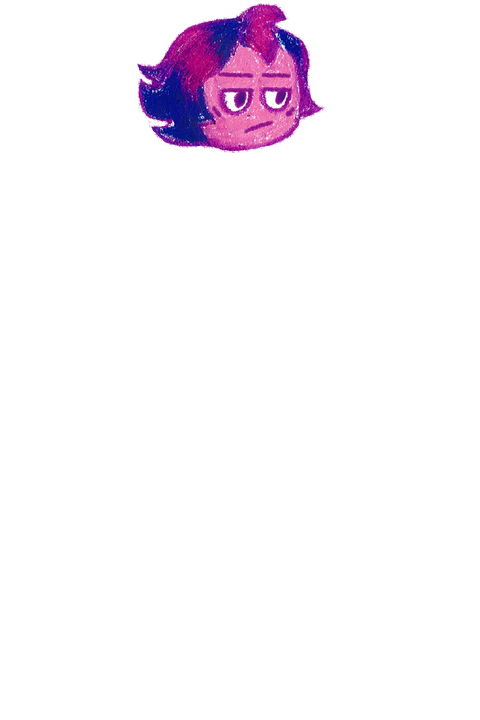
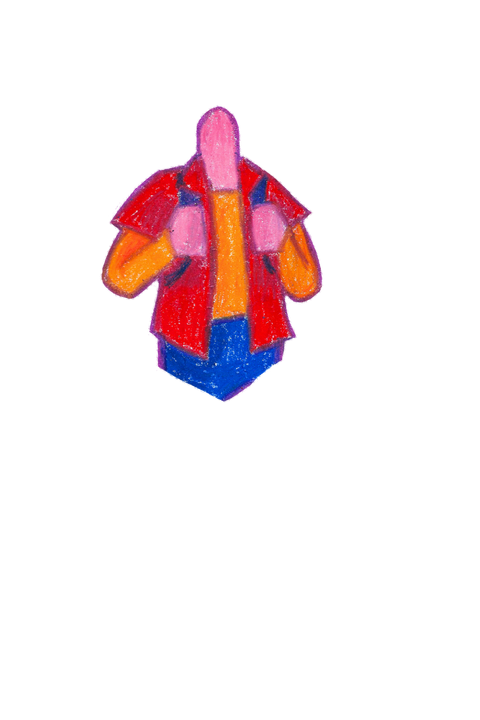
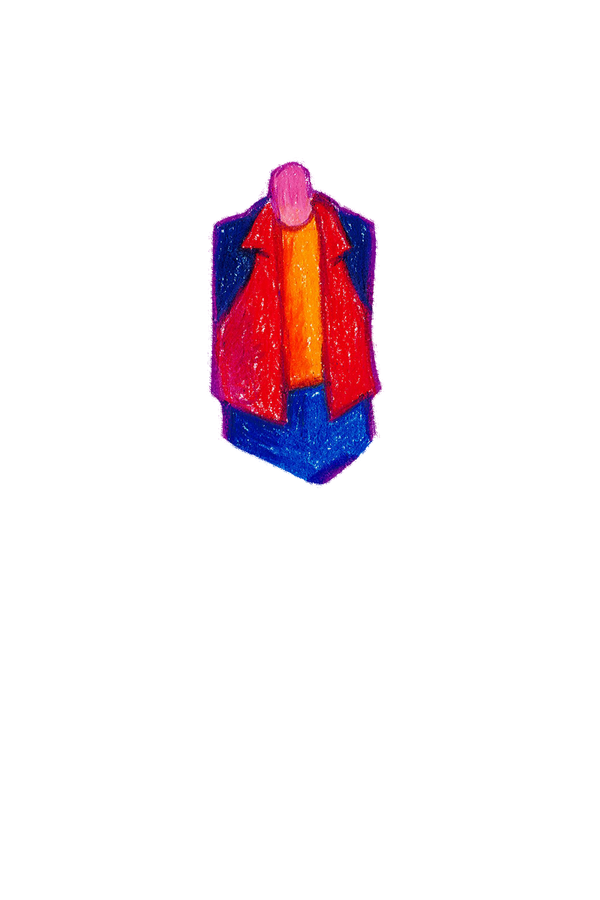
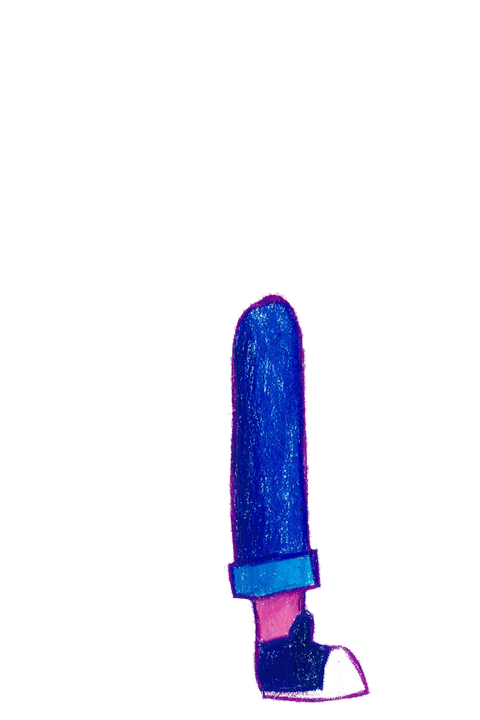
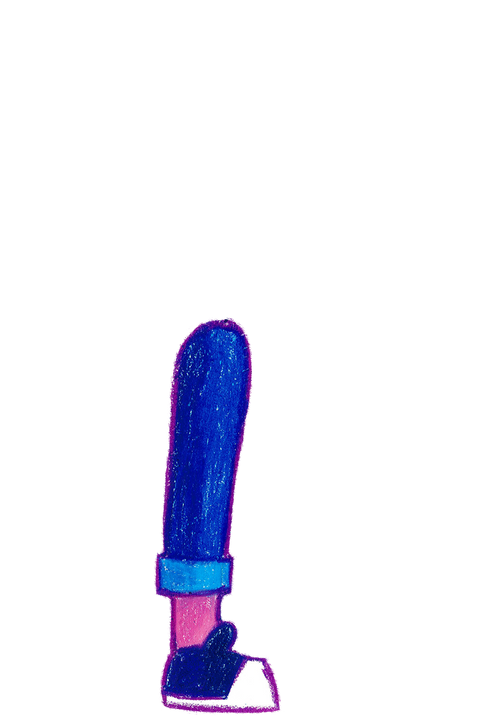
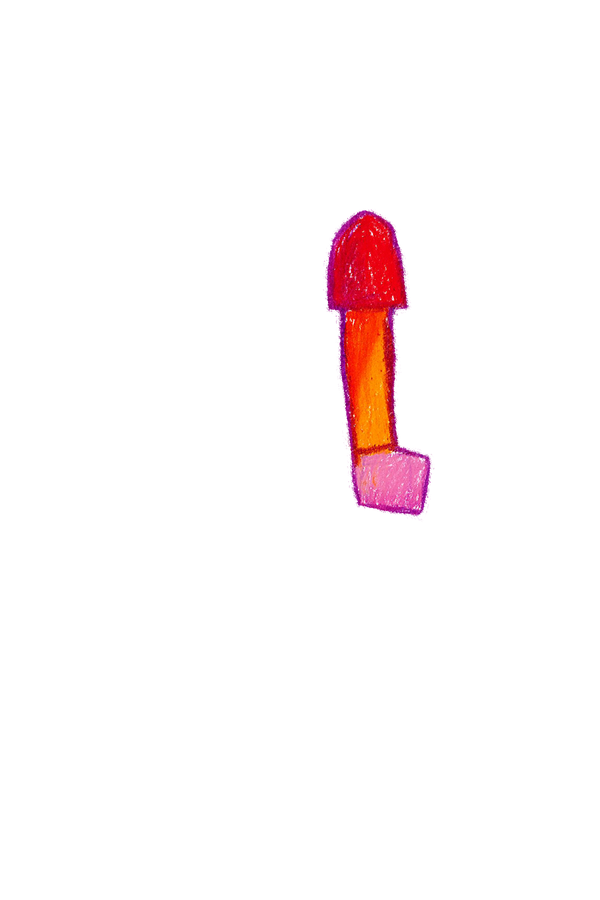
Since frame-by-frame animation would be too difficult to do in an analogue medium, especially oil pastels, I decided to draw the individual elements of my character separately, scan them, then use them to make a rig.
This also allowed me to add new styles of animation to my game - I chose to do this for the "walk" story option because I thought rigging a walk cycle would be the most easy for the character puppet. I created key frames, then use Adobe Animate to create tweens.
Practical Skill | Backgrounds
Some rough ideas for how I could colour my background, vs the finished background
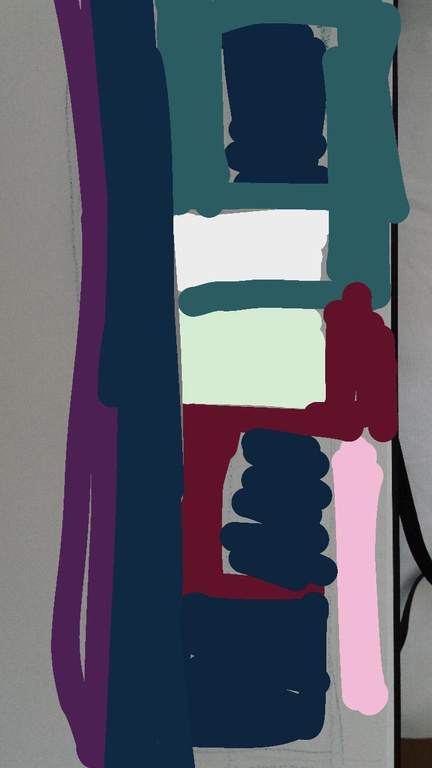
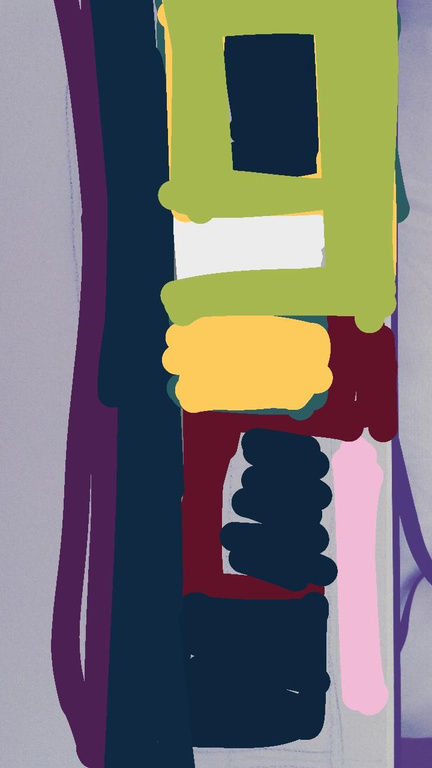
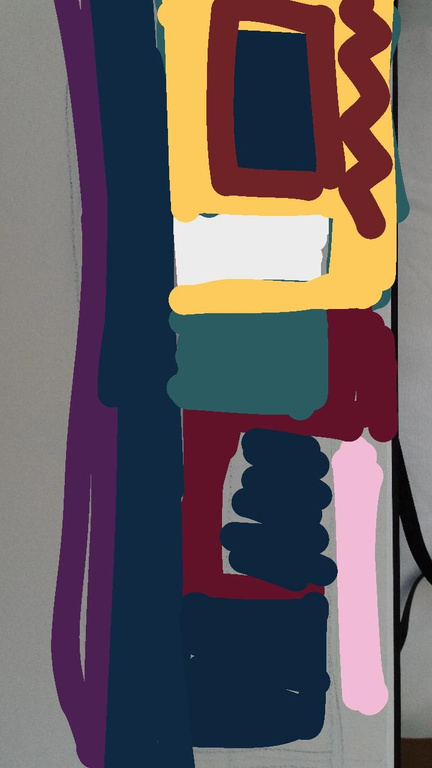
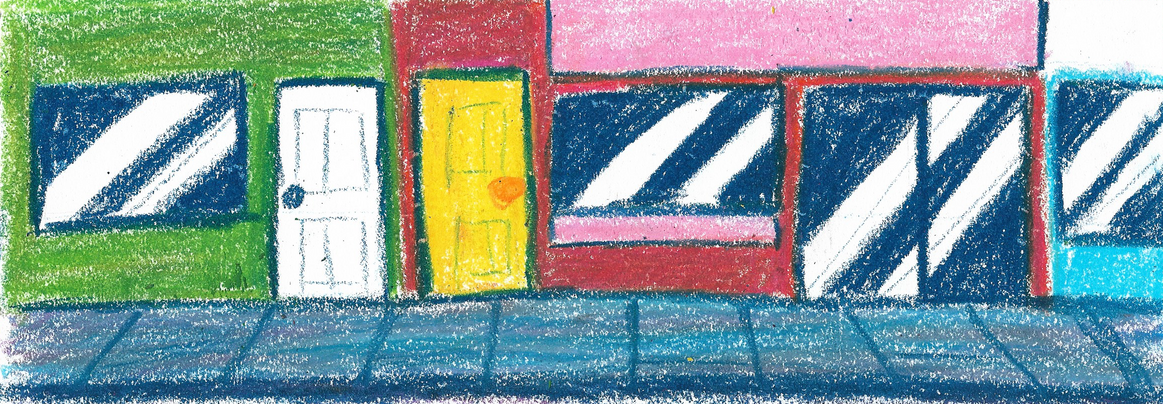
I was unsure of what colours to use for the street background, so I did a few digital tests. I found this task useful because it helped me see which colours worked the best together before I committed to using them. The third image above was what I used as inspiration for the final background.
Practical Skill & Problem Solving | Backgrounds
A large section of my animation involves the character walking along the street. I was unsure of how to animate this, especially considering the perspective, so I watched the outro to Star Vs the Forces of Evil (2015), since it shows something similar to what I was trying to create.
From analysing this animation, I found that there are no separate elements in the background (I was concerned that I would have to create a parallax) Instead, the background changed perspective as it moved from left to right. I decided to use this technique in my own work, and drew long landscapes that would move along behind the character.
I drew my backgrounds in oil pastel, so that they were the same style as the character, then scanned and edited them so that I could put them in my animation.
(from top to bottom) Scan of the background, the background with colour correction, animation of my key frames, and final animation
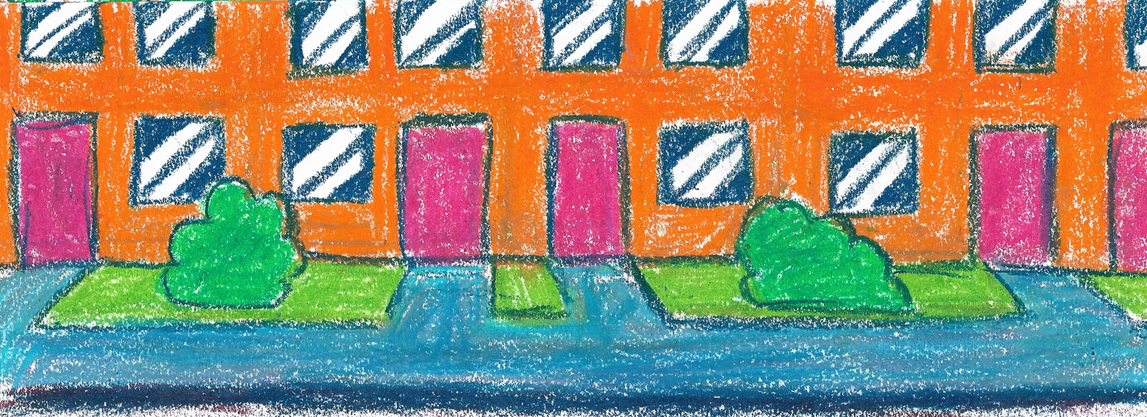
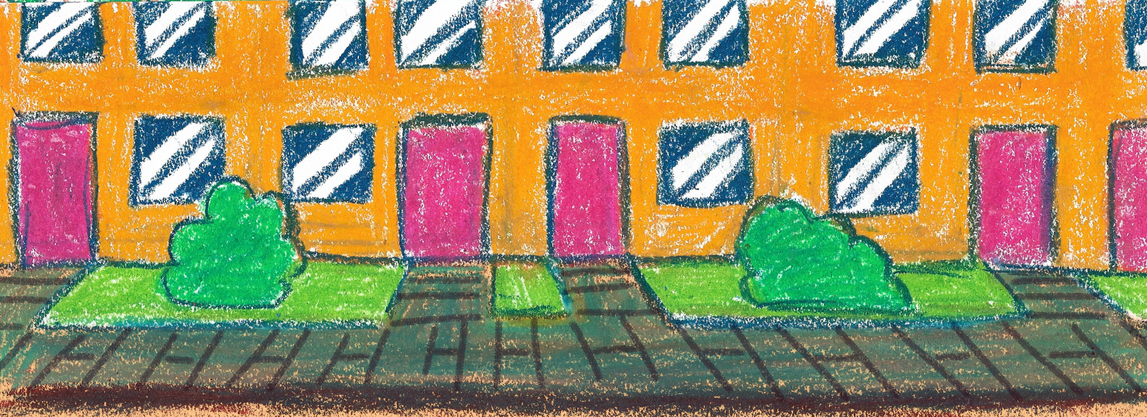
(from top to bottom) Scan of the background, the background with colour correction, animation of my key frames, and final animation
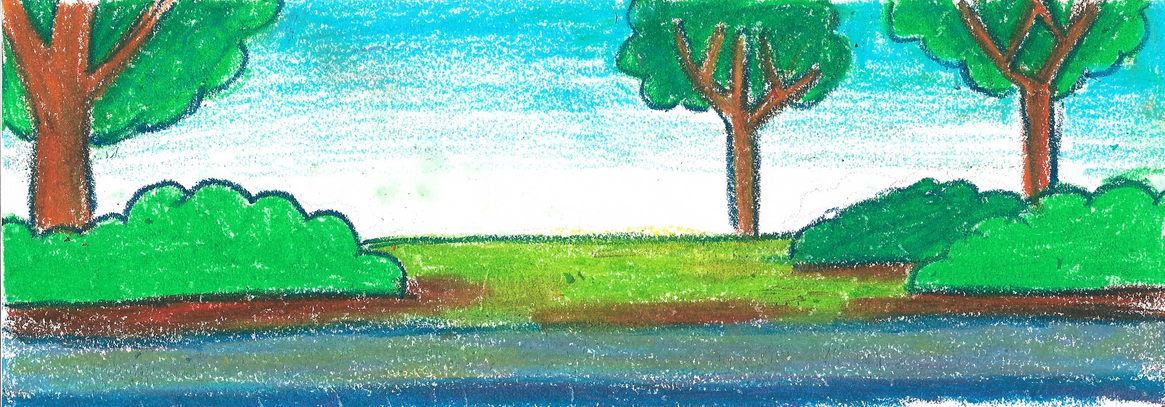
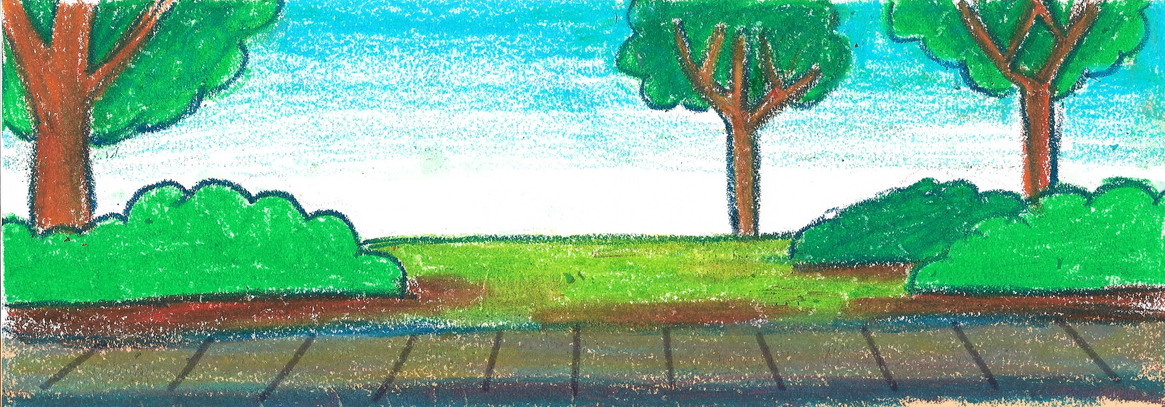
I used Adobe Animate to create these animations. I first assembled all my keyframes, then used Animate's tweening tool to create inbetweens and make the animation look smoother.
I created a different walk cycle for each shot, because I wanted to show how the character's energy was draining as they walked further. I think this was particularly successful in these two shots, but I struggled with it in the middle shot (below).
Problem Solving | Backgrounds & Walk Cycles
(from top to bottom) Scan of the background, the background with colour correction, initial animation of my key frames, initial animation, final animation of my keyframes and final animation
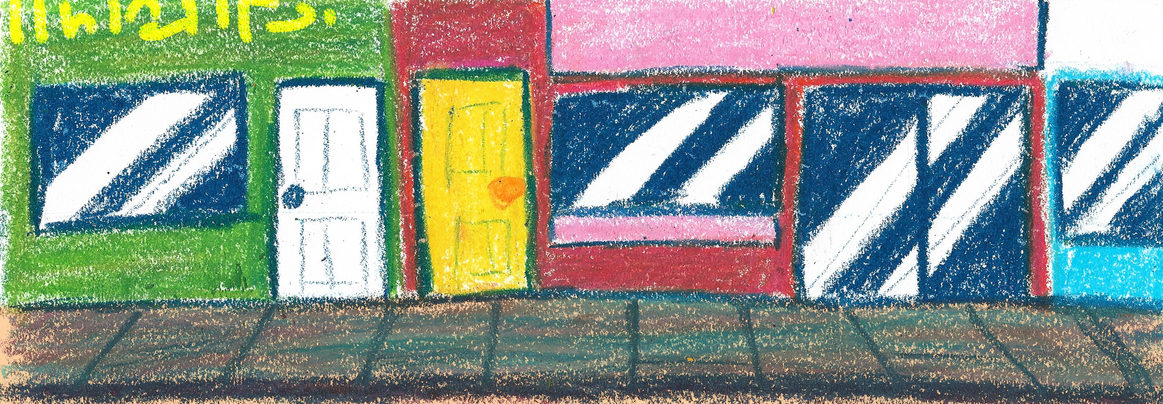
For this scene, my first attempt at the walk cycle came out wrong - the character's steps were uneven, which caused the background to be quite jerky. To resolve this, I had to reanimate this scene with a different walk cycle, where the character took larger steps.
Presentation | Final Animations
First scene in my game
The animation for when you choose the train option
The animation for when you choose the bus option
The animation for when you choose the train option
These are all the final animations I'll use in my game, however they're not the final edits. I'm happy with how they came out, I think they're all consistent with each other, even though they use different styles.
Evaluation | Talking Mornings
How will I polish and finalise my work for presentation?
How do I plan to edit and curate my work?
I need to research the best websites to host my game on, so that it will be easy to play and easy. I've considered using Canva, as I'm already proficient at it, however I don't think it will be the best suited to my game.
I am going to curate a brand or aesthetic for my game, to make it more cohesive and consistent. I will do this by giving it a colour palette and choosing fonts.
I also need to add sound to my animations, to make them more dynamic and professional.
Presentation | Curation
Classnotes on curation
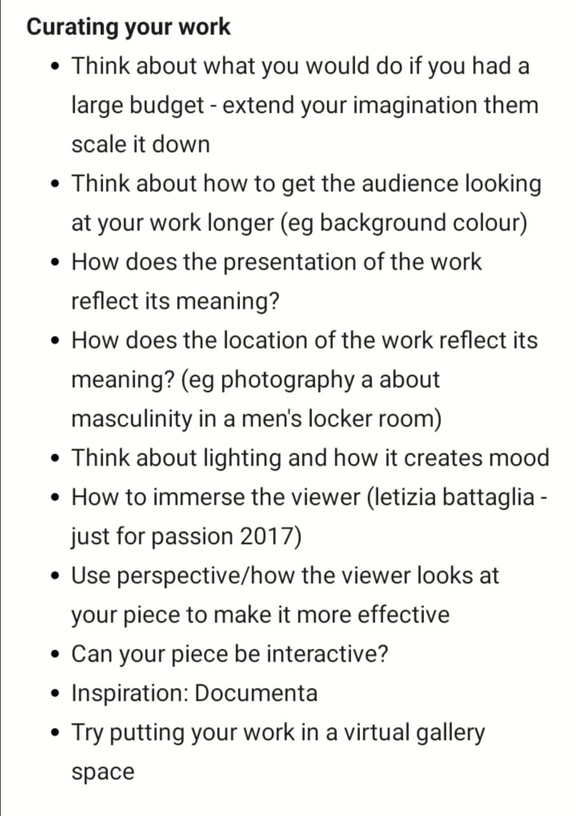
I had to think about how my work would look in an exhibition space, and how I would curate it in a way that best shows its meaning and engages the viewer.
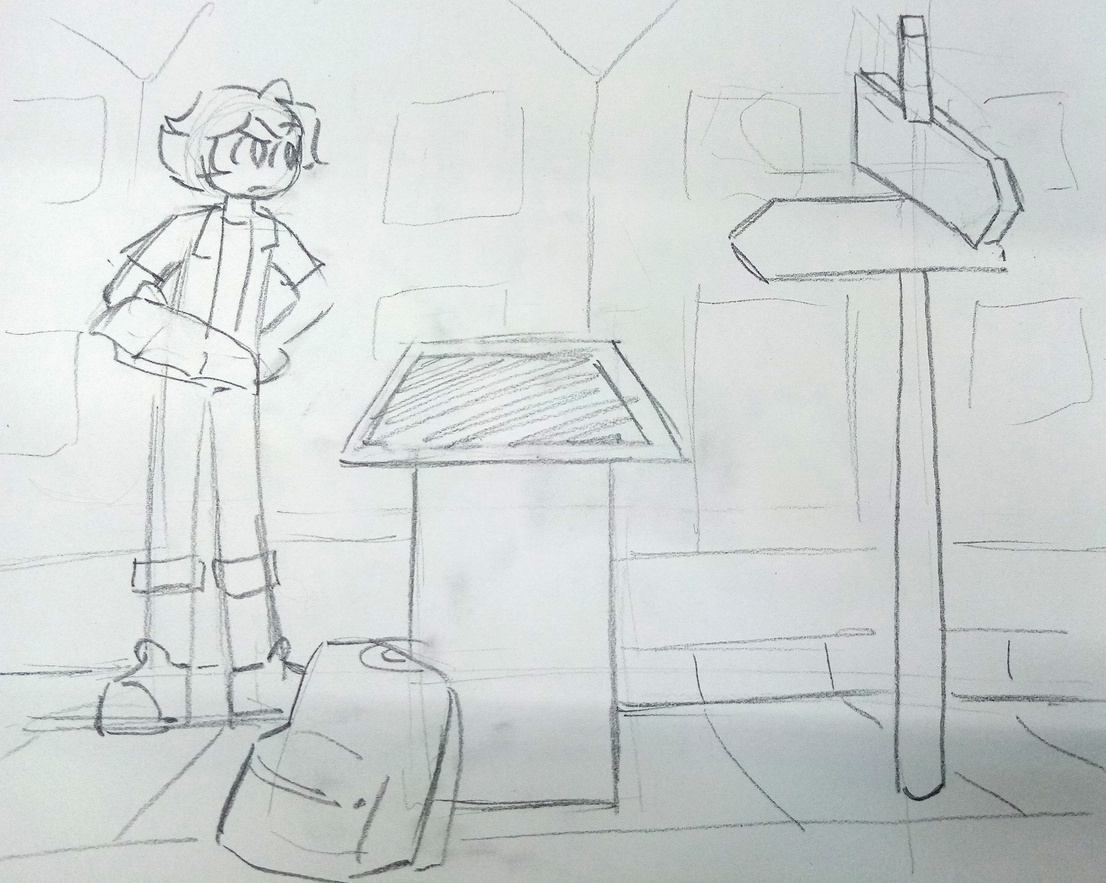
Below I sketched some ideas for how I could do this.
Since my piece is an interactive game, I decided to play off this idea and make the space around it interactive too - the game is on a tablet for the viewer to play, with props from the game around it, like the signpost and character's backpack. The character would also be painted on the wall of the room, along with some backgrounds from the game. I wanted the viewer to feel immersed in this world because they're the one that makes decisions for the character. Being surrounded by features of the game would help them feel more involved in the gameplay.
Sketch of how my game might be curated
Planning & Production | Colour
My character's colour palette

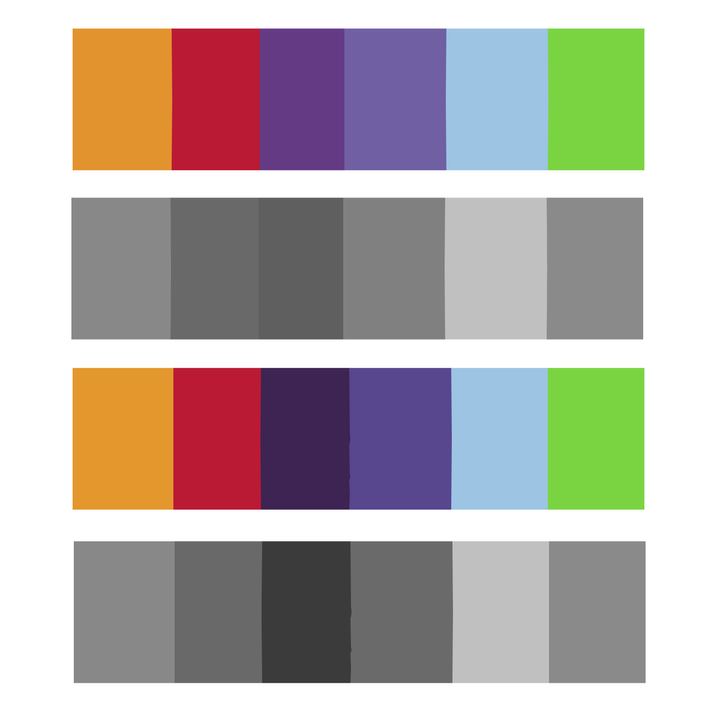
I wanted to give my game a colour palette, so that any extra artwork I make would be consistent and recognisable as being from the game. I used shots from my animation and the eyedropper tool to create some colour palettes, which would give me inspiration. I noticed that my animation uses a lot of blues and purples, with a bright red or pink. Green is used very occasionally.
Colour palettes made using my backgrounds
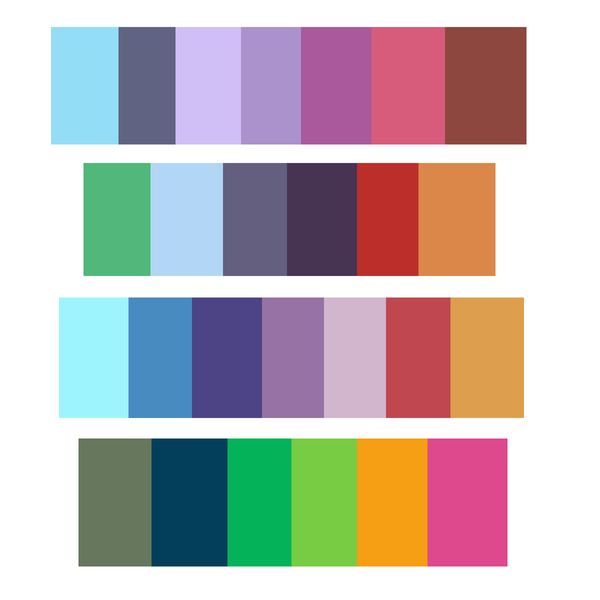
Experimental colour palettes
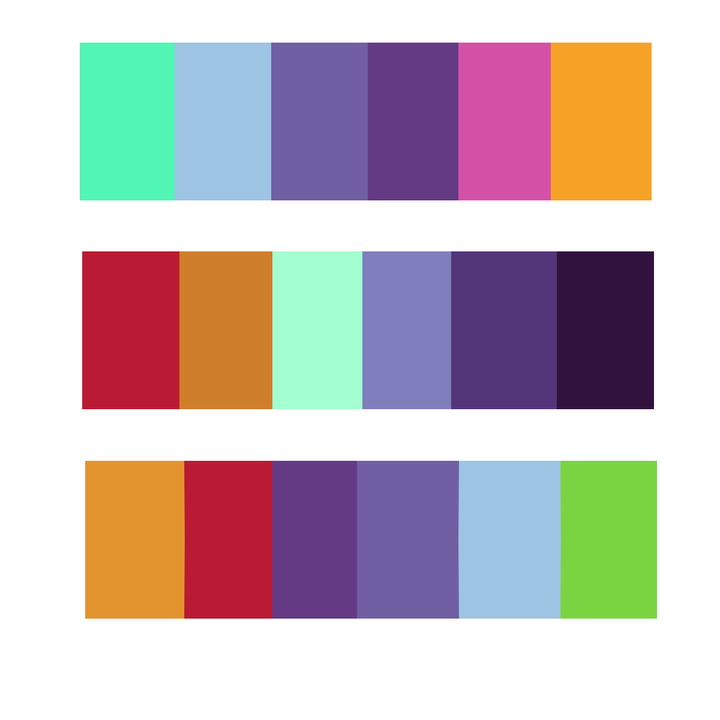
I then used a black & white filter on my chosen colour palette, so I could more easily analyse the colour contrast. I found that my colours were all quite similar tones, so I refined the palette to make it more striking.
This new palette will be the one I use for my game. It will provide me with a good reference for when I'm designing elements of the game.
With this in mind, I started to design some new colour palettes.
Of these experiments, my favourite is the bottom one. It combines the colours that I think were most interesting in the first two palettes, and I added green to make it less predictable.
Refining my chosen colour palette
Planning & Production | Fonts
I wanted the font for my game to have a handwritten quality to it, to reflect the hand-drawn art style of the game. I think this kind of font would also give the game a much more personal vibe, which is fitting because the player is making the character's decisions. However, I still want the font to look clean, I think making it scribbley will make the game appear too juvenile.
Some font tests using a brief description of my game
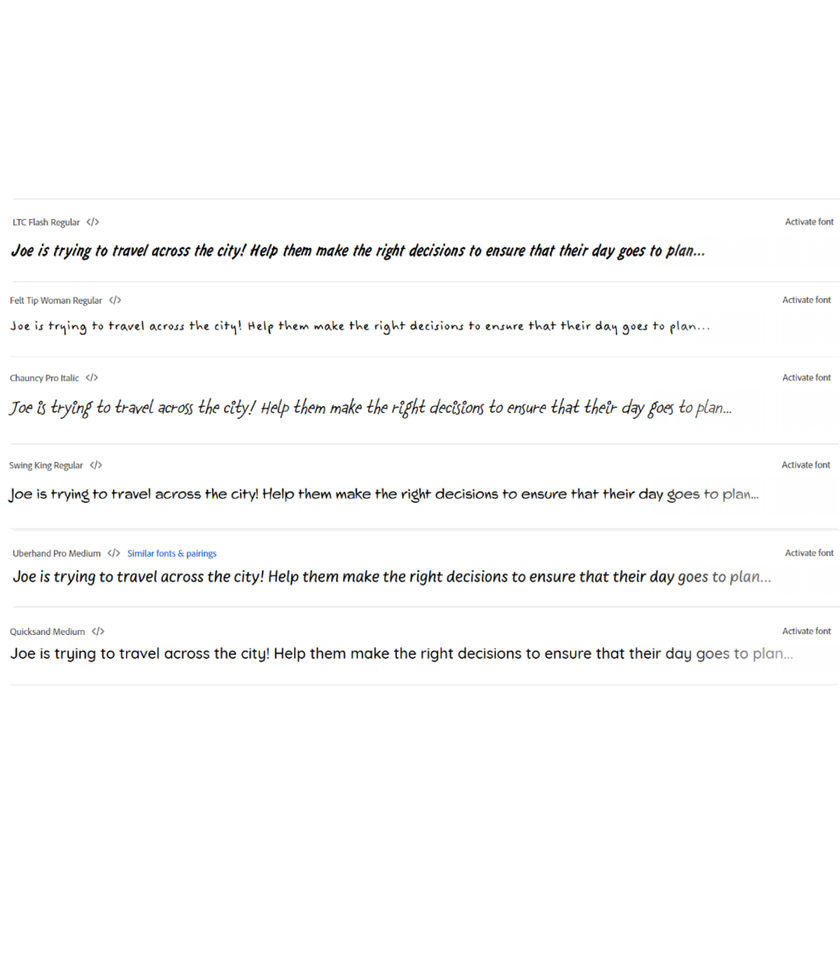
I chose to use "Felt Tip Woman" to use for my game because its texture is fitting to the style of the game. I think it's also an unusual font to be used in a game, which makes the aesthetic it creates more interesting.
Practical Skill | Game End Screen
My process - (From left to right, top to bottom) Initial sketch, the background oil pastel drawing, scan of my oil pastel drawing with colour corrections and editing, plan for character placements on the background, finished drawing, plan for where text will go and final end screen
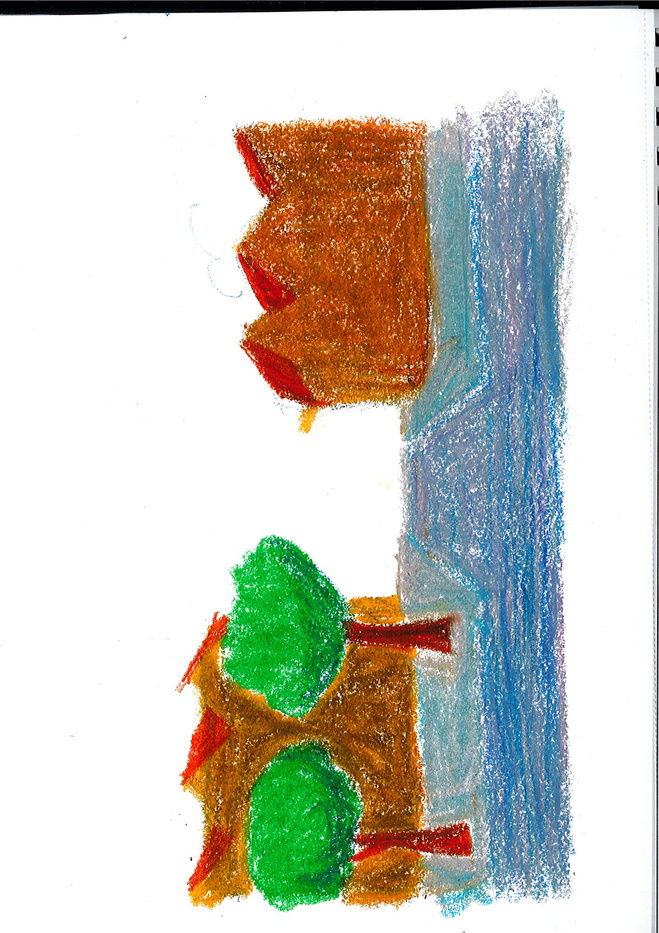
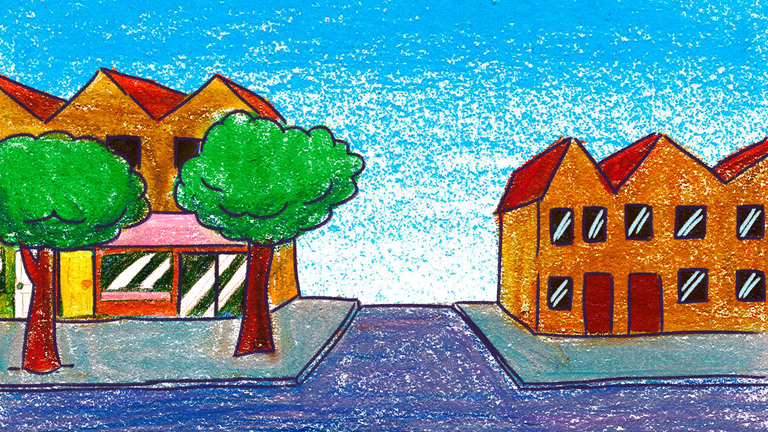
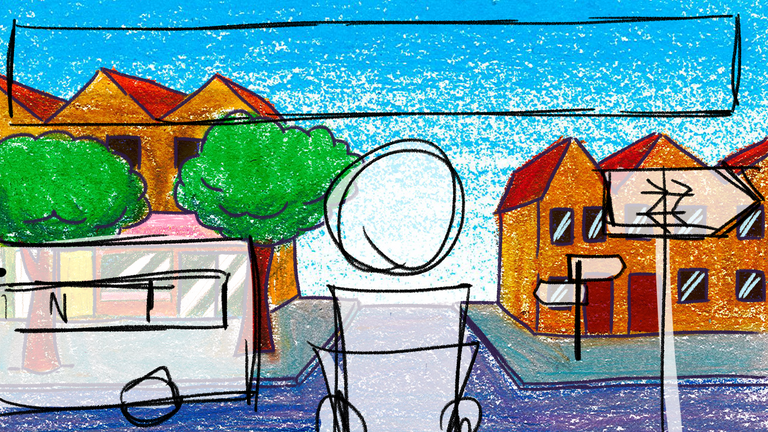
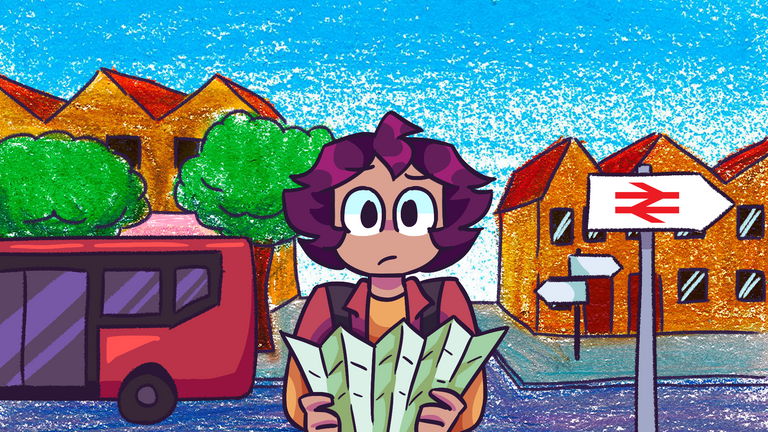
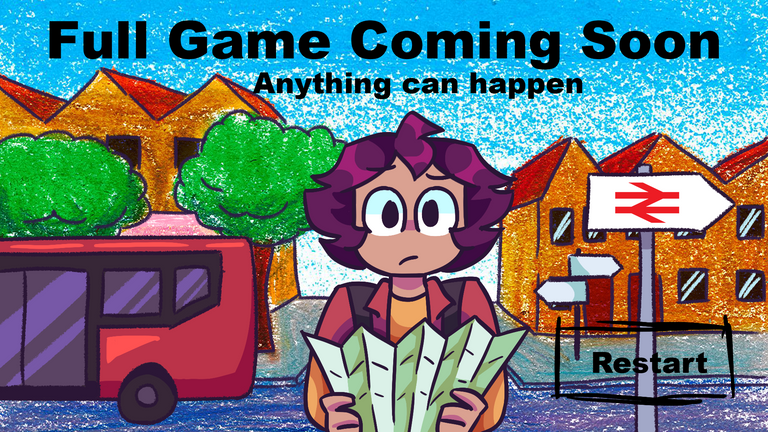
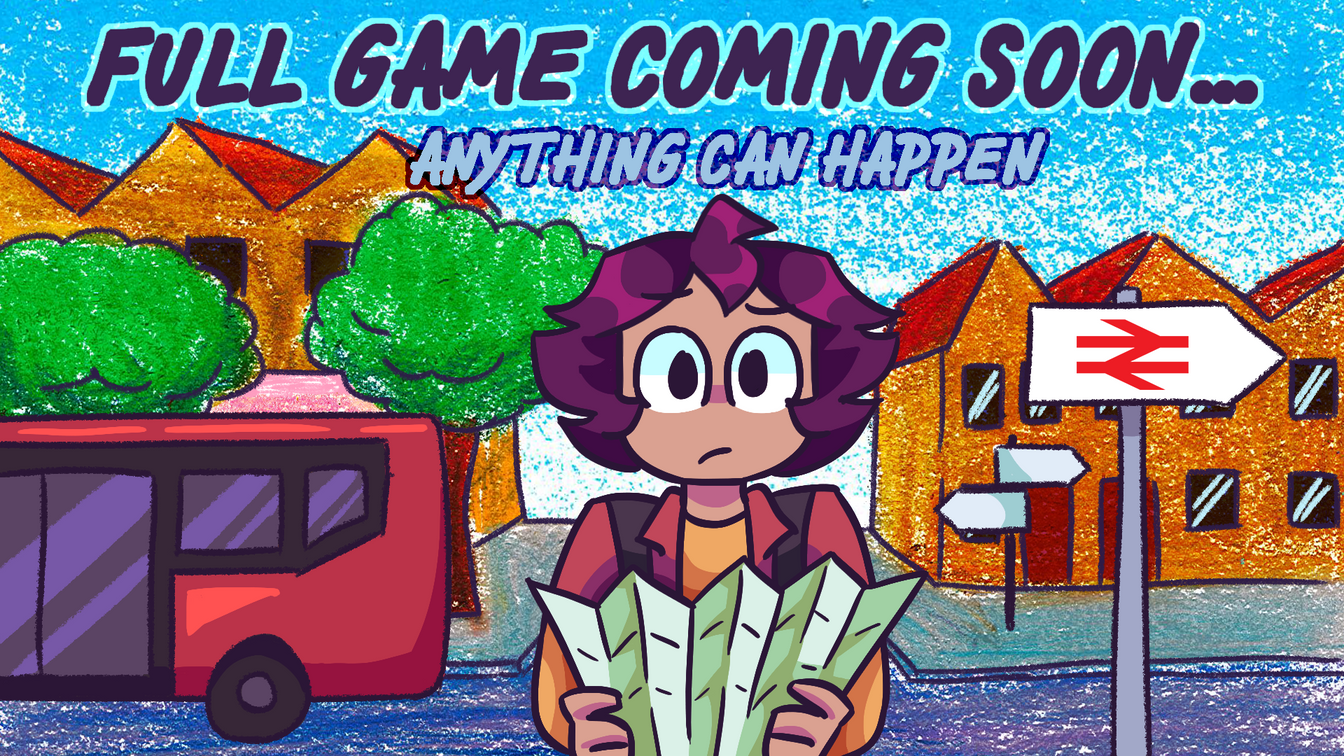
For this image, I wanted to try and combine the different art styles used throughout my game. To do this, I did the background in oil pastel, then draw the character and other details over it digitally. For the font, I chose "Chauncy"; I think it works well because it's neither too formal or too messy. It's also reminiscent of comic book fonts, which works well with the style of my game.
This design works well as an end screen because it gives the effect of a cliffhanger - the character's worried expression concerns the viewer and makes them want to find out what happens.
Practical Skill | Game Title Screen
My process - (from left to right, top to bottom) initial sketch, reference photo (featuring Alice), digital sketch, background drawing, finished end screen with text and texture, and two ideas for where the game buttons could go
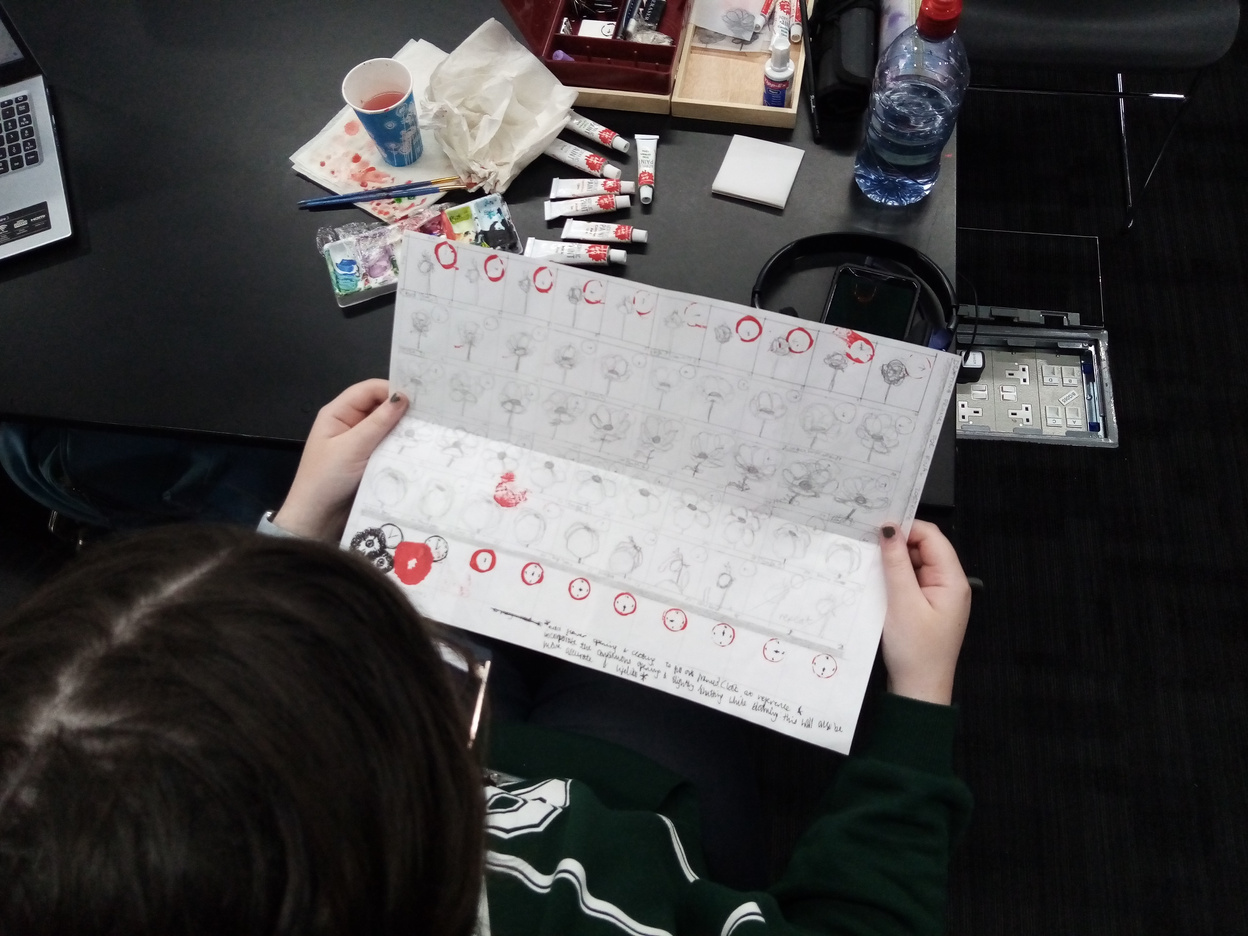
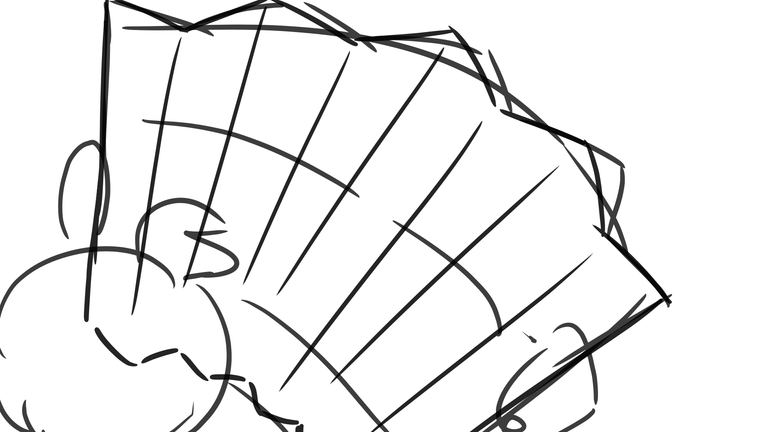
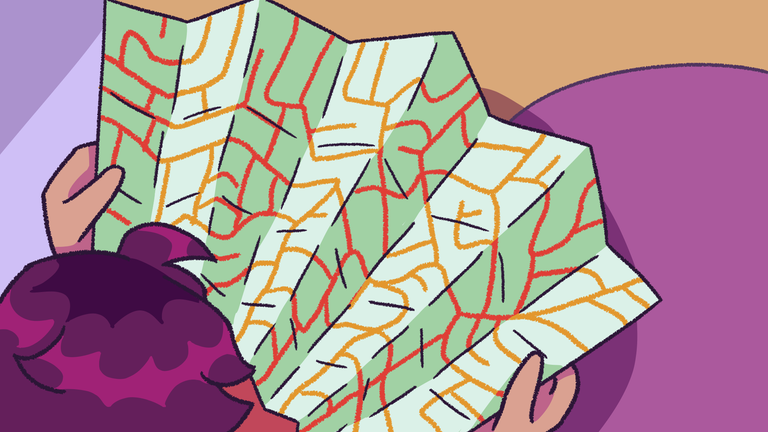
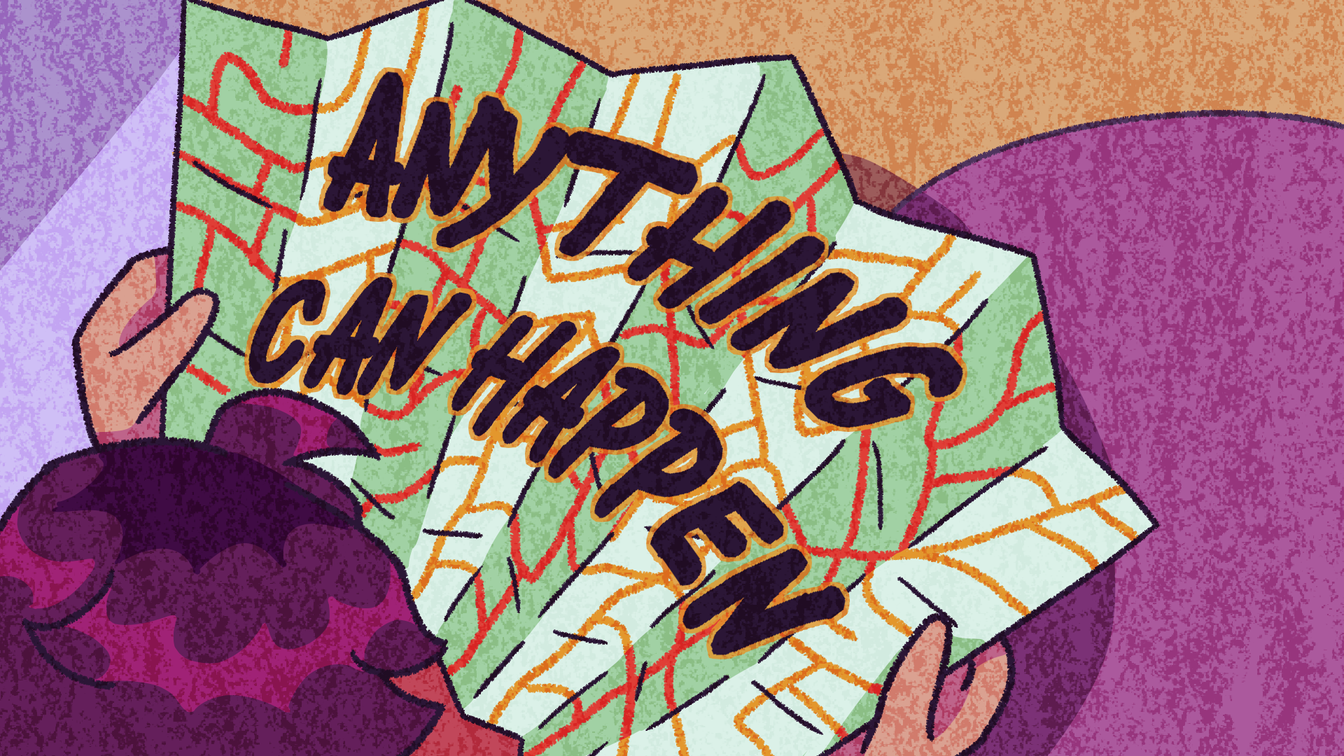
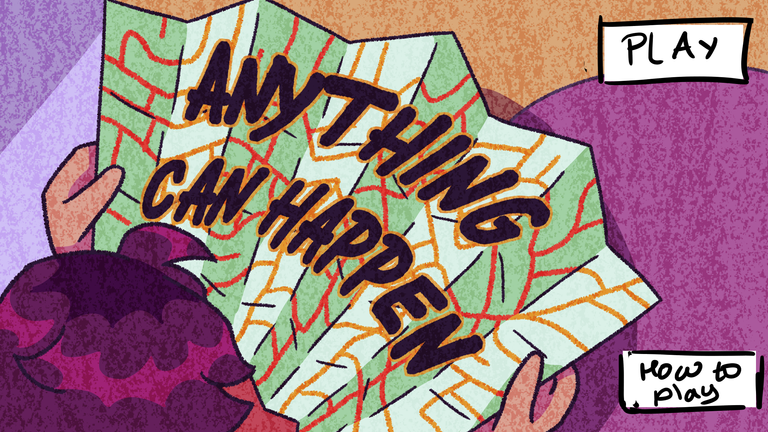
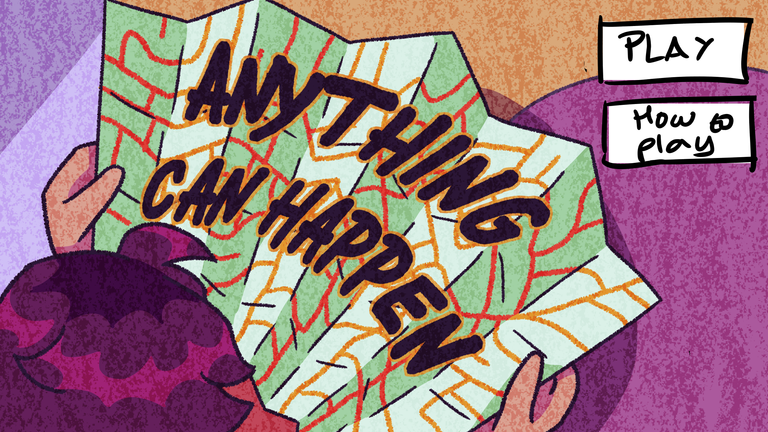
For my title screen, I still wanted to try using a mixture of digital and analogue mediums, but I wanted to try a different technique to the end screen. To do this, I did some mark making with oil pastels, then scanned it and used it to create texture over the image.
Overall I'm happy with this image. Although I don't think it's as successful as my end screen - the background isn't very detailed - I still think its design is quite unusual and interested.
Practical Skill | Makers Morning
What is something I've wanted to make for FMP but haven't had the chance to?
Something I've wanted to include more of in my FMP was smoother animation, using more of the 12 principles. While this was not crucial to my game, one of my goals during FMP was to practice and improve my animation skills. I was unable to do much of this during the project due to time constraints.
(left) Sketch animation I used in my game - 12FPS (right) The same animation but with added tweens - 17FPS
I wanted to see how my game might've looked with smoother animation. However, since it's too difficult to re-animate an entire scene, I decided to redo this sketch from the intro of my game. I added new frames in between all the old frames, then increased the animation speed from 12 frames-per-second to 17 frames-per-second. This does actually make the character's movement much smoother and more pleasing to look at. However, I think some of the character's movements look off - this is because I struggle with using the animation principles, especially in higher frame rates. Therefore I think working in 12FPS for my game was for the best, although I enjoyed this exercise.
Evaluation | Post FMP
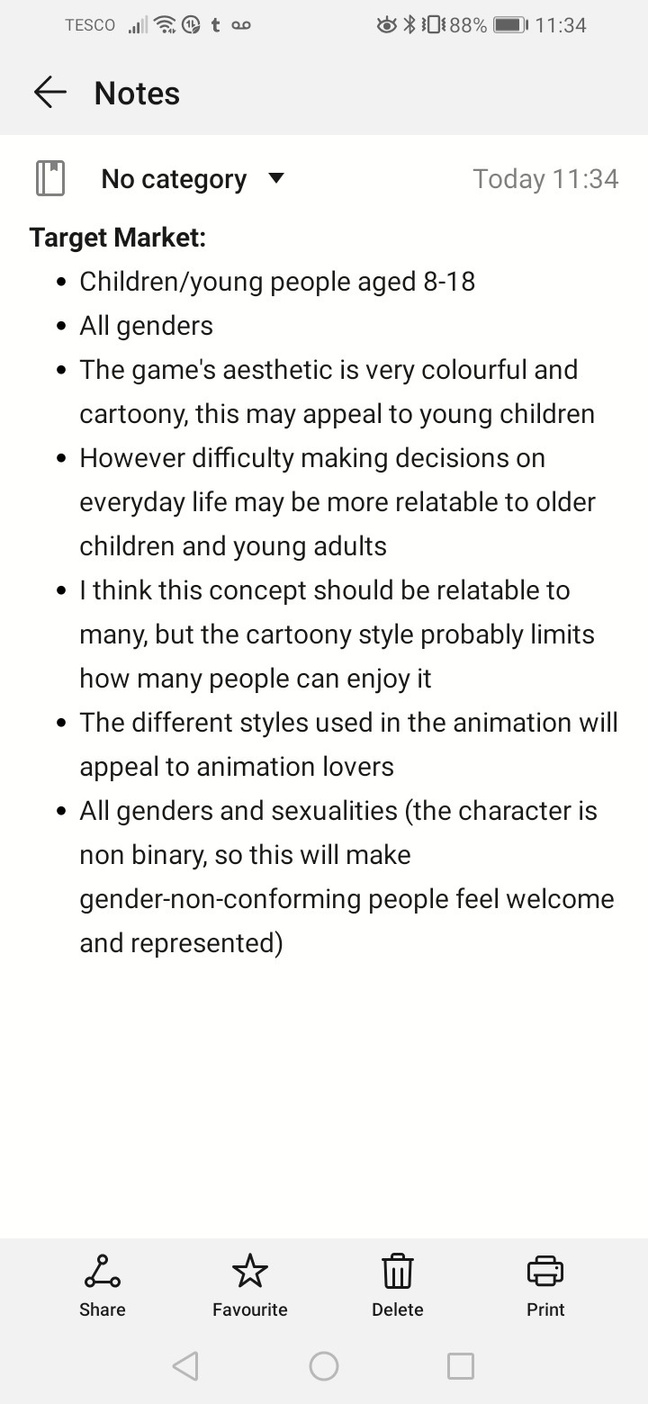
I made notes on the target market of my project. In some ways I think that who I would like to play my game and who actually will are different.
Using my target market, I started to research the best places to exhibit my work. I wasn't sure if my game would be applicable to film festivals, because it's interactive. Since my target market is children and young people, I started to research children's galleries.
Notes on my target market
The Saatchi Gallery
- A contemporary gallery that "presents projects in physical and digital spaces that are engaging, enlightening and educational for diverse audiences." (Saatchi Gallery, undated)
- Although it isn't a children's gallery, it has many exhibits that are appropriate for children
- Having been there before, many of their exhibits have been bright and colourful, and digital, meaning my project would be very fitting.
The Royal Academy
- A gallery run by artists, that shows art and architecture
- Their are lots of activities and workshops for families with children, and kids under 16 go free.
- My game may be suitable for this gallery because it's aimed at children and is interactive. However, it's the wrong medium for the gallery.
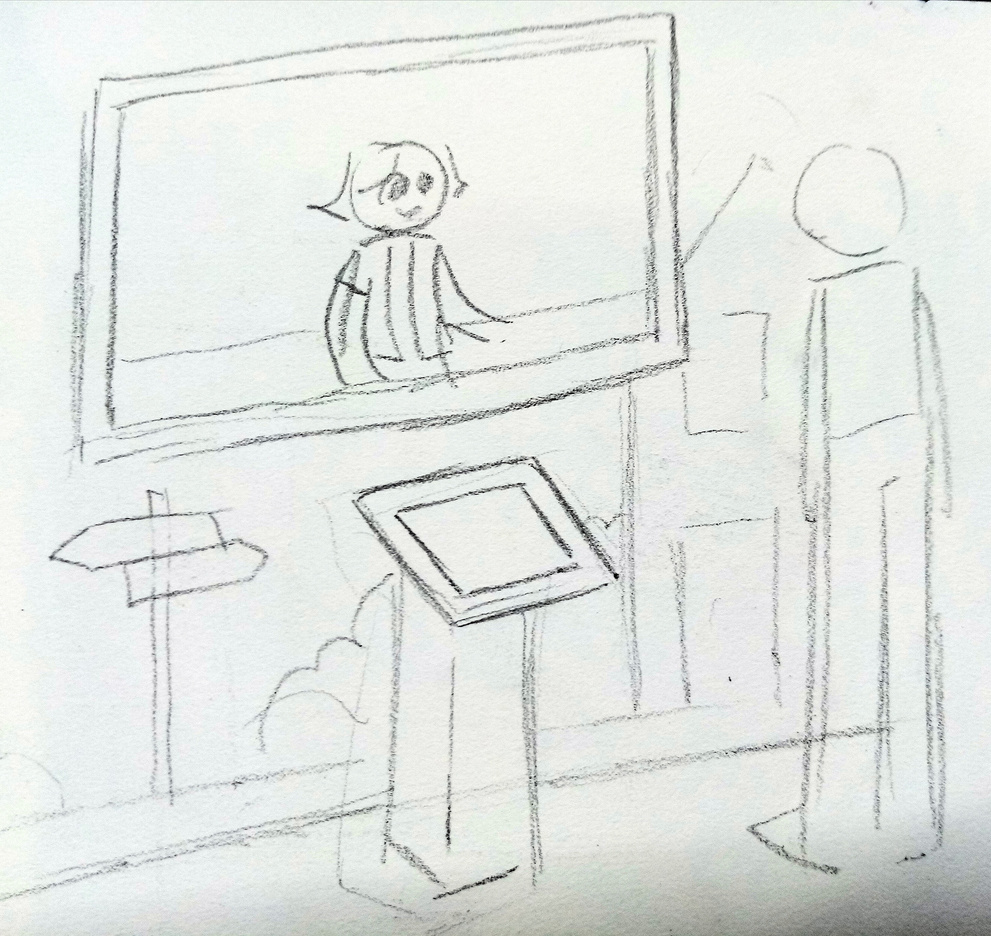
Based on this research, I reimagined how my game could appear in a gallery. The game is controlled by a tablet on a stand, but the videos are also shown on a larger screen, so multiple people can watch what happens. Drawings from the game are printed on decals and stuck on the wall.
I tried to design this installation to a lower budget, but I think it's more successful because it allows more than just the person playing the game to see it.
Sketch of my game in a gallery space
Practical Skill | Buttons
I designed the buttons that would be clicked on to make decisions in the game, as this would make my game look more professional. I first decided what shape I wanted the buttons to be - I chose the rectangle with rounded corners because it looks neat, but not too harsh.
All the different colours of buttons
Some different button shapes
I then used the colour palette I had previously created to colour the buttons. When adding the buttons to each scene, I chose their colour based on what would best compliment the scene.
All the shots from my game with different options
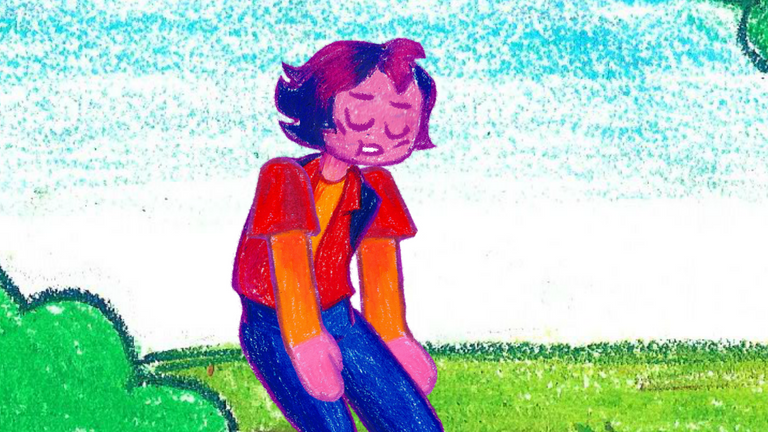
My title and end screen with the added buttons
Evaluation | Talking Mornings
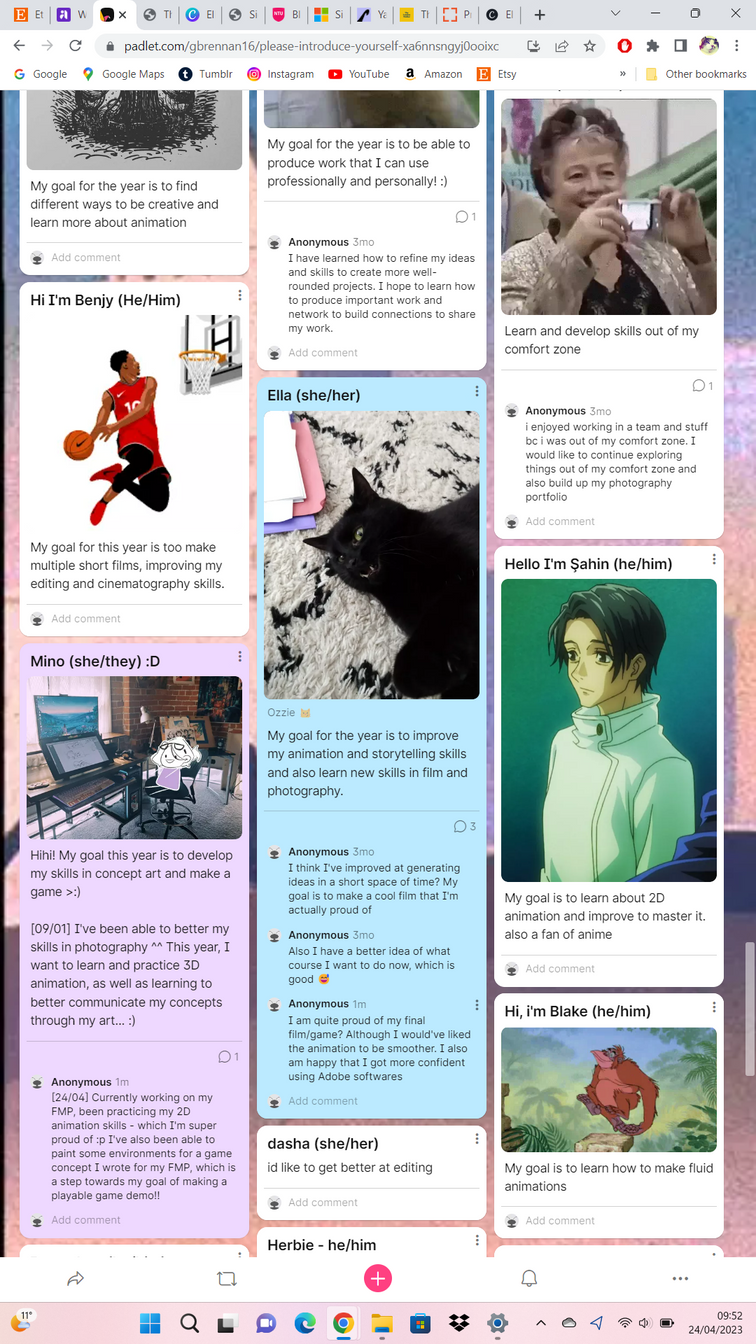
Have I achieved what I wanted at the beginning of the year?
In the beginning of the year, I wanted to improve my animation skills. I think I have achieved this, because I've learned how to use Adobe Animate to work in new styles of animation like motion graphics. I also wanted to practice film and photography - while I haven't done much photography, I think I do have a better understanding of film.
At the midway point, I wanted to have made a film that I was proud of. While I am happy with my FMP film, there are also things I would want to improve.
Have my values on what I wanted to achieve changed?
I've always wanted to use this course to improve my animation skills, and I don't think my values have changed throughout this course because I would still like to do this. (However improvement isn't always obvious - just because I still want to improve, it doesn't mean I haven't already)
What's my next step?
I want to do more practice of the animation principles in my spare time, so that when I have to use animation in a project, I will be better prepared and able to work to a higher quality.
Practical Skill | Sound Design
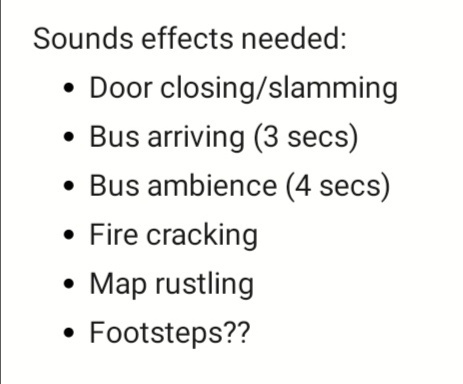
The sound design for my film was something I particularly struggled with, because I'm not familiar with sound. There's no dialogue in my film, so all I had to add was music and sound effects.
I decided to record sound effects myself, as this was something I enjoyed in a previous project. I recorded all the sounds on my list (right) except the fire crackling and siren sounds (not listed).
As for music, I had specific ideas in my mind of how I wanted my animation to sound (right) This part of the sound design was the most difficult because I can't compose my own music, but found it hard to find royalty free music that fit my mental description. I solved this problem by finding specific parts of songs that would be useful to my film, then adapting them to fit.
Notes I made on what sounds I needed to record
How I envisioned my animation sounding:
- A "ping" or sound of accomplishment for when the character decides which transport to take
- A dramatic note of shock when the character realises they've missed their stop (similar to a "dun dun duh" tune, but quicker)
- A note or chord that plays during each cut as the character continues to walk. Each time, the note is slightly lower.
- A tune in the beginning that fades out
An example of some of my sound design in the animation.
My initial plan of using a single note in the walking montage didn't work well with the transitions. Instead I played music over the whole scene, but changed the key of the music each time the scene changed. I think this represents the character running out of energy and becoming discouraged well.
Overall I'm quite happy with my sound design, especially considering sound design is not my strength and some of the ideas I'd planned didn't work very well in reality. There are aspects of my sound design that I'd like to improve, but I don't think I'd be able to achieve the quality I wanted unless I learned to compose my own music or hired a professional. Considering this, I think my sound design was pretty successful, and definitely makes my animation more immersive.
Presentation | Final Website

Play "Anything Can Happen" game here!
Start screen
The Screen when you click "How to Play"
Intro Video (plays when you click "Play")
The "Get the Bus" Option
The "Walk" Option
The "Get the Train" Option
The End Screen
Evaluation | Final Website
I used Wix to create my game website, which works well and does everything I wanted it to; the only thing I dislike is the bar along the top of the screen, and the fact the sound doesn't play automatically.
Screenshot of my game's website
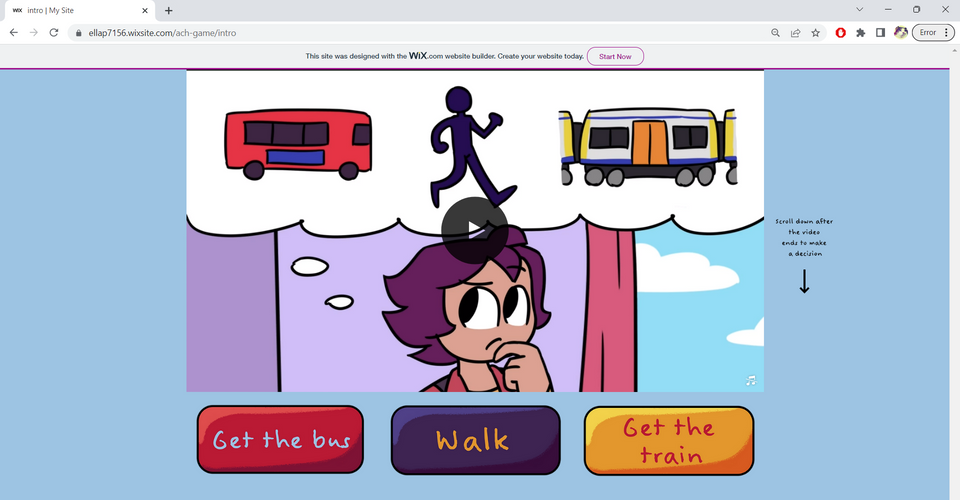
I'm very happy with how my game turned out - I think it accurately presents the idea I was trying to get across. The thing I like most about my game is that it looks mostly how I had planned it. The layout I used also makes it very easy to continue making the game in future if I wanted to. The main thing I would improve about my game would be it's soundtrack; I think it would benefit from having its own theme tune.
Errors in my game:
- The character's backpack cannot be seen in the walk option video
- If you choose "get the train" then "walk" or "get the bus", it will show the character leaving their house again, even though they already left it to get to the train station.
- When the character walks through the park, the line of their sleeve is missing.
When editing my game, I noticed a few mistakes I'd made while animating. While they're not too noticeable to the players, these are the kind of things I should be more aware of in future projects.
I showed my game to a few of my classmates. The reactions I received were positive, with some people stressing over which decision to make, and others becoming invested in the story and wanting to know what happens next. This means my game was successful in entertaining and engaging its players.
Evaluation | FMP
My evaluation from earlier on in my FMP
What do I want to say?
I want my story to confront the player's fears about events going wrong and there being no way to control them, but at the same time give a hopeful ending that shows how even in the most unpredictable scenario there can be a fun, happy outcome.
How will it be perceived?
I think my game will be perceived as similar to other decision based games, except mine focuses on a quite mundane plot - the different methods of travelling - which will be more relatable to the viewer and allow them to get more invested in the character and the game.
What are my strengths?
My strengths are in writing comedy, and I wanted all the story outcomes to be quite unusual, so this skill will be useful in making my game funny and lighthearted.
Has it been done before and how do I make it unique to me?
I think decision based games/stories like mine are quite common, however, they all usually have at least one correct or more successful ending that the player has to aim to. In my game, there will be no way to actually reach the desired goal (getting to the location) but instead every ending will be something pleasant.
I would also like to continue using my ideas about alternate universes, and show the character design or art style developing as the story progresses, but in different ways depending on which choices the player makes.
What is the end goal for this?
My end goal is to create the concept for a decision based game. I have no experience in coding and my whole idea is too much to animate in the time frame, so I will probably only create a tutorial or demo version of it.
I decided to look back at this evaluation I wrote around halfway through FMP - just as I'd started to realise my idea - and compare it with my final outcome, to see how my thoughts had changed.
- I think my game successfully confronts the players worries about things going wrong, as many of the people I showed the game to took their time in choosing each option, suggesting that they're concerned with picking the right one. However, since my game is unfinished, I did not get to see how people would respond to the ending.
- I no longer think my game will be perceived as being similar to other choice-based games - my style has made it quite unique. However, I think it may be perceived as a game for children, due to the simple storyline and bright colours.
- I got some classmates to play my game, and they found the twists in the story funny. This shows that I was right about my skills in writing comedy, and it makes my game more entertaining to play.
- Considering I have no previous experience in coding, I think my final website works very well. I didn't manage to animate the entire game, as I'd anticipated, but what I did create is playable. I'm very happy with this because it's a better representation of my idea.
Bibliography
- Drake, N. (2022). What is the multiverse—and is there any evidence it really exists? [online] Science. Available at: https://www.nationalgeographic.com/science/article/what-is-the-multiverse#:~:text=Even%20though%20certain%20features%20of [Accessed 6 Mar. 2023].
- Vilenkin, A. (2011). Parallel Universes: Theories & Evidence. [online] Space.com. Available at: https://www.space.com/32728-parallel-universes.html [Accessed 6 Mar. 2023].
- Kakalios, J. (2022). What is the multiverse—and is there any evidence it really exists? [online] Science. Available at: https://www.nationalgeographic.com/science/article/what-is-the-multiverse#:~:text=Even%20though%20certain%20features%20of [Accessed 6 Mar. 2023].
- Smart, B. (2022). Curious Kids: how likely is it that there are parallel universes and other Earths? [online] The Conversation. Available at: https://theconversation.com/curious-kids-how-likely-is-it-that-there-are-parallel-universes-and-other-earths-178081 [Accessed 6 Mar. 2023].
- ‘Remedial Chaos Theory' (2011) Community, Series 3, Episode 4. NBC, 13.10.11.
- ‘Remedial Chaos Theory' (2011) Community, Series 3, Episode 4. NBC, 13.10.11.
- ‘Mathmagic’ (2017) Star vs the Forces of Evil, Series 2, Episode 32. Disney XD, 13.2.17
- ‘Mathmagic’ (2017) Star vs the Forces of Evil, Series 2, Episode 32. Disney XD, 13.2.17
- Spider-man: Into the Spider-verse (2018) Directed by Peter Ramsey, Bob Persichetti, Rodney Rothman [Film] Place of distribution: Sony Pictures, Sony Pictures Releasing
- Spider-man: Into the Spider-verse (2018) Directed by Peter Ramsey, Bob Persichetti, Rodney Rothman [Film] Place of distribution: Sony Pictures, Sony Pictures Releasing
- Case, A. (2017). One to Watch: Alice Case creates kaleidoscopic alternate realities. [online] SaatchiArt. Available at: https://canvas.saatchiart.com/art/one-to-watch/alice-case [Accessed 10 Mar. 2023].
- Case, A, (2015) Thalia Reborn [Painting] [Online] Available at: https://www.saatchiart.com/art/Painting-Thalia-Reborn/827392/3264895/view (Accessed: 10 Mar. 2023)
- Case, A. (2015) Nigh [painting] [online] Available at: https://www.saatchiart.com/art/Painting-Nigh/827392/3266283/view [Accessed 10 Mar. 2023].
- Wayne, E. (2018). New Art: Selfies From Alternate Universes #9. [online] Art & Crit by Eric Wayne. Available at: https://artofericwayne.com/2018/03/11/new-art-selfies-from-alternate-universes-9/ [Accessed 10 Mar. 2023].
- Wayne, E. (2018) #3 [painting] [online] Available at: https://artofericwayne.com/2018/03/11/new-art-selfies-from-alternate-universes-9/ [Accessed 10 Mar. 2023].
- Wayne, E. (2018) #4 [painting] [online] Available at: https://artofericwayne.com/2018/03/11/new-art-selfies-from-alternate-universes-9/ [Accessed 10 Mar. 2023].
- Wayne, E. (2018) #5 [painting] [online] Available at: https://artofericwayne.com/2018/03/11/new-art-selfies-from-alternate-universes-9/ [Accessed 10 Mar. 2023].
- Wayne, E. (2018) #6 [painting] [online] Available at: https://artofericwayne.com/2018/03/11/new-art-selfies-from-alternate-universes-9/ [Accessed 10 Mar. 2023].
- Wayne, E. (2018) #8 [painting] [online] Available at: https://artofericwayne.com/2018/03/11/new-art-selfies-from-alternate-universes-9/ [Accessed 10 Mar. 2023].
- Wayne, E. (2018) #9 [painting] [online] Available at: https://artofericwayne.com/2018/03/11/new-art-selfies-from-alternate-universes-9/ [Accessed 10 Mar. 2023].
- Rowe, Jeffrey (2016) Gravity Falls: Dipper and Mabel and the Curse of the Time Pirates' Treasure!: A Select Your Own Choose-Venture!, United States of America: Disney Press
- ‘Remedial Chaos Theory' (2011) Community, Series 3, Episode 4. NBC, 13.10.11.
- ‘Brunchsquatch’ (2017) Bob's Burgers, Series 8, Episode 1, Fox, Broadcast 1.10.17. Available at: https://www.disneyplus.com/en-gb/series/bobs-burgers/4CjR6DOjbiCM?distributionPartner=google (Accessed: date)
- Zaidi, A. (2021) Kala pani and the blasted egg ceremony, [Acrylic on canvas] Tomorrow 2021 [Online] Available at: https://whitecube.viewingrooms.com/viewing-room/tomorrow-2021-alyina-zaidi/ (Accessed: 16.3.23)
- Zaidi, A. (2021). Tomorrow 2021: Alyina Zaidi. [online] White Cube. Available at: https://whitecube.viewingrooms.com/viewing-room/tomorrow-2021-alyina-zaidi/ [Accessed 16 Mar. 2023].
- Cparrisart, (2021) Twitter, [chart] Available at: https://twitter.com/cparrisart/status/1475535559984656392 (Accessed: 21.3.23)
- weaver-of-fantasies-and-fables. (2022) [Tumblr] 4th of November. Available at: https://www.tumblr.com/weaver-of-fantasies-and-fables/696282565427036160/25-character-questions-for-the-writer?source=share (Accessed: 2.3.23)
- Star Vs. the Forces of Evil (2015) Disney, 18 Jan 2015.
- Saatchi Gallery (n.d.). About - Saatchi Gallery. [online] www.saatchigallery.com. Available at: https://www.saatchigallery.com/about [Accessed 24 Apr. 2023].
- Royal Academy (n.d.). Families | Royal Academy of Arts. [online] www.royalacademy.org.uk. Available at: https://www.royalacademy.org.uk/families [Accessed 24 Apr. 2023].